Rather than metabolizing sunshine like photosynthesizers, these autotrophic bacteria get their energy living in the transition zone where ground water, de-oxygenated by microorganisms feeding on the organic-rich swamp beneath, meets the air. The bacteria acts like a gatekeeper, waiting for oxygen from the air--or from plants nearby--to combine with iron dissolved in the water, then keeping the electron released by the oxidation (rust) process as its energy supply. Similar iron-fixing bacteria survive at the bottom of the sea at iron-rich thermal vents, where the sun never penetrates.
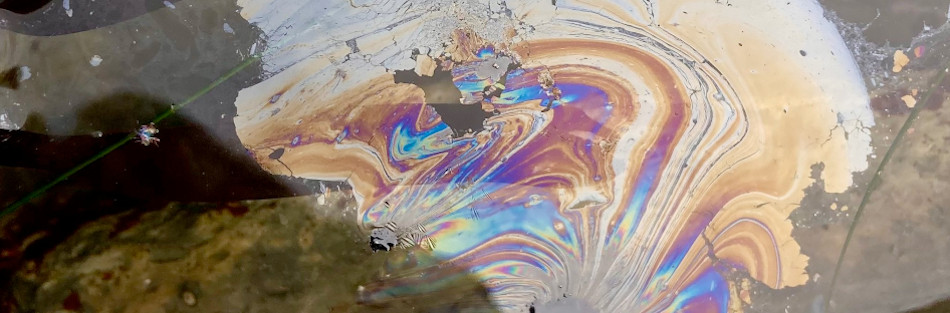
Presence of these bacteria in a bog can be detected by the "oily" film they (maybe?) leave on the surface of the water, which is actually not oily, but gelatinous and will shatter when touched. It is precipitate of iron-hydroxide, a byproduct of methane formation. The swirling colors reflected in the film are an example of Thin Film Interference, where light waves reinforce or cancel each other ...more ↓
Rather than metabolizing sunshine like photosynthesizers, these autotrophic bacteria get their energy living in the transition zone where ground water, de-oxygenated by microorganisms feeding on the organic-rich swamp beneath, meets the air. The bacteria acts like a gatekeeper, waiting for oxygen from the air--or from plants nearby--to combine with iron dissolved in the water, then keeping the electron released by the oxidation (rust) process as its energy supply. Similar iron-fixing bacteria survive at the bottom of the sea at iron-rich thermal vents, where the sun never penetrates.
Presence of these bacteria in a bog can be detected by the "oily" film they (maybe?) leave on the surface of the water, which is actually not oily, but gelatinous and will shatter when touched. It is precipitate of iron-hydroxide, a byproduct of methane formation. The swirling colors reflected in the film are an example of Thin Film Interference, where light waves reinforce or cancel each other as they bounce off the upper and lower surfaces of the film. The colors are the result of the interfering light waves, not the rainbow colors of fractured white light. So they can be turquoise, magenta, brown, or other mixed colors.
Any photosynthesizers nearby play dual roles in the bog iron process, too: as oxygen producers--and thus passive iron oxidizers--and as surfaces to which the iron can bind. This causes aquatic plants to become heavily encrusted with a light-orange floc of iron oxyhydroxide near the point of oxygen gas released from the plants.
Humans can process bog iron with limited technology, since it does not have to be made molten to remove impurities. The only resources necessary for production are wood for charcoal, clay for the construction of bloomery furnaces, and water for processing. Watch this Primitive Technology guy doing something even more sophisticated with homemade supplies and equipment: running the bacteria's reaction backward to make metallic iron from the swamp paste! In later videos, he makes a knife from his (very hard) refined iron, then figures out how to decarburize the iron to make it forgeable (caution: VERY sticky rabbithole ahead!).
Europeans developed iron smelting from bog iron during the Pre-Roman Iron Age of the 5th/4th–1st centuries BCE, and most iron of the Viking era (late first millennium CE) came from bog iron. Later, in New England, bog iron provided the first iron source for the settlers: cannonballs were cast from it during the American Revolution. Bog iron is a renewable resource; the same bog can be harvested about once each generation by peeling back the peat and picking off the iron "peas", then laying the mossy peat down again.
Iron-bearing groundwater typically emerges as a spring and the iron in it forms ferric hydroxide upon encountering the oxidizing environment of the surface. Oxidation may occur on its own, or through enzyme catalysis by iron bacteria. In general, bog ores consist primarily of iron oxyhydroxides, commonly goethite (FeO(OH)).
See wikipedia and the other Project Journal posts (and their comment threads) for more information.
Bog iron is a form of impure iron deposit that develops in bogs or swamps by the chemical or biochemical oxidation of iron carried in solution. It is a renewable ore deposit.

 Bog Iron