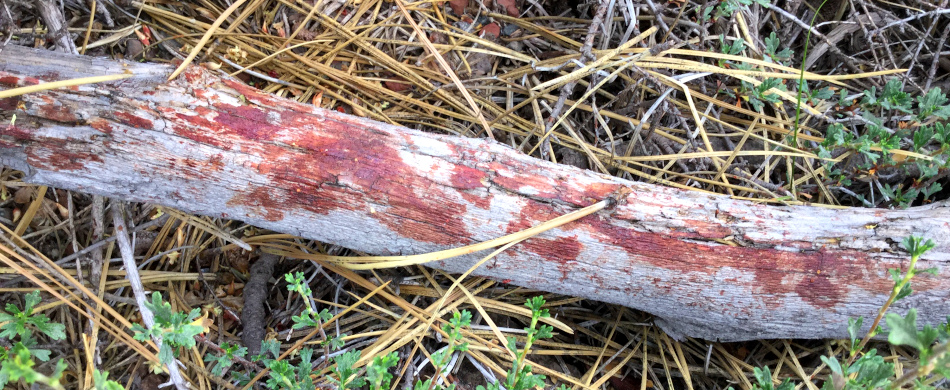
 Mystery Red Stuff


Consolidated discussions
You can read the notes and comment threads on each observation, but that is tedious and confusing. So, I've collected the salient points in this post:
Feb. 8, 2016
faerthen: "I suspect the 'blood' in the [porcupine] track is really urine. Lagomorphs have red urine when they eat evergreen needles in the winter, and I'm thinking maybe porcupines have this chemistry, too, since they also eat evergreen needles."
caraleigh: "I wanted to share an observation I had yesterday: I was handling a porcupine to attach a radio collar, and while recovering from anesthesia it urinated almost exactly this color. And they are, in fact, eating conifer needles and bark this time of year. I'm glad I had read your comment on here or I wouldn't have known what to think!"
You can read the notes and comment threads on each observation, but that is tedious and confusing. So, I've collected the salient points in this post:
Feb. 8, 2016
faerthen: "I suspect the 'blood' in the [porcupine] track is really urine. Lagomorphs have red urine when they eat evergreen needles in the winter, and I'm thinking maybe porcupines have this chemistry, too, since they also eat evergreen needles."
caraleigh: "I wanted to share an observation I had yesterday: I was handling a porcupine to attach a radio collar, and while recovering from anesthesia it urinated almost exactly this color. And they are, in fact, eating conifer needles and bark this time of year. I'm glad I had read your comment on here or I wouldn't have known what to think!"
ipomopsis: "...I often see what I think is blood on downed trees, logs and rocks out in the forest. Maybe it's porcupine urine!"
beartracker: "Could this porcupine have been in estrus?"
Feb 20, 2016
caraleigh: "No animal photo here, but an interesting observation from a porcupine we captured to radio-collar. While recovering from anesthesia, it urinated (fairly common) and its urine was a deep orange/red color, seen in the photos. This was the first time I had seen that. Also shown are some photos of fresh feeding sign I took the same day, showing porcupine feeding on bark and needles of shore pine (Pinus contorta contorta) this time of year."
July 23, 2018
faerthen: "What is this stuff? It's all over. Seem to be seeds in it. Only berries around right now would be a few wax and White-stemmed currents. Hardly seems like enough to make this big a mess. Maybe Dwarf Mistletoe? It's out, and apparently sticky enough to require birds to wipe."
beartracker: "It's interesting that it is spread out so widely on the rocks and sticks. Like the animal wiped its face after getting the berry juice and seeds all over. I can see the seeds, but cannot identify them. Wondering if this is mammal sign rather than bird? Birds tend to drop splats rather than larger areas like this. Very curious sign."
Aug 2019
jonathanpoppele: "This is not something I am familiar with. The only times I can recall seeing staining from urine were either in snow or in desert environments, where the urine could sink into the substrate. It would surprise me if urine could stain rocks or sticks in this way."
Aug 14, 2019
beartracker: "This one looks more like bird sign to me. There is bird scat in the photo. Also, an opened seed is seen. I think this one is attributable to a bird wiping its beak or consuming the fruit there on the rock."
faerthen: "...lagomorphs and at least some rodents get red urine in the winter when they are eating conifer needles...Maybe this is a similar reaction? Though I wouldn’t think many animals bother eating conifer needles in the summer when there’s better food around...dwarf mistletoe would probably pick up the chemistry of their host conifer, [however, so eating it might create the same color effect in droppings]"
ipomopsis: "...I think it's a rodent eating purshia. Purshia is known to induce vomiting... Perhaps it's a food resource thing some years and or a learned behavior because I am only seeing it in certain areas. I have some observations tying this directly to purshia."
jonathanpoppele: "I'm not familiar with this and look forward to the continuing conversation."
July, 2021
Ipomopsis: "I was walking around through the forest when I noticed what appeared to be blood on a stick. For about ~100 meters of land there was the same blood looking stuff on several sticks, rocks, a stump and across a log. My thinking was that either a raptor had a meal at these locations or a bob cat, or a mountain lion was dragging its kill. I also considered it was a wounded deer or bear. I even brought a sample stick home with me if I found someone to possible DNA test it. I saw this same thing in another location near here and once in another area of the basin about 6 miles away as if a wounded animal blood trail.
Fast forward 2 years and I came across this observation of porcupine urine. Suddenly I thought, 'Maybe what I saw was the same thing!'
So I then spent the next 2 days trying to locate the pictures I took...but [due to a tech melt-down] I was left with these low-resolution cropped photo previews...These photos were taken in Tahoe Vista/Carnelian Bay August 2019..."
"I talked to a porcupine expert about this observation. He isn't convinced it is porcupine...Another thing to note. I observed these cases in areas of sugar pine. Is there something in sugar pine bark that could result in the color of urine?"
"I have been doing more research and come to find out that it appears to be a rodent that is eating antelope bitter brush seeds, then using the pigment from those to mark territory?
https://www.inaturalist.org/observations/128821739
https://www.inaturalist.org/observations/130729519
https://www.inaturalist.org/observations/130729520"
July, 2022
chris_haas: "The marking pattern reminds me of ringtail. They eat a lot of fruits, and smear a sticky scat on rocks. I haven't seen it as close to the ground as these, nor scattered all over. It doesn't [look] like territorial marking. I can't rule out squirrel just feeding and leaving a mess. Looks like quite the carnage!" less ↑