 Tilly Bones


Tilly Bone Updates
First, we got linked to by a museum!
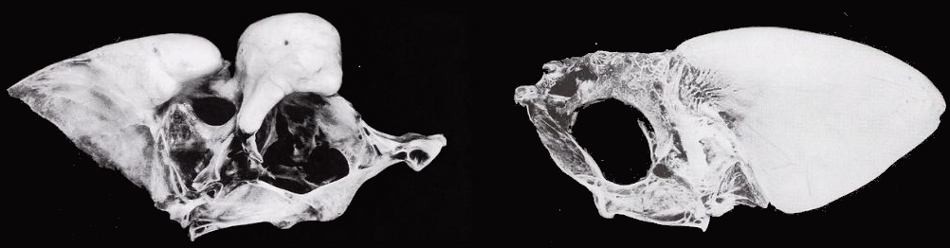
The Paleontological Research Institution’s Museum of the Earth has a profile on Tilly Edinger that linked to the project and used one of the observation's pictures.
They chose a stunning observation, this is sort of my platonic ideal of a tilly bone. Love the spines that have those bizarre tooth like growth on the end.
from
https://www.inaturalist.org/observations/40557916
Thanks to everyone who uploads their tilly bones, I'm glad we have built a project that can help provide references for these fascinating bones.
------------------------------------------------------------------------ ...more ↓
First, we got linked to by a museum!
The Paleontological Research Institution’s Museum of the Earth has a profile on Tilly Edinger that linked to the project and used one of the observation's pictures.
They chose a stunning observation, this is sort of my platonic ideal of a tilly bone. Love the spines that have those bizarre tooth like growth on the end.
from
https://www.inaturalist.org/observations/40557916
Thanks to everyone who uploads their tilly bones, I'm glad we have built a project that can help provide references for these fascinating bones.
------------------------------------------------------------------------
There has also been a recently published paper about tilly bones, Hyperostosis in Fishes: An Update With New Species Records , worth a read for anyone interested. Might do a list on a journal post of all the documented species they have one day, but for now I want to summarize their "What we Know About Hyperostosis" and "Unsubstantiated Statements about Hyperostosis" as a nice, updated check in to make sure I do have the most up to date info on here.
Hyperostosis is influenced by genetics. Hyperostosis is predictable with age across species. It is consistent, once the species reaches the point at which they develop the hyperostosis, they are going to start developing it. Apparently more evidence hyperostosis is influenced by genetics is the sexual dimorphism of the hyperostosis in Australasian snapper's (Chrysophrys auratus) supraoccipital and frontal bones. I've been adding a lot of them to the project lately, I might try and go through the paper the cited for that and see if I can annotate sex accordingly, if I ever have time for that...
Environmental conditions and calcium regulations have some factor in hyperostosis. Almost all fish with hyperostosis have been and are marine, but the fresh water exceptions lived in waters rich in calcium. There is only one extant species of fresh water fish known to have hyperostosis, and it lives in a calcium rich environment.
We still don't know the function of hyperostosis, and they call for histological studies of live fish to understand the function. There is "a high degree of remodeling activity" at the cellular level.
Hyperostosis is the most common in Jacks (Carangidae, 19 genera, 52 species), followed by Seabreams and Porgies (Sparidae, 14 species), and then Drums (Sciaenidae, 11 species).
Hyperostosis is spread across unrelated species, and isn't even often similar in related species. Therefore, does seem to have a phylogenetic significance.
Because hyperostosis has consistent patterns within the same species, and is often different between two closely related species, it can be useful for ID. The Atlantic Crevalle Jack (Caranx hippos) and Pacific Crevalle Jack (Caranx caninus) had two consistently different patterns of hyperostosis that differentiate them! Tilly bones are also important for zooarchaeology carbon dating and interpreting past environments.
Even the fish that have mostly acelluar bone, the hyperostotic bones are primarily cellular. A bit about cellular vs acelluar here: https://austhrutime.com/bone.htm
And a summary from "Unsubstantiated Statements about Hyperostosis":
It seems to be commonly repeated that hyperostosis is irregular or random, but in reality it has a pretty consistent pattern, it just doesn't show up until the fish reach a certain size or age.
Hyperostosis is sometimes described as pathological, but it isn't. I need to check to make sure I haven't put any tilly bones in projects related to illness, I think I might have misunderstood it as pathological in th past. That's why I am glad to do an up-to-date research check in!
There is a belief that fish with hyperostosis aren't safe to eat, but that is unsubstantiated.
There is a belief that tilly bones help with balance or equilibrium, I see this sometimes when people call them ballast bones. This seems highly unlikely if not outright untrue in some cases.
Some believe the tilly bones help with fin erection, but this is untested.
Some believe they are birth defect related, but this belief could be from misinterpretation of bones that weren't actually tilly bones.
Some believe it could be from a virus, which seems unlikely because of how consistent it is in every individual of some effected species.
------------------------------------------------------------------------
Not tilly bones? Fresh water tilly bones?
Someone found two bones that certainly look like tilly bones, very far inland, in fresh water.
1 2
They look a lot like drum pterygiophore.
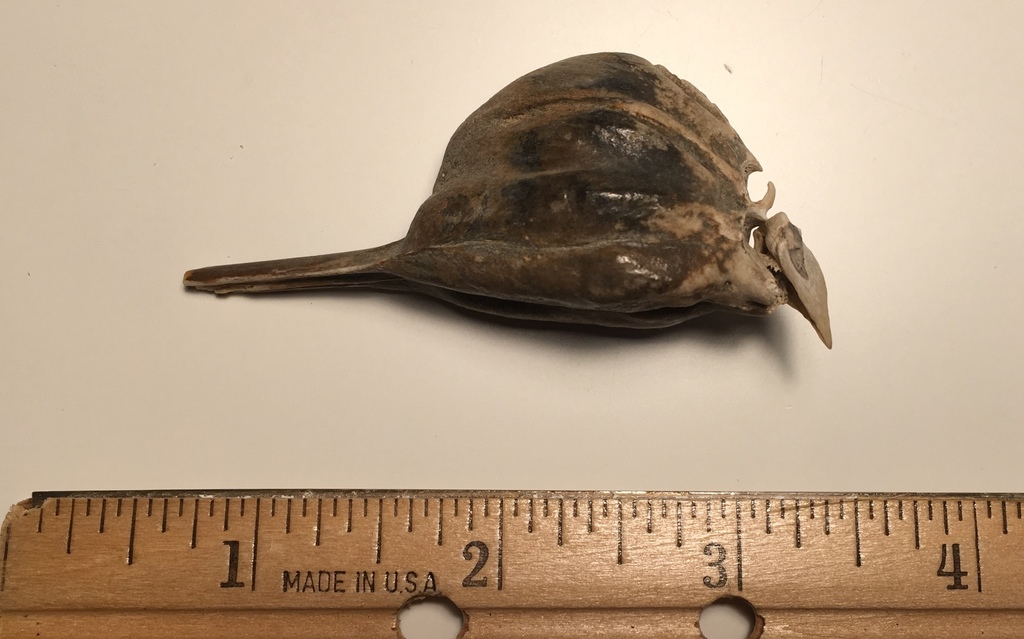
I found two more bones that certainly look like tilly bones, but are fresh water. Those iNat observations are from Kentucky, as is this one, from the Ohio River.
And then there is this one, also the Ohio river.
I one day want to email the corresponding author of the above paper and ask their input, just hope I can find the time and energy one day...
11/21 edit, found another Kentucky freshwater "tilly bone"...
3
4
------------------------------------------------------------------------
Thanks to everyone who has ever observed or IDed for Tilly Bones, and anyone who has read this! less ↑