
Species Search
 CC
CC
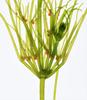
Muskgrass
(Genus Chara)
Info
Chara is a genus of charophyte green algae in the family Characeae. They are multicellular and superficially resemble land plants because of stem-like and leaf-like structures. They are found in fresh water, particularly in limestone areas throughout the northern temperate zone, where they grow submerged, attached to the muddy bottom. They prefer less oxygenated and hard water and are not found in waters where mosquito larvae are present. They are covered with calcium carbonate depo
(Wikipedia)
 CC
CC
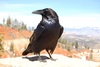
Crows, Jays, and Magpies
(Family Corvidae)
Info
Corvidae is a cosmopolitan family of oscine passerine birds that contains the crows, ravens, rooks, jackdaws, jays, magpies, treepies, choughs, and nutcrackers. In common English, they are known as the crow family, or, more technically, corvids. Over 120 species are described. The genus Corvus, including the jackdaws, crows, rooks, and ravens, makes up over a third of the entire family.
(Wikipedia)
 CC
CC
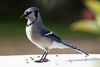
Blue and Steller's Jays
(Genus Cyanocitta)
Info
Cyanocitta is a genus of birds in the family Corvidae, a family which contains the crows, jays and magpies. Established by Hugh Edwin Strickland in 1845, it contains the following species:
(Wikipedia)
 C
C
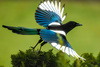
True Magpies
(Genus Pica)
Info
Pica is the genus of two to four species of birds in the family Corvidae in both the New World and the Old. The genus name Pica is derived from the Latin name for the Eurasian magpie.
(Wikipedia)
 CC
CC
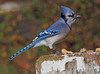
Blue Jay
(Cyanocitta cristata)
Info
The blue jay (Cyanocitta cristata) is a passerine bird in the family Corvidae, native to North America. It is resident through most of eastern and central United States, although western populations may be migratory. Resident populations are also found in Newfoundland, Canada, while breeding populations can be found in southern Canada. It breeds in both deciduous and coniferous forests, and is common near and in residential areas. It is predominantly blue with a white chest and...
(Wikipedia)
 CC
CC
Scrub-Jays and Allies
(Genus Aphelocoma)
Info
The passerine birds of the genus Aphelocoma include the scrub jays and relatives. They are New World jays found in Mexico, western Central America and the western United States, with an outlying population in Florida. This genus belongs to the group of New World (or "blue") jays–possibly a distinct subfamily–which is not closely related to other jays, magpies or treepies. They live in open pine-oak forests, chaparral, and mixed evergreen forests.
(Wikipedia)
 CC
CC
Old World Jays
(Genus Garrulus)
Info
Garrulus is a genus of Old World jays, passerine birds in the family Corvidae.
(Wikipedia)
 CC
CC
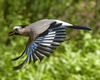
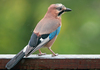
Eurasian Jay
(Garrulus glandarius)
Info
The Eurasian jay (Garrulus glandarius) is a species of bird occurring over a vast region from Western and north-west Africa to the Indian Subcontinent and further to the eastern seaboard of Asia and down into south-east Asia. Across its vast range, several very distinct racial forms have evolved to look very different from each other, especially when forms at the extremes of its range are compared.
(Wikipedia)
 C
C
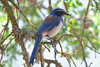
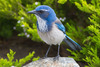
California Scrub-Jay
(Aphelocoma californica)
Info
The California scrub jay (Aphelocoma californica), is a species of scrub jay native to western North America. It ranges from southern British Columbia throughout California west of the Sierra Nevada. The California scrub jay was once lumped with the island scrub jay, and Woodhouse's scrub jay, collectively called the western scrub jay. The group was also lumped with the Florida scrub jay; the taxon was then called, simply, the scrub jay. The California scrub jay is...
(Wikipedia)
 CC
CC
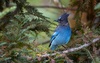
Steller's Jay
(Cyanocitta stelleri)
Info
The Steller's jay (Cyanocitta stelleri) is a jay native to western North America, closely related to the blue jay found in the rest of the continent, but with a black head and upper body. It is also known as the long-crested jay, mountain jay, and pine jay. It is the only crested jay west of the Rocky Mountains.
(Wikipedia)
 CC
CC
Cyanocorax Jays and Magpie-Jays
(Genus Cyanocorax)
Info
Cyanocorax is a genus of New World jays, passerine birds in the crow family, Corvidae. The generic name is derived from the Greek words κυανος (kuanos), meaning "dark blue," and κοραξ (korax), meaning "raven".
(Wikipedia)
 C
C
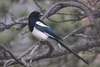
Black-billed Magpie
(Pica hudsonia)
Info
The black-billed magpie (Pica hudsonia), also known as the American magpie, is a bird in the crow family that inhabits the western half of North America, from Colorado, to southern coastal Alaska to northern California, northern Nevada, northern Arizona, northern New Mexico, central Kansas, and Nebraska. It is black and white, with black areas on the wings and tail showing iridescent hints of blue or blue-green. It is one of only four North American songbirds whose...
(Wikipedia)
 CC
CC
Boreal Jays
(Genus Perisoreus)
Info
The genus Perisoreus is a very small genus of jays from the Boreal regions of North America and Eurasia from Scandinavia to the Asian seaboard. An isolated species also occurs in north-western Szechuan province of China. They belong to the Passerine order of birds in the family Corvidae. Not closely related to other birds known as jays, they are instead related to the genus Cyanopica.
(Wikipedia)
 CC
CC
Canada Jay
(Perisoreus canadensis)
Info
The Canada jay (Perisoreus canadensis), also gray jay, grey jay, camp robber, or whisky jack, is a passerine bird of the family Corvidae. It is found in boreal forests of North America north to the tree line, and in the Rocky Mountains subalpine zone south to New Mexico and Arizona. A fairly large songbird, the Canada jay has pale grey underparts, darker grey upperparts, and a grey-white head with a darker grey nape. It is one...
(Wikipedia)
 CC
CC
Woodhouse's Scrub-Jay
(Aphelocoma woodhouseii)
Info
Woodhouse's scrub jay (Aphelocoma woodhouseii), is a species of scrub jay native to western North America. It ranges from southeastern Oregon and southern Idaho to central Mexico. It comprises two distinct subspecies groups. They are Woodhouse's scrub jay (interior US and northern Mexico), and Sumichrast's scrub jay (interior southern Mexico). Woodhouse's scrub jay was once lumped with the California scrub jay and the island scrub jay and collectively called the wester
(Wikipedia)
 CC
CC
Typical Treepies
(Genus Dendrocitta)
Info
Dendrocitta is a genus of long-tailed passerine birds in the crow and jay family, Corvidae. They are resident in tropical South and Southeast Asia.
(Wikipedia)
 CC
CC
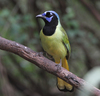
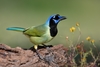
Green Jay
(Cyanocorax yncas)
Info
The green jay (Cyanocorax yncas) is a bird species of the New World jays, and is found in both North and South America. Adults are about 27 cm (11 in) long and variable in colour across their range; they usually have blue and black heads, green wings and mantle, bluish-green tails, black bills, yellow or brown eye rings, and dark legs. The basic diet consists of arthropods, vertebrates, seeds, and fruit. The nest is usually built in a...
(Wikipedia)
 CC
CC
Blue-Magpies
(Genus Urocissa)
Info
Urocissa is a genus of birds in the family Corvidae, a family which contains the crows, jays and magpies. Established by Jean Cabanis in 1850, it contains the following species:
(Wikipedia)
 C
C
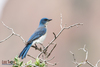
Mexican Jay
(Aphelocoma wollweberi)
Info
The Mexican jay (Aphelocoma wollweberi) formerly known as the gray-breasted jay, is a New World jay native to the Sierra Madre Oriental, Sierra Madre Occidental, and Central Plateau of Mexico and parts of the southwestern United States. In May 2011, the American Ornithologists' Union voted to split the Mexican jay into two species, one retaining the common name Mexican jay and one called the transvolcanic jay. The Mexican jay is a medium-sized jay with blue upper
(Wikipedia)
 CC
CC
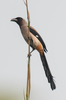
Gray Treepie
(Dendrocitta formosae)
Info
The grey treepie, also known as the Himalayan treepie, (Dendrocitta formosae) is an Asian treepie, a medium-sized and long-tailed member of the crow family. They are widely distributed along the foothills of the Himalayas in the Indian Subcontinent and extending into Indochina, southern mainland China and Taiwan. The populations vary in plumage and several are named as subspecies.
(Wikipedia)
 C
C
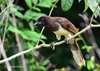
Brown Jay
(Cyanocorax morio)
Info
The brown jay (Cyanocorax morio) is a large jay native to Central America and southern Texas.
(Wikipedia)
 CC
CC
Red-billed Blue-Magpie
(Urocissa erythroryncha)
Info
The red-billed blue magpie (Urocissa erythroryncha) is a species of bird in the crow family, Corvidae. It is about the same size as the Eurasian magpie but has a much longer tail, one of the longest tails of any corvid. It is 65–68 cm (25.5–27 in) long and weighs 196–232 g (6.9–8.2 oz).
(Wikipedia)
 CC
CC
Yucatan Jay
(Cyanocorax yucatanicus)
Info
The Yucatan jay (Cyanocorax yucatanicus) is a species of bird in the family Corvidae, the crows and their allies. It is native to the Yucatán Peninsula where its habitats are subtropical or tropical dry forest, plantations and cleared areas at altitudes up to 250 m (820 ft). Adults are about 30 cm (12 in) long, black, with blue wings, mantle, and tail, black bills, yellow eye rings and legs. Immature birds have yellow bills. This is a common species of...
(Wikipedia)
CC
Rufous Treepie
(Dendrocitta vagabunda)
Info
The rufous treepie (Dendrocitta vagabunda) is a treepie, native to the Indian Subcontinent and adjoining parts of Southeast Asia. It is a member of the crow family, Corvidae. It is long tailed and has loud musical calls making it very conspicuous. It is found commonly in open scrub, agricultural areas, forests as well as urban gardens. Like other corvids it is very adaptable, omnivorous and opportunistic in feeding.
(Wikipedia)






_(1547)_-_Relic38.jpg)
