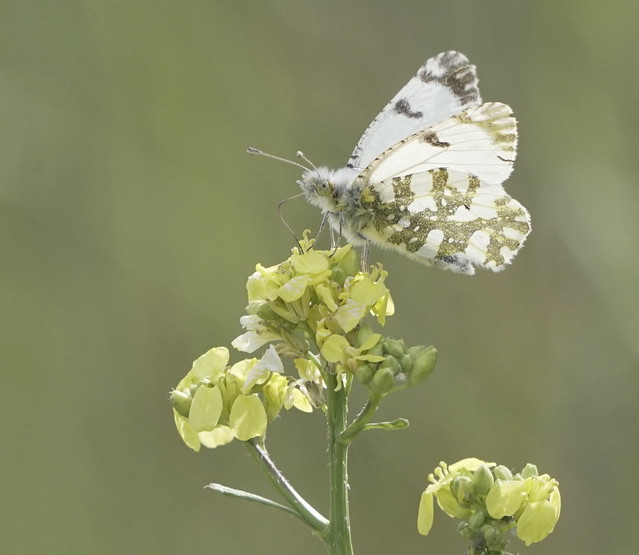
Plagiobothrys glaber (Gray), presumed extinct, CNPS Rank 1A

Comparison of nutlets from An Illustrated Flora of the Pacific States by Leroy Abrams, Stanford University Press, 1951.
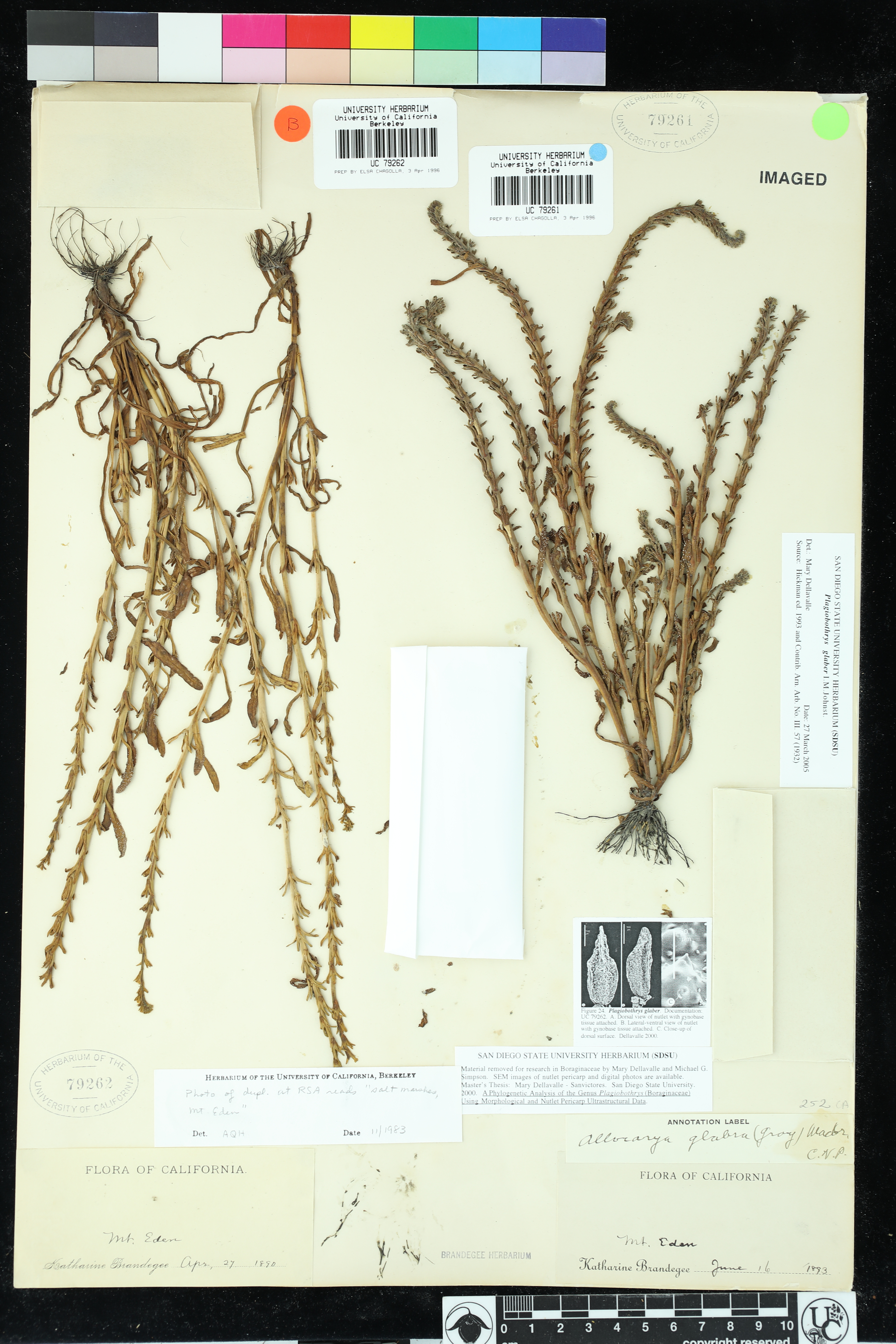
Herbarium collection from Mt. Eden, Alameda
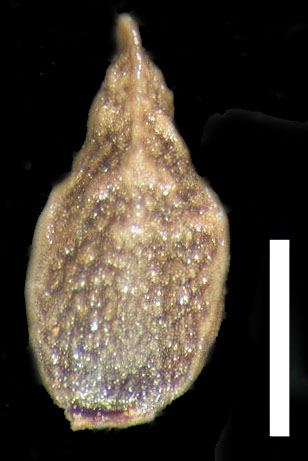
Abaxial view of nutlet
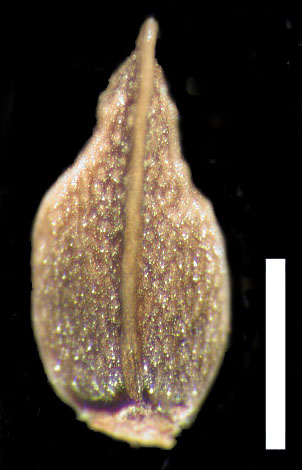
Axial view of nutlet
Jepson:
Habit: Annual, sparse-short-strigose.
Stem: ascending to erect, 1--2 dm, thick, hollow.
Leaf: cauline, lower 2--11 mm. Inflorescence: dense, bracts below; pedicels 0.5--2 mm, thick, hollow.
Flower: calyx 3 mm, 8--10 mm in fruit, narrow, basal 2--3 mm fused into fleshy cylinder, lobes appressed, +- spreading at tip, oblong to spoon-shaped, midveins thick; corolla limb +- 3 mm diam.
Fruit: nutlet 1.8--2 mm, lanceolate to lance-ovate, shiny, dark brown, attached firmly; abaxial ridge narrow, obscure below middle, cross-ribs above middle, few, rounded, wrinkled, +- flat below, +- tubercled; margins with entire border; adaxial ridge V-shaped, fine- to obscure-granular to smooth; scar basal, generally on peg.
Ecology: Wet, saline, +- alkaline soils in valleys, coastal marshes; Elevation: < 100 m.
Flowering Time: Apr--May
Unabridged Note: As noted by C.V. Piper in 1920, Plagiobothrys glaber and succulent forms of Plagiobothrys stipitatus var. micranthus can be distinguished by nutlets (the latter coarse- and conspicuous-granular adaxially, with margin border not entire).
Illustrated Flora of the Pacific States:
Allocarya glabra (A. Gray) J. F. Macbride. Glabrous Allocarya.
Stems erect, with stout erect branches from near the base, 1-2 dm. high, succulent, very sparsely strigillose. Lower leaves linear, 5-8 cm. long, upper ones linear-oblanceolate and shorter, glabrous above, sparsely pustulate and strigose below ; racemes rather densely flowered, erect and somewhat fistulous, leaf-bracted at base, unilateral with the flowers somewhat 2-ranked; corolla about equaling the calyx-lobes, the limb about 1.5 mm. broad; fruiting calyx sessile accrescent, 8-10 mm. long, the lobes united below with a tube about 2 mm. long, becoming firm by the indurated midrib; nutlets lanceolate, 2 mm. long, the body flattened and the apex attenuate and beak-like ; dorsal side with a cauline keel and two rather definite lateral ones, also with a few transverse ridges mostly above the middle, tuberculate; ventral side keeled the whole length, weakly tuberculate; scar basal, circular, substipitate. Salt marshes and alkaline flats, Upper Sonoran Zone; margin of San Francisco Bay in Alameda and Santa Clara Counties, and near Hollister, San Benito County. Type locality: "Apache Pass. S. Arizona, Lemmon, 1881." "Some misplacement of labels is to be suspected, for the form is common in the Alameda marsh lands, particularly about Mount Eden." K. Brandegee