 Annotations
Corinne Fuchs
Joined: Jun 6, 2019 Last Active: Sep 22, 2026 iNaturalist
Curator of a natural history research collection in muggy, sunny Florida. Marine ecologist, photographer, scientific illustrator, and massive story-telling nerd.
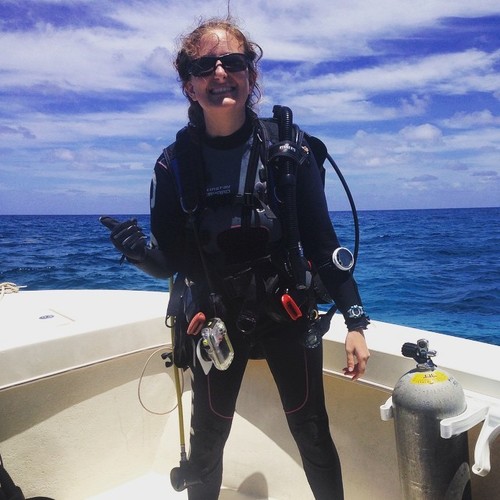
My graduate research is on coral reef community responses to multiple human stressors. I grew up snorkeling and running about the wilds of Florida but love learning about the nature anywhere I go, from CA mountain hikes to FL's mangroves & seagrasses.
I am a marine ecologist by schooling, becoming a better taxonomist by trade. I strive to be confident in my IDs, but I will get things wrong. Please don't hesitate to correct &or comment, I always want to improve.
ID EXPERIENCE:
- Very experienced in field ID of Caribbean reef fishes and hard corals; decent with coral disease symptoms
- Some experience with non-Scleractinian Caribbean benthic cnidaria (soft corals, anemones, hydroids, zoanthids, and corallimorphs).
- Increasingly improving in specimen ID of Gulf of Mexico inverts. e.g. mantis shrimps, irregular urchins, lobsters, elbow crabs, hermits). Overall decent with larger/common invert taxa.
NOTES ON PARTICULAR GROUPS:
HERMITS; I'm slowly compiling a key to hermits FL/GoM, from multiple older papers/keys/sources and our specimen collection. I wholeheartedly welcome input on any IDs! Specifically, Paguristes tortugae and co. are a terribly confusing species complex and I've attempted to improve iNat records for tortugae vs. karenae (described late 2022). [P. karenae description and (gorgeous!) plates/pics here: https://mapress.com/zt/article/view/zootaxa.5178.1.1]
PYGMY OCTOS aka (Par)octopus; Our collection is currently barcoding members of the Octopus joubini complex (joubini/mercatoris/sp. X??) that our regular monitoring provides us. There is currently no superficial way to tell P. mercatoris & O. joubini apart (and few for O. vulgaris group...), but we are keeping an eye out for them. Feel free to ping me here or in the iNaturalist Discord. I probably won't add a certain ID, but I'll try to weigh in based on my experience seeing freshly-trawled octos we later barcode.
OVERLOOKED MARINE INVERTS: I am currently trying to get/add local snorkeling observations in my tiny attempt to improve the iNat algorithm's marine IDs. This will include a decent amount of low resolution/higher IDs (Zoantharia, Hydrozoa...), especially where microscopic examination or further processing is required. I'll add records that are more rigorously IDed and cataloged as specimens when I can. But even a rough ID on many of these marine groups can assist iNat's computer vision.
Cameras/Gear:
Lab photos: Nikon D7100 or D7200 with 50 or 60mm lens and 2 external strobes (any photos on a solid black background are usually with this)
Underwater & field photos:
- most photos taken on my secondhand Olympus TG-4 out of convenience and nukeproof-ness
- recently acquired a Nikon AW-1
- main diving camera is a Sony Alpha a-6000 with kit lens and SeaLife flash
Most field pics are taken on snorkel (unfortunately). The majority of my SCUBA dives are for a specific scientific purpose, so my underwater kit has to be on the smaller size to avoid getting in the way. I usually post-process underwater photos in Lightroom, but Ive been less picky/patient recently; apologies for the unedited snorkel-only pic quality.