Quick identification guide to Tigrosa females
DISCLAIMER: This guide assumes you do already know how to recognize a wolf spider. The presented list of characteristics and differences might not be exhaustive and are not always suitable to ID young juveniles. This guide focusses on IDing females, which I think are a easier to ID. A guide for males will follow or be added here.
The spider genus Tigrosa is a mainly US-american genus of wolf spiders (Lycosidae) comprised of 5 species: T. annexa, T. aspersa, T. georgicola, T. grandis and T. helluo. The genus occurs predominantly in the eastern half of the country, with a notable exception in the Sacramento area in California. Whether those californian spiders are T. helluo - with which they share huge visual similarities - or are a different species, remains unknown at this point. Tigrosa is present with two species (T. helluo and T. aspersa) in south-eastern Canada and with at least one species (T. helluo) in Mexico.
Recognizing a Tigrosa spider
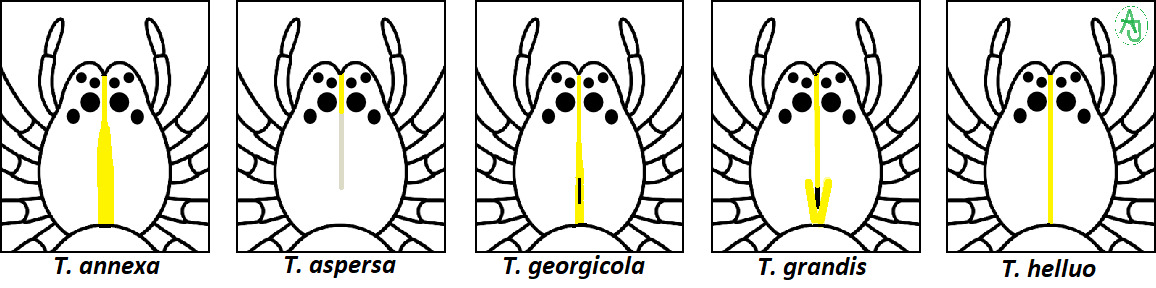
Tigrosa spiders are easily recognized by their compareably thin prosomal median stripe starting anteriorly between the eye region and running down to the posterior end of the prosoma (see last figure). This stripe is never wider than the space between the median eyes and the edges are straight. However, there are some similar wolf spiders that can easily be confused with Tigrosa spiders.
Schizocosa:
Similar to Tigrosa, some species of Schizocosa spiders do show a prosomal median stripe. However, in Schizocosa this median stripe is comparably wider once it surpasses the eye region towards the posterior end.Hogna:
Hogna spiders can be extremely similar and are commonly confused with Tigrosa. The prosomal median stripe in some species (especially in the not yet formally described H. 'incognita') is also very thin. To distinguish those Hogna with thin median stripes from Tigrosa look out for the bold dark leg band on tibia IV (last pair of legs, see Figure 1), which reaches right to the joint, while in similar Tigrosa (e.g. georgicola) there is usually a slim lighter coloured ring before the joint.Rabidosa:
Spiders in this genus can be confused with Tigrosa, especially when the females carry offspring. The spiderlings will then obscure the otherwise different enough opisthosomal pattern, which consist of a long, dark median stripe running down to the far posterior end of the opisthosoma, while in Tigrosa, a similar cardiac mark will end midway. When only the prosomal pattern is visible, the very bold/wide submarginal bands differentiate Rabidosa spiders from Tigrosa.Trochosa:
Another genus of wolfspider that frequently gets misidentified for Tigrosa here on iNaturalist is Trochosa. However, their usually much lighter cardiac mark, which shows the same colour as their prosomal median stripe, makes them easy to tell appart. In Tigrosa the cardiac mark is always darker coloured than the prosomal median stripe.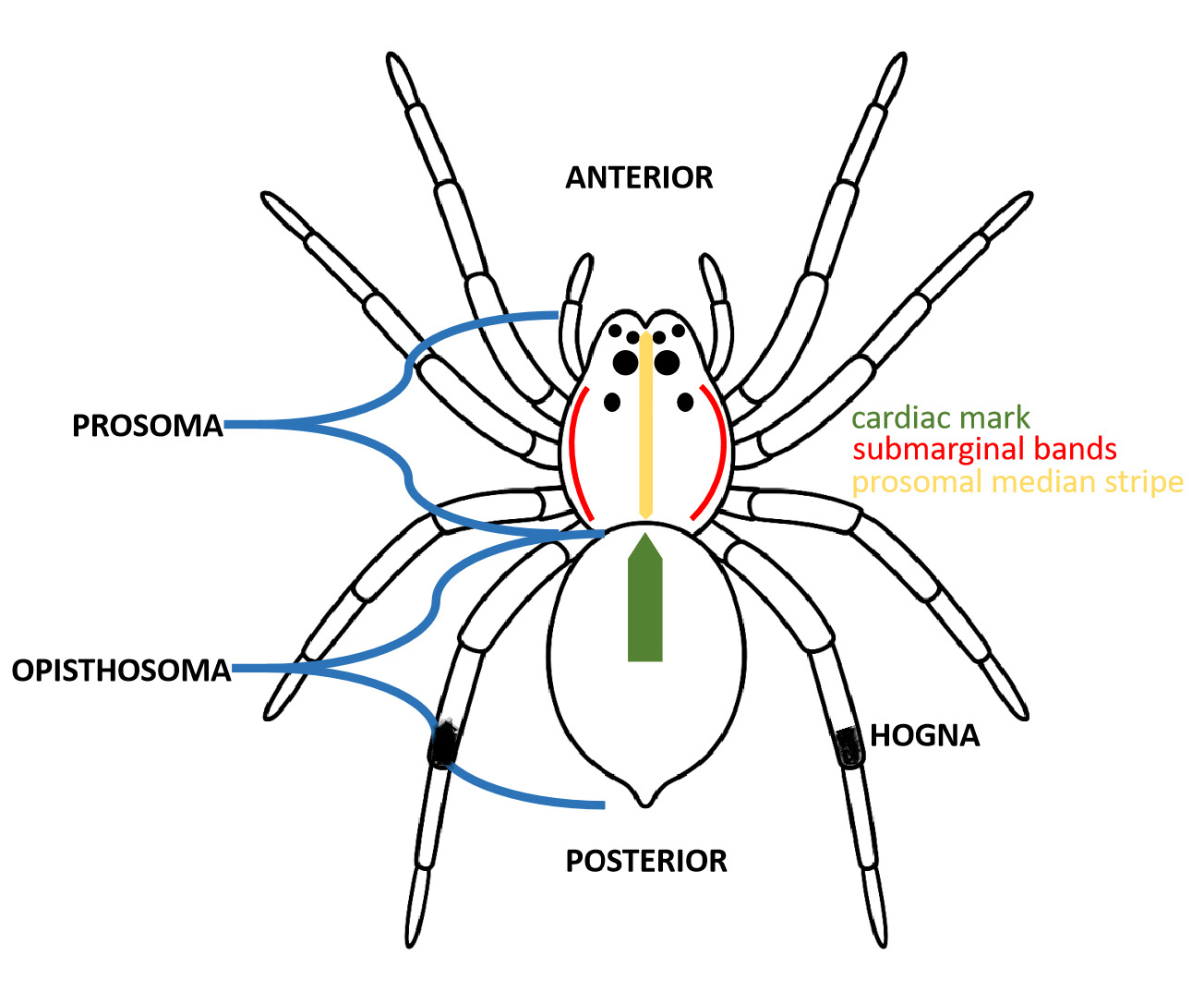
Identifying Tigrosa species
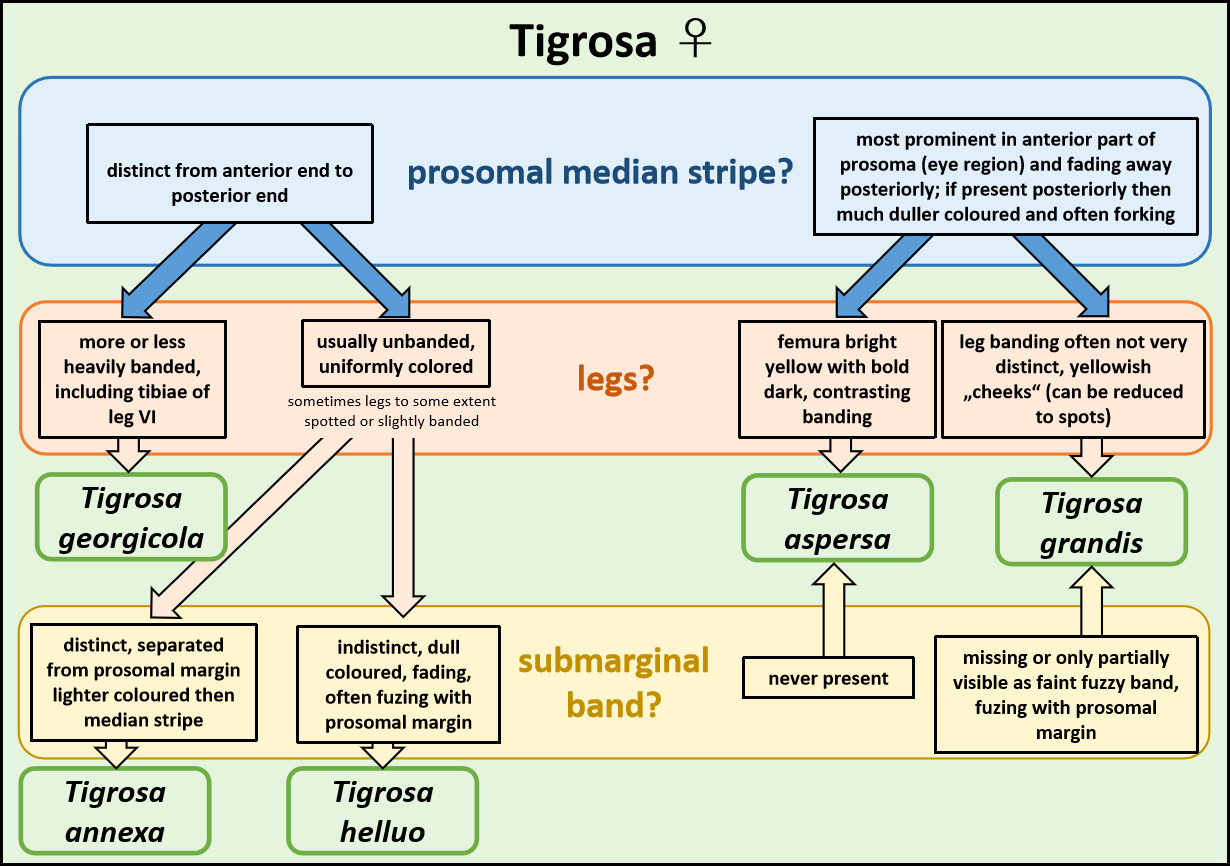
The 5 species of Tigrosa spiders differ - among other things - in the presence and expression of leg banding and the submarginal band as well as the development of the prosomal median stripe. The following chart provides a quick ID guide to identify females of those 5 species. The following short descriptions of each species go into a bit more detail.
Short descriptions of Tigrosa species
Tigrosa annexa:
• very prominent submarginal band, lighter coloured than prosomal median stripe, well defined and separated from similar coloured margin of prosoma by a dark line
• prosomal median stripe slightly widening towards posterior end
• legs often uniformly yellowish-brown, sometimes femora slightly spotted
• dark cardiac mark bordered by a broad, white-ish band
• venter cream coloured with few dark spots, but no larger dark markings
• most similar to T. helluo, look out for differences in submarginal band and prosomal median stripe
Tigrosa aspersa:
• often very dark, black-ish base colour
• prosomal median stripe regularly only present in first third of prosoma; sometimes it is visible further towards the posterior end, but then only very faintly coloured
• prominent banding on femora of all legs - two bold dark bands alternating with bright yellow bands
• submarginal bands almost never visible, sometimes some lighter brown patches in that area
• most similar to T. georgicola, look out for differences in banding of femora and tibiae as well as prosomal median stripe
Tigrosa georgicola:
• thin and complete prosomal median stripe, often bright orange, sometimes a thin dark line is visible in the posterior part
• legs not uniformly coloured, often strongly banded with a characteristic sequence of brighter and darker bands on tibia IV with the last dark band not reaching the joint (unlike similar Hogna!)
• venter with 3 dark bands running from epigastric furrow (genital region) to spinnerets. They might by only rudimentary developed or very prominent, giving the venter an almost black appearance
• very variable and can be confused with most other Tigrosas
Tigrosa grandis:
• many specimen show distinct "orange cheeks", separated by a dark line from the chelicerae/fangs.. but careful! Those cheeks might be reduced to small dots and T. georgicola also might show orange colouration in the face region (but then often not that well defined and not that clearly separated from the chelicerae)
• legs often banded, but not as contrasting in colours as in T.aspersa
• most similar to T. georgicola, look out for differences in prosomal median stripe, which appears "forked" in posterior region (see last figure), while in T. georgicola the stripe appears more or less "solid" all the way
Tigrosa helluo:
• visually similar to T. annexa, but overall darker and duller in appearance
• submarginal band might be similarly well defined as in annexa, but not as brightly coloured.. usually similar colour to prosomal median stripe
• cardiac mark not bordered by a bright band
• legs often uniformly yellow-ish to brown, sometimes slightly spotted or banded
• venter cream coloured, but sternum and coxae black
• most similar to T. annexa, look out for differences in submarginal band/prosomal median stripe AND T. georgicola, look out for differences in leg markings
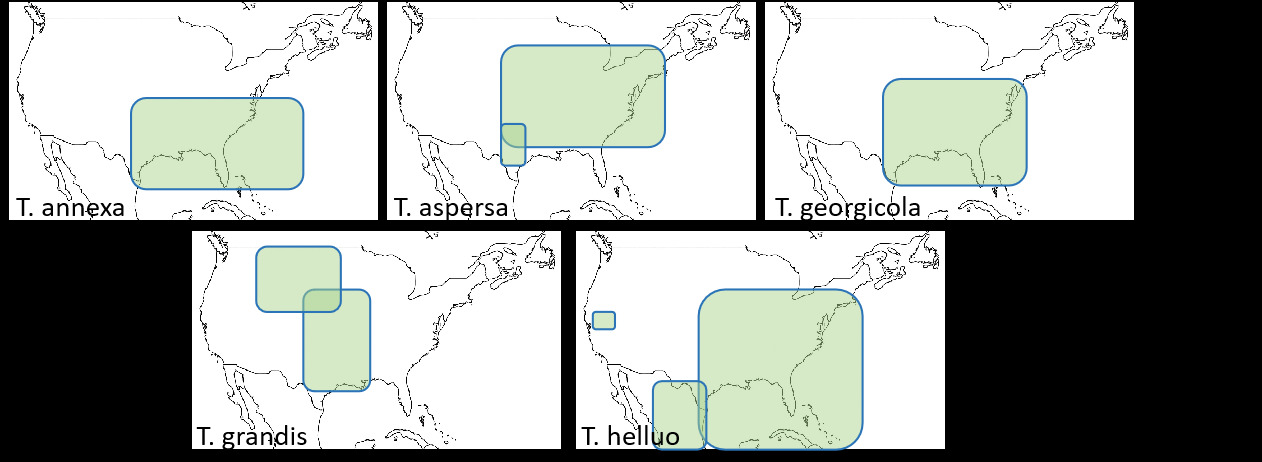
The following maps give a rough estimation of where the species are commonly observed, based on Brady 2012 (see references at the end) and observations IDed here on iNaturalist. Those maps are not official or necessarily complete. Please note - I included the occurrence of Tigrosa in California in the map of T. helluo, due to the visual similarities.. however, whether those spiders are indeed T. helluo remains to be investigated.
General advice: Please keep an open mind when IDing. Try to use as many characteristics, including range maps, as possible/visible to ID Tigrosa spiders. Keep in mind that some characters can be variable leading to a very similar appearance to other species. Certain features might be disguised by dirt or wear or flash or not yet fully developed e.g. before adulthood or after a molt and so on. If in doubt, it is totally fine to leave an ID at genus or @tag other active Tigrosa IDers to get another opinion. If you want to get into Tigrosa IDing using this guide, feel free to @tag me if needed. I am willing to assist the learning curve.
You can download this guide as PDF here. Thanks again to @eaneubauer for being so kind to provide a space for hosting it
https://eaneubauer.us/images/document/20380821/TigrosaF-seTz5i36EMLQ35QL6NJtyA.pdf
EXTERNAL REFERENCES
Brady, A. R. (2012). Nearctic species of the new genus Tigrosa (Araneae: Lycosidae). Journal of Arachnology 40(2): 182-208. doi:10.1636/K11-77.1 (register on the world spider catatlogue and get free access to the paper here: https://wsc.nmbe.ch/genus/1865/Tigrosa)
https://bugguide.net/node/view/747000
Special Thanks to @paolosol and @eaneubauer for getting me into Tigrosa, leading me along the way and sharing fruitful discussions and last but not least providing feedback and help on this guide :-)