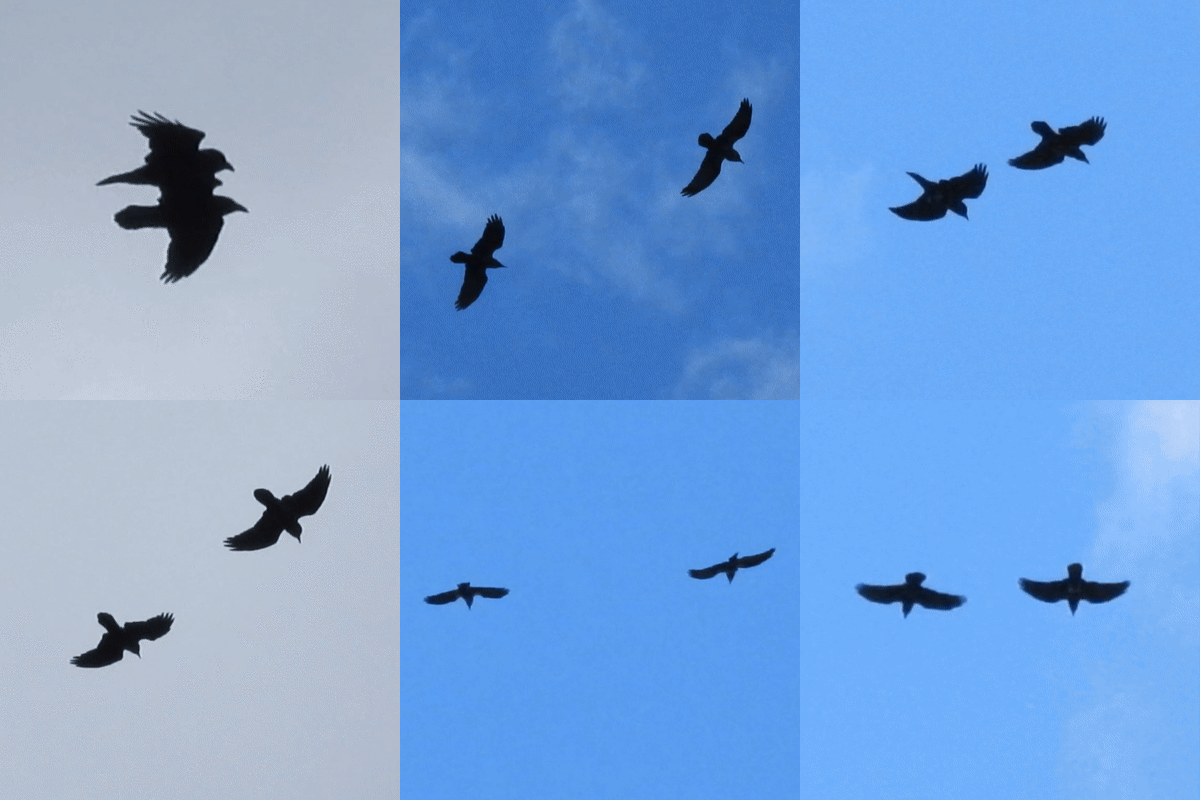
Raven recruits wind force to easily eat ice
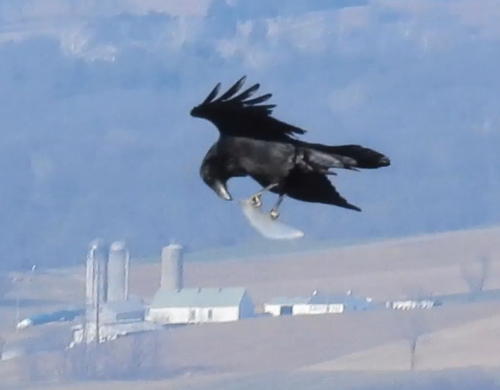
In addition to enjoying wind surfing, this clever raven is recruiting the force of strong upslope wind to facilitate easier eating of foot-held ice. If it sat on a branch, it could not easily grasp both the branch and this large flat chunk of ice. If the raven pecked at this piece of ice on the cliff rocks where it was found, it would slide away. If the raven was in normal flight without powerful winds holding it aloft, flapping its wings instead, it would be more cumbersome to eat and the raven would carry its full weight. The powerful wind held aloft both the raven and the ice for free, allowing the raven to nibble on the ice held in its feet as casually as you would nibble on an ice-cream cone in your hand. See this full observation in my video showing the raven eating the ice.
| Disposition | Result |
|---|---|
| Sit on a tree branch | Impossible: can't hold this awkward shaped ice with feet while also holding a branch with feet. |
| Stand on the rocks where the ice was found | Difficult: the ice will slide around the irregular-shaped cliff rocks if pecked at or stood upon to try to hold it steady. |
| Carry while flying with no wind | Difficult: bending neck down while flapping wings is awkward and the full weight of the large chunk of ice must be borne. |
| Carry while hovering in strong upslope wind | Easy: the strong upward wind holds the raven and the ice aloft almost effortlessly, allowing for casual nibbling of the ice, facilitating otherwise unavailable ease. |
Is this similar to tool use?
If this raven was intentionally recruiting wind to facilitate eating ice, as it seems to be, imo, then it seems as if it was using the wind as a tool. Let's express this utilitarian hypothesis as a formula and apply it to a famous example of tool use by crows and then to this scenario.
W uses X to facilitate manipulation of Y so as to achieve Z.
A crow uses a stick to facilitate manipulation of grubs so as to achieve food.
A raven uses wind to facilitate manipulation of ice so as to achieve food/drink.
An important difference is that, while a stick is an object manipulated as a tool, the wind is not an object. However, the raven nevertheless manipulates the wind aerodynamically in just the right way to hold it aloft thereby facilitating easy eating of the ice. Both sticks and winds are physical phenomena that are being recruited in these examples as a means to an end, so the object distinction seems rather arbitrary. However imperfectly the proposed intentional use of wind may conform to the formal concept of tool use, it seems to require similar levels of cognitive insight, which ravens and crows are known to possess.