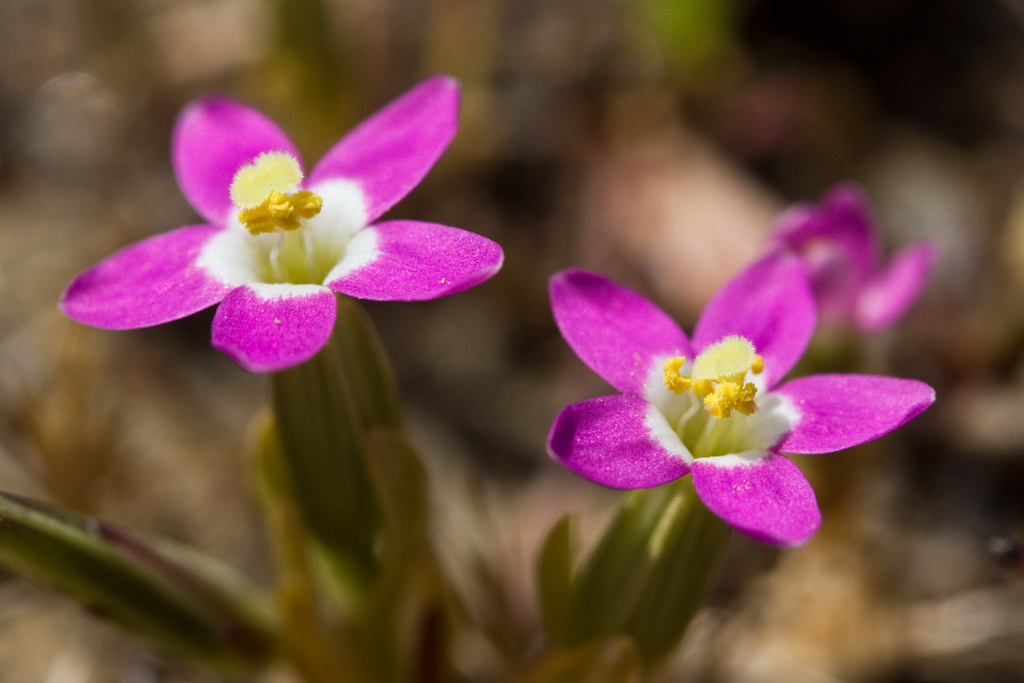
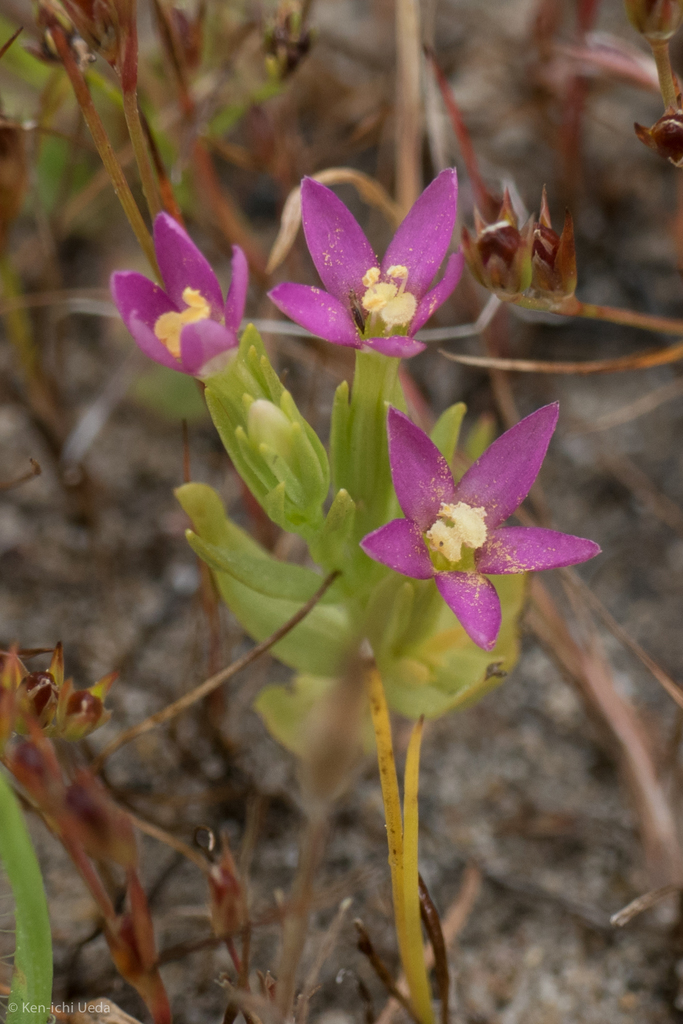
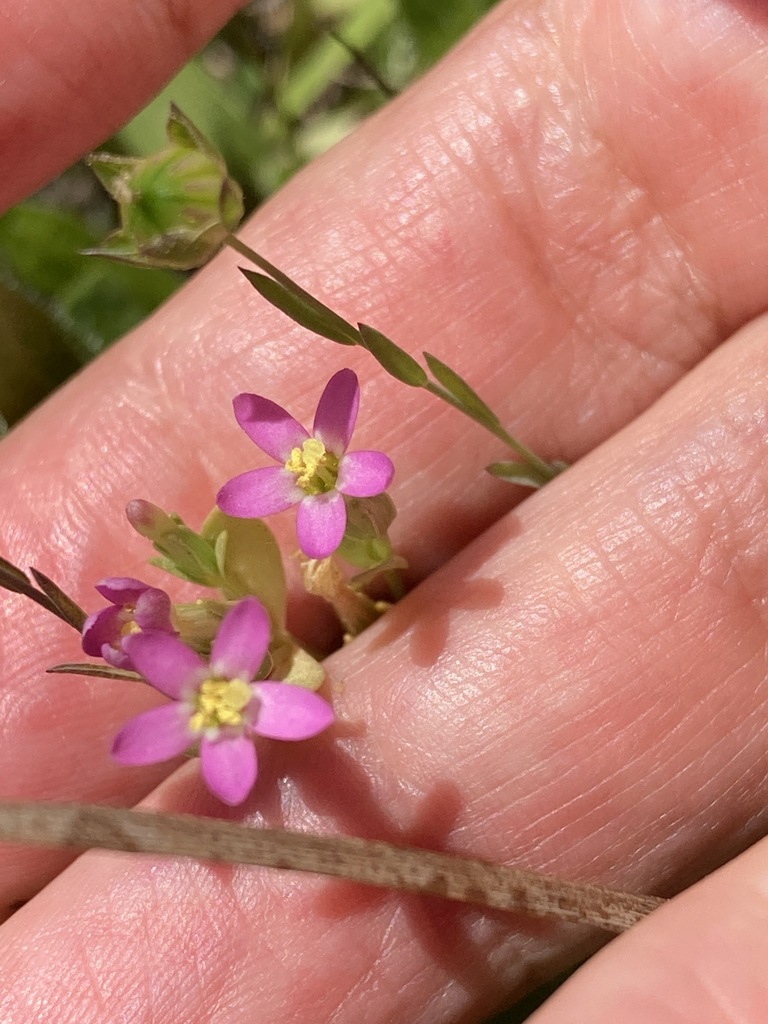
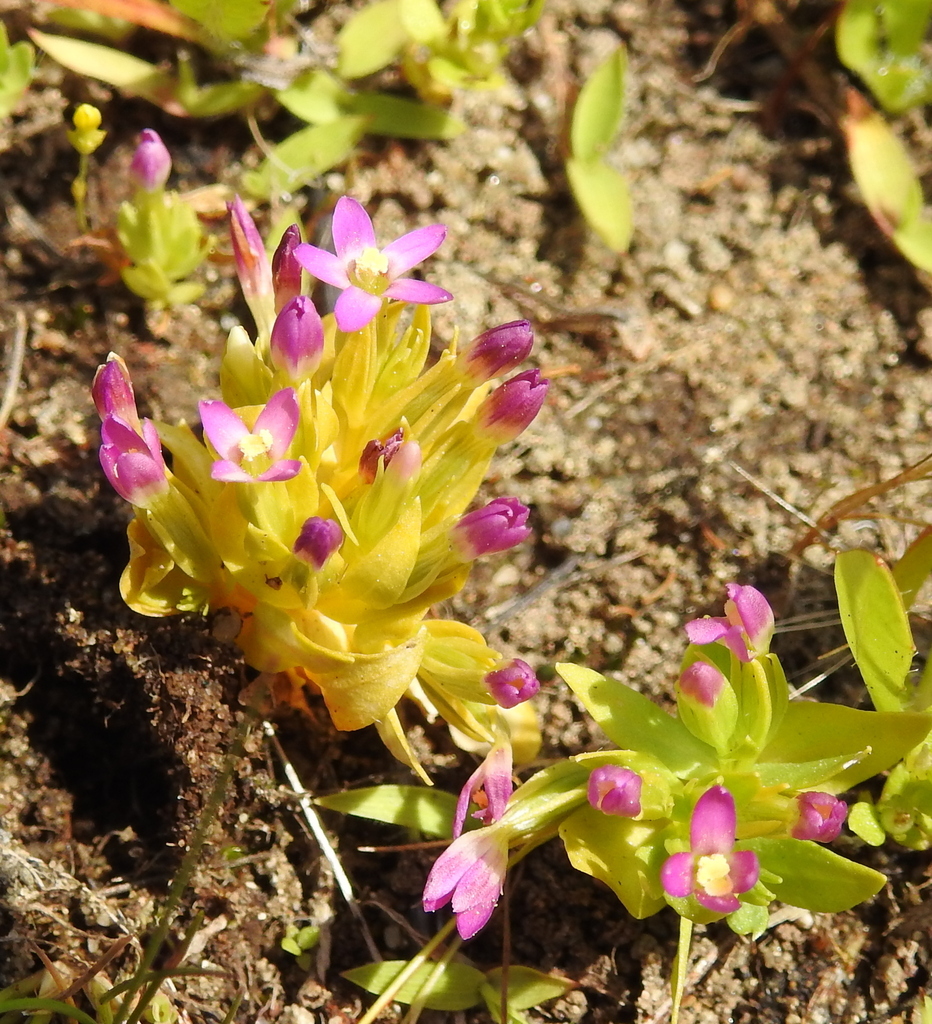
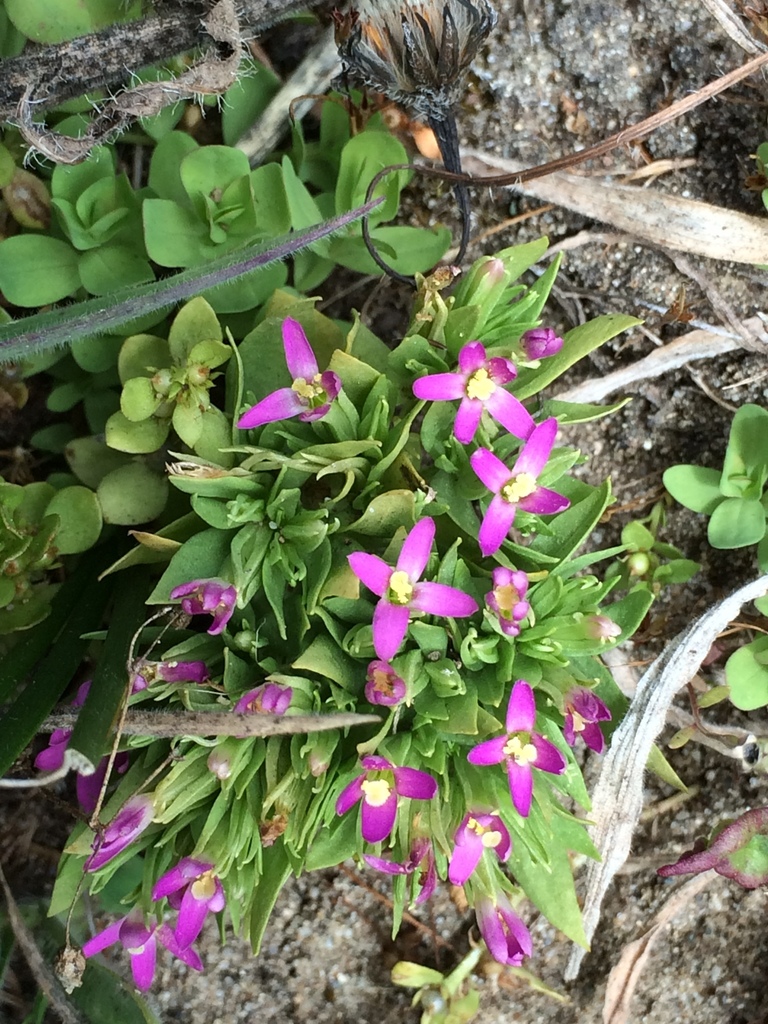
Differentiating Zeltnera muehlenbergii from Centaurium and other species in western North America
TLDR (Abstract)
The species Zeltnera muehlenbergii (Griseb.) G. Mansion has long been confused with Centaurium tenuiflorum (Hoffmannsegg & Link) Fritsch, Mitt. (Pringle 2010). This confusion has continued on iNaturalist where most observations identified as Z. muehlenbergii are likely C. tenuiflorum. A review of observations on iNaturalist has revealed characteristics of the corolla which may be used to differentiate the species and raised questions about characteristics and taxonomy of the species.
Introduction
Zeltnera muehlenbergii (Griseb.) G. Mansion is a small flowered member of the Gentianaceae family that is native to the northwest of North America, including California, Oregon, Washington, Idaho, and British Columbia (Pringle 2023b). Due to similarities in flower size and pedicel length, it has historically been confused taxonomically with non-native Centaurium species such as Centaurium tenuiflorum (Hoffmannsegg & Link) Fritsch, Mitt. until Zeltnera was separated from Centaurium by Mansion(2004). The tangled history of several small flowered Centaurium and Zeltnera in north America was explored by Pringle(2010) with a close comparison of Z. muehlenbergii, Z. davyi, and C. tenuiflorum.In 2022, both C. tenuiflorum and C. pulchellum were being misidentified on iNaturalist as the native Z. texensis in Texas (McDaniel 2022). Though the genera are formally differentiated by aspects of the stigma (Mansion 2004, Pringle 2010, 2023a, 2023b), differences in the form of the inflorescence and pedicel length could often be used to correct those identifications. Given the historical confusion of Z. muehlenbergii and C. tenuiflorum documented by Pringle(2010), I began an initial examination of observations of Z. muehlenbergii on iNaturalist. As there appeared to be no definitive photograph of Z. muehlenbergii at the time, it was unclear how similar live specimens actually were to C. tenuiflorum. Since the literature indicated a much closer morphological similarity with C. tenuiflorum than was the case with Z. texensis, it appeared that photos of the stigma would be necessary for identification of the two species. Given that clear photos of the stigma shape were uncommon and quite difficult to obtain given the small size and perspective needed, it seemed unlikely to be able to sort out the situation with the observations available at the time.
In the summer of 2024, in preparation for an aborted trip to California to search for and photograph Z. muehlenbergii, I began a review of the available online herbarium evidence of Z. muehlenbergii and iNaturalist observations of similar Gentianceae in the known range of Z. muehlenbergii, looking primarily for locations to search but also for any possible differences that may not have been documented in the literature. The herbarium data was problematic, for the most part only revealing a few scant details not already covered in Pringle(2010). The review of iNaturalist observations uncovered a small set of around one hundred observations of small flowered Gentianaceae which appeared consistent with descriptions of Z. muehlenbergii but which had corollas that were visually distinct from C. tenuiflorium, C. erythraea, and Z. davyi. Within this small group, there may be two different corolla color patterns. Further research will be needed to determine if they simply represent variation within Z. muehlenbergii or if one of them might warrant recognition as a separate taxon.
This post is intended primarily as a guide for users of iNaturalist to identify Z. muehlenbergii in order to correct the large number of misidentifications present at this time (May 2025). For the general reader the two sections "A Brief History and Differentiating Characteristics" and "Guide to differentiating species" are probably the most useful. Portions of the section "Methodology and General Results" focus on the herbarium record and so may be of less interest, though there are also subsections specific to iNaturalist. A list of likely Z. muehlenbergii observations is provided towards the end.
- Main Sections
- A Brief History and Differentiating Characteristics
- Methodology and General Results
- Guide to differentiating species
- List of likely Z. muehlenbergii observations
- Moving Forward on iNaturalist
- Copyright
- References
A Brief History and Differentiating Characteristics
The species now included in the genus Zeltnera, which are native to the new world, were part of Centaurium until they were separated out by Mansion (2004). Early descriptions of these species were typically found in the genus Erythraea until it was later replaced by Centaurium, so many early descriptions of Zeltnera were originally described in one of those two genera. Species now included in the genus Centaurium are mostly native to the old world, though many have been introduced in other areas. Pringle (2010) unravels the historical confusion between Z. muehlenbergii and C. tenuiflorum and addresses to various extents other similar species such as Z. davyi, C. erythraea, and C. pulchellum.The holotype of Z. muehlenbergii (Douglas s.n., K, barcode K000195655) was collected by David Douglas in California, in the early 1830s, possibly near his base of Monterey but other locations have been suggested (Pringle 2010). It was described by Grisebach as Erythraea muehlenbergii (1839, some sources say 1838). Additional species that were later synonimized with Z. muehlenbergii were collected in the Sacremento Valley of California and also Oregon and Washington throughout the 1800s and into the early 1900s (Pringle 2010). Its documented range extends from Monterey County, California in the south to British Columbia in the north and eastward into Idaho (Pringle 2010, 2023b), though recent reports appear to extend the range southward to San Luis Obispo county, California (Excoff 2025). The holotype of Z. davyi (Davy 396, UCJEPS) was collected in Alameda county, California, in 1893, though earlier samples likely exist. It was originally treated as a variety of C. exaltatum by Jepson(1925) and later elevated to species by Abrams (1951). Regarding Centaurium, the known North American introductions are C. pulchellum, C. erythraea, and C. tenuiflorum (Mansion et al 2005; Pringle 2010,2023a). According to Pringle (2010), the earliest specimens of C. tenuiflorum he encountered come from the Humboldt county area of California in the 1890s and early 1900s, with other early specimens from Butte and Yuba counties in California and Douglas county, Oregon, while specimens from the Bay Area start in the 1940s. It was also introduced to the southern U.S., with earliest samples from that region apparently from the 1960s (Pringle 2010). However, C. tenuiflorum in north America and introduced in much of the world is thought to be of hybrid origin, possibly derived from both C. erythraea and C. tenuiflorum and it is sometimes called C. xtenuiflorum (Mansion et al 2005). It is not known if Pringle's (2010,2023a) descriptions of C. tenuiflorum were based only on North American specimens and thus are limited to the hybrid entity. It is unclear if there are any significant morphological differences between it and C. tenuiflorum in the narrow sense found in parts of the old world.
As carefully explained by Pringle (2010), the root of the historical confusion between Z. muehlenbergii and C. tenuiflorum appears to be an early misapplication of the name C. floribundum to the entity referred to here as C. tenuiflorum. C. floribundum was a synonym of Erythraea floribunda which was described based on a sample collected by Hartweg in the Sacramento Valley around 1846 or 1847(Bentham 1839-). Apparently, throughout much of the 1900s, C. tenuiflorum in the U.S. was incorrectly treated as C. floribundum while Z. muehlenbergii was treated as C. muehlenbergii. However, C. floribundum was eventually synonymized with C. muehlenbergii in the 1980s by N.H. Holmgren, and though the type of C. floribundum may have actually been C. muehlenbergii, many of the specimens which had been identified as such were not. Pringle theorized that this may have led to a situation where descriptions of C. muehlenbergii may have been based more on the increasing number of specimens of C. tenuiflorum than on C. muehlenbergii, as may have been the case with Hickman's descriptions (1993). During this period however, again as noted by Pringle, C. Rose Broome appeared to be the first to make the connection between the specimens previously noted as C. floribundum and C. tenuiflorum and began annotating specimens as the latter from the late 1970s to the early 1990s. However, despite some indications from these annotations that she intended to publish a monograph on Centaurium, it does not appear to have occurred, and thus adoption of C. tenuiflorum in the U.S. was slow to occur. Only with Mansion's work, ultimately in Mansion and Zeltner (2004), was this finally fully recognized.
The main morphilogical differences between Centaurium and Zeltnera as presented by Mansion (2004) are aspects of the stigma lobe, style division, and capsule shape. Pringle (2010) contrasts additional aspects of Z. muehlenbergii, Z. davyi and C. tenuiflorum, which helps with the practical difficulties of using the stigma, style, and capsule. Later treatments (Pringle 2012,2023b) mostly reflect the earlier descriptions, but sometimes differ in subtle yet, important ways. The following tables summarize the morphilogical differences.
| Feature | Zeltnera | Centaurium |
|---|---|---|
| Stigma | flabelliform (fan shaped); no or very weak fleshy surface | reniform to shoe shaped; distinctly thickened to fleshy |
| Style division | not divided to subcapitate, absent or very inconspicuous | slightly bifid, distinct (2-5mm) |
| Capsule shape | elliptic to oval | linear |
| Feature | Z. muehlenbergii | Z. davyi | C. tenuiflorum |
|---|---|---|---|
| Stigma | flabelliform | flabelliform | elliptic, ovate |
| Style | entire, cleft < 0.5mm | entire, cleft < 0.5mm | cleft 0.5-1mm |
| Pedicel | proximal flower in center of cyme division, sessile or to 12mm; distal flowers sessile or to 4mm | (2–)4–25(–55) mm | sessile or subsessile to 2mm |
| Calyx keels | not keeled or proximal only < 0.25mm wide | keeled most of their length, proximally 0.3-0.6mm wide | no description |
| Corolla lobe width | less than 2mm wide | 2-3mm wide | no description |
| Branching | stems usually 1, occasionally 2–4, simple or variously branching | stems 1–10, simple (small plants) or few-branched ± throughout | stems usually 1, simple or branching above or near middle or occasionally with few, slender branches from base |
| Inflorescence | distally or completely monochasial cymes;open, few flowered, not corymboid | completely monochasial or occasionally proximally dichasial | dense, +- coymboid, dichasial cymes |
| Calyx lobes | linear-oblong, usually 0.5-0.7mm wide at midlength and nearly parallel sided most of their length,acute to short acuminate at the apex | acicular, tapering gradually from the base, 0.3-0.5mm wide at midlength, and long acuminate apically | |
| Corolla throat | tube flares gradually between summit of ovary and base of lobes | tube flares at ca. 40 deg. almost immediately above summit of ovary | slender neck abrubtly differentiated from limb |
| Leaves | broader leaves usually limited to lower 1/3 | elliptic to ovate leaves over 5mm well into inflorescence |
The above table focuses on differentiating aspects. The actual treatments include other details such as size and shape of some features, which are not included here for brevity and clarity.
The stigma shape and associated drawings(Mansion 2004, Pringle 2010) appear to apply to the abaxial view. Pringle (2012) mistakenly includes a drawing of the shape of both Z. muehlenbergii and C. tenuiflorum in the line drawing for Z. muehlenbergii, perhaps left over from an earlier draft before Pringle became involved. Pringle (2010) however does contain the correct drawings.
It is also worth noting that Pringle(2010) went to great care to determine that the holotype of Z. muehlenbergii (Douglas s.n., K, barcode K000195655) was not Z. davyi, indicating that some samples of the two may bear great similarity. He ultimately relied mostly on two features, the size of the calyx lobe keel and the size of the corollas to make that determination. Z. muehlenbergii may apparently contain a smaller, proximal keel, and has smaller, mostly narrower, corolla lobes than does Z. davyi. The presence of the keel in Z. muehlenbergii was omitted in Pringle (2023b), though it is not known if was in error or a purposeful revision.
Muehlenbergii or Muhlenbergii?
According to Pringle(2010), Grisebach (1839) originally named Erythraea muehlenbergii after Gotthilf Heinrich Ernst Mühlenberg, an American botanist of German descent, also known as Henry Ernest Muhlenberg. It is unclear to me which spelling should take precendence. It is apparently customary to write 'ü' as 'ue' when unable to use the umlaut, and since Latin does not contain diacritics, the 'ue' spelling appears appropriate for plant names (Eckel 2023). Many plants named after Muhlenberg, such as the plant genus Muhlenbergia, appear to have dropped the 'e' however. Some references to his name include an umlaut but others do not (Historical Society of Pennsylvania, n.d.). Most synonyms of Z. muehlenbergii seem to have retained the 'e' until Mansion(2004) and Pringle(2010,2012), though numerous annotations prior to then also seem to have dropped it. Pringle (2023b) reverted to having the 'ue' spelling. Not being an expert on the matter, I do not know which is correct. However, as a practical side effect, herbarium specimens have often been annotated in either way, and not all variants of the spelling end up being synonomized in many database systems.Methodology and General results
This effort was an informal, exploratory one to determine possible locations to look for Z. muehlenbergii and possible differences from C. tenuiflorum and other similar species such as Z. davyi. Research initially focused on online images of herbarium specimens, but encountered significant issues. The bulk of the research eventually was done mostly using iNaturalist observations(iNaturalist 2024, 2025) of Gentianaceae in western North America. Initially, I focused on locations documented by distribution maps in Pringle(2010) as containing Z. muehlenbergii, which focused on California and southern Oregon. I used both the Explore and Identify interfaces of iNaturalist to scan through observation photos, looking for observations which appeared dissimilar from the other observations. After the initial review, I expanded the scope to include all Gentianceae observations in those areas and included locations further north such as Oregon, Washington, and British Columbia. After the initial research provided some possible characteristics useful for identification, I reviewed a small sample of Research Grade Z. muehlenbergii observations to assess their correctness.The state of online herbarium images for Z. muehlenbergii and similar species
The goal of looking for herbarium images was twofold: to find specific locations where Z. muehlenbergii was known to occur to aid in searching both on iNaturalist and possibly in the field and to find images that might help elucidate the differences between the various species. Two key problems were encountered in this effort: finding correctly identified specimens and insufficient resolution in most images to discern important features, which was not unexpected. Ultimately, these two challenges led me to deprioritize and discontinue the effort, though I am documenting the limited findings here for future reference.A safe set of specimens
Given the historical confusion between Z. muehlenbergii, C. tenuiflorum and also Z. davyi outlined in Pringle(2010), it seemed important to ensure that any herbarium specimens that were to be used be properly identified, but this became problematic for two reasons. First, neither Mansion nor Pringle provided a list of representative specimens in most of their published works (Mansion 2004, Mansion and Zeltner 2004, Pringle 2010, 2012, 2023a, 2023b), with the only exception being a list of Centaurium specimens collected by Mansion (Mansion et al 2005), which apparently were mostly deposited at NEU and do not appear to be online. The only other specimens they did name mostly came from the lists of types and synonyms, and also a few additional collections Pringle mentioned directly (Mansion 2004, Pringle 2010). The types and synonyms list mostly applies to Z. muehlenbergii, which has a number of historical synonyms, while Z. davyi has only the type(Davy 396, UCJEPS - image not online) and C. tenuiflorum apparently does not have a type(Pringle 2010). Pringle (2010) directly referenced several specimens from UCJEPS, but UCJEPS does not appear to have images or determination history online yet. It seems likely that quite a few of the specimens he used to create his distribution maps may have come from there.
Second, specimens annotated by them also appear either uncommon or unavailable. I have yet to find anything annotated by Mansion. Annotations by Pringle were only found at CHSC, 6 on Z. muehlenbergii, 1 on Z. davyi and 38 on C. tenuiflorum. While he noted using specimens from a number of different herbaria, none of those with a significant number of specimens online like GH, K, and NY have Zeltnera or Centaurium specimens annotated by him online, though it is unclear if they may have been imaged or databased before he worked with them. The resulting number of collections(duplicates were sometimes found) was thus quite small for Z. muehlenbergii(12) and Z. davyi(1) but more moderate for C. tenuiflorum(38).
| Name | Collector Info | Location | Herb | Image found | Notes |
|---|---|---|---|---|---|
| E. muehlenbergii | Douglas s.n. | California | K | K | Barcodes K000195655 and K000195658 per Pringle(2010) but currently only found under Centaurium genus at K. Likely collected in 1831/1832 somewhere between San Luis Obispo and Sonoma (see below) |
| E. floribunda | Hartweg 405 (Aka 1832) | Sacramento Valley, California | K,GH,LD,NY | K,GH,LD,NY(2),P | An annotation on one of the NY samples by R. Barneby speculates that it was probably near Marysville, probably based on knowledge of Hartweg's travels |
| E. tenella | Hall 425, 1871 | Oregon | GH,ILL,K,MO,NY | GH,NY(2?),BRU | |
| E. curvistaminea | Suksdorf s.n., 30 July 1885 | Falcon Valley, Klickitat Co., Washington | S,BM,GB,GH, H,K,LD,MANCH, MPU,WRSL | S,LD,VT | Originally mislocated by Mansion(2004) and Pringle(2010) as Spokane and Lincoln counties (see below) |
| E. minima | unknown s.n., June 1883 | near Hillsboro, Oregon | ORE | OSC | name misattributed to J.T. Howell by Pringle(2010) but should have been T. or T.J. Howell (Howell 1903) |
| C. muehlenbergii var. albiflorum | Suksdorf 8903, 20 July 1916 | Spokane Co., Washington | WS,BM,CAS,GH, ILL,K,MO,NY, PH,US | CAS,GH,NY |
Locations from the safe set of specimens
The number of locations for Z. muehlenbergii resulting from this search was low. Three of the types could only be narrowed to state regions based on collection notes or historical information about the collectors. Two of the types could be traced to counties(Klickitat and Spokane counties in Washington) and one had a municipality (Hillsboro in Oregon). The 6 collections from CHSC were limited to three counties in California: Butte, Colusa, and Sutter. Though some had good locality information, they all appeared to be on private land. One of those, Schlising 3434 (CHSC), was from a site which apparently has since been converted to agriculture (Richvale vernal pools) according to satellite imagery.
Of the locations published for the types and synonyms, the location for the type of E. curvistaminea, Suksdorf s.n. 30 July 1885(S) was incorrect in both Mansion(2004) and Pringle(2010). V. B. Wittrock apparently published the name as part of an exsiccata named Erythraeae exsiccata, and the portion including E. curvistaminea seems to have been announced at the December 15, 1885 meeting of the Botanical Society of Stockholm(Botaniska Sällskapet i Stockholm). A summary of the contents of this exsiccata, including most of the description of E. curvistaminea, was later published in the Swedish Botaniska Notiser and the German Botanisches CentralBlatt in 1886 (Wittrock 1886a, 1886b). The summary description did not include the date or specific locality of collection, only that it was collected by Suksdorf in Washington. However, the original treatment provided in the exsiccata seems to have included more information, noting that it was collected by Suksdorf in Falcon Valley, Washington on July 30, 1885 (Suksdorf s.n. 30 July 1885, S, LD, VT). I have not seen the original exsiccata, but the pages for E. curvistaminea appear to be scanned at S, LD, and VT. It is possible that the original collection information was not widely known due limited availability of the actual exsiccata. Howell (1903) noted that E. curvistaminea occurred in Lincoln county, Washington. Some of the confusion may come from an earlier sample by Suksdorf, which was thought to be collected in Lincoln county. A sample at OSC collected on June 13, 1884, has a hand written label indicating E. curvistaminea and being collected near Duck Lake, Lincoln county. An apparent duplicate, Suksdorf 388 (WS), is annotated as E. douglasii, a synonym of Z. exaltata. Much later, Dunn designated the specimen from S as the lectotype by annotation, though she did not explicitly mention this designation in her dissertation(1967). This may have been why it was missed by Mansion(2004) and Pringle(2010) as neither of them indicated seeing that particular sample, though both indicated that the holotype was at S. Mansion(2004) seems to have conflated the date and location of Suksdorf s.n. 30 July 1885 with the county and collection number of Suksdorf 8903, which was collected in 1916 in Spokane County. Pringle(2010) actually formally designated Suksdorf s.n. 30 July 1885(S) as the lectotype, despite apparently only seeing specimens from BM and GH. He mistakenly placed Falcon Valley in Lincoln county, Washington, perhaps based on Howell(1903). The actual location of Falcon Valley may also have been a source of confusion as it likely was not a widely used name. However, it was apparently located near Suksdorf's home of Bingen in Klickitat county, Washington (Cooke and Shaw 1952). In a bit of botanical irony, the collection label on Suksdorf s.n. 30 July 1885(S) appears to have orginally been annotated by Suksdorf as E. muhlenbergii, but apparently Wittrock changed it first to E. washingtoniana and then finally E. curvistaminea.
The collection location of the holotypes(Douglas s.n., K, barcodes K000195655 and K000195658) was long thought to be near Monterey since Douglas was based there during his time in Calfornia from late 1829 to late 1832 (McKelvey 1955). Pringle(2010) speculated that a more likely location might be near Sonoma, based on his interpretation of the range of Z. muehlenbergii typically being further north, its apparent bloom time (unstated by Pringle), and accounts of Douglas's travels in McKelvey(1956). Several aspects of this interpretation are suspect. First, while Monterey was thought to be at the southern end of the range of Z. muehlenbergii, Pringle did note that collections by Elmer which seemed to suggest intergradation with Z. davyi occurred in the area, and the type is quite similar to Z. davyi. Also, Z. muehlenbergii has been noted more recently as occurring as far south as San Luis Obispo in the recent update to Vascular Plants of San Luis Obispo County by David J. Keil and Robert F. Hoover(Excoff 2025), which seems to be corroborated by recent iNaturalist observations. Second, it is unclear what Pringle's understanding of the bloom time was. Douglas was only known to be near Sonoma in late July and possibly part of August of 1831. While it is difficult to assess flowering time based only on a few verifiable samples that are from a different part of California(specimens in the northern Sacramento Valley annotated by Pringle at CHSC), it seems to range from mid May to mid July with most being in June. In general, iNaturalist observations also seem to be mainly in June. In June of 1831, Douglas was returning from the Santa Barbara area to Monterey while from late June to July he was known to travel north. This bloom time and the expanded geographic range seem to expand the possible range for collection of the type all the way from San Luis Obispo to Sonoma. Lastly, Douglas's travels are only well known in 1831, at least according to McKelvey(1955). He was based in Monterey for much of 1832 until his departure in August, and apparently travelled and worked during that time, though attempting to stay closer to Monterey while waiting for a ship to take him northward.
Identifying specimens from herbarium images
As is common with herbarium images, they can have limited usefulness when visibility of smaller features is necessary for study. Since images are of the whole sheet, smaller features are not usually discernible. The degree to which some features are visible can depend on such imaging factors as resolution, focus, lighting and also on specimen preparation. The image quality on these specimens was variable. There were noticeable differences in resolution, possibly stemming from how early they were scanned. The lowest resolution images were at OSC, 682x1000 pixels, and K, 1150x1600(the holotypes), while those from GH and CAS were the best at roughly 6800x9800 pixels. Images from other herbaria (CHSC,LD,NY,S,VT) were in between these ranges. The low resolution of the Douglas holotypes from K unfortunately obscured any useful details that might have been present, making it difficult to confirm anything other than superficial qualities of the plants such as size and the occasional pedicel length. As for specimen preparation, specimens were usually pressed with corolla lobes closed, obscuring the stigma, and leaves in an upward direction, often obscuring pedicels.
The small data set also introduced a couple of difficulties. First, there was only one specimen of Z. davyi, Triano 204 (CHSC), so it was difficult to generalize about aspects of Z. davyi. Therefore, this data set only allowed comparison of Z. muehlenbergii and C. tenuiflorum. Second, the lack of known good samples from large swaths of the range of Z. muehlenbergii in California made it difficult to assess geographic trends.
The few conclusions to be drawn from this small data set mostly relate to the possibility of identifying the species based on herbarium images. I was unable to confidently identify many of the specimens that Pringle annotated, but that is likely due to the inability to discern features critical for identification from the images. Seeing the specimens in person would probably help.
- Larger plants of C. tenuiflorum often identifiable by size and form of inflorescence Specimens of C. tenuiflorum were often larger than Z. muehlenbergii, and with a crowded inflorescence limited to the distal end. Pringle (2010) noted the differences in the inflorescence and documented the differences in size (2023a,2023b), but did not specifically note the possible size differences as a way to differentiate the species. Also, though Pringle indicated specimens of Z. muehlenbergii ranged from 3 to 30cm or 40cm, the largest specimens in this set were around 20cm, Hartweg 405(NY) and Ahart 3437 (CHSC), both of which appear to be from the Sacramento Valley region. C. tenuiflorum in contrast ranges from 2-75 or 90cm. Larger specimens are often bent in half on herbarium sheets.
- Smaller plants of C. tenuiflorum often not discernible from Z. muehlenbergii Smaller specimens of C. tenuiflorum could often not be distinguished from Z. muehlenbergii. The inflorescence often contained a similar number of flowers as specimens of Z. muehlenbergii and the appearance was not different enough to confidently identify the specimen from images. It is likely that being able to view the finer details of the pedicels and calyx in person would make such an identification possible.
- Pedicels of Z. muehlenbergii sometimes longer than expected Some of the types, specifically those from Oregon and Washington such as E. tenella (Hall 425, GH, BRU) and E. curvistaminea (Suksdorf s.n. 30 July 1885, S), had more variation in the pedicel length than expected. While most samples appeared to have shorter pedicels, especially on distal flowers, sheets with multiple samples sometimes had specimens with longer pedicels from 15 to 20mm long on the most proximal flowers. In contrast, the specimens from CHSC in California, which are often somewhat larger and more open like Ahart 1775, Ahart 3437, and Ahart 3613, typically did not have longer pedicels. These longer pedicels may be helpful in differentiating Z. muehlenbergii from C. tenuiflorum but may make it more difficult to differentiate them from Z. davyi. Of the CHSC specimens, only Schlising 3434 seemed to have one sample with a pedicel clearly over 2mm.
- Stigmas not visible or discernible In the majority of samples, the stigmas were obscured by the corolla lobes. In the rare cases that they were visible, they were too small for the shape to be ascertained.
- Corolla lobe width difficult to ascertain It was usually difficult to ascertain corolla lobe width as one could rarely reliably tell if they were pressed flat, which may indicate problems with differentiating Z. muehlenbergii and Z. davyi. The one collection of Z. davyi contained 15 small plants ranging from 3-4cm tall. Of these, only two appeared to have corolla lobes as wide as 2mm, the lower boundary of the range in Pringle's descriptions. The borders of the lobes were usually indiscernible from one another and also looked shriveled to varying degrees.
- Calyx lobes often not discernible Calyx lobes were often not easily discernible due to image quality, and often could not be distinguished from subtending bracts, which sometimes made it difficult to ascertain pedicel length or determine if something was a pedicel or a branch.
- Calyx keels not discernible on the Z. davyi sample
Since the initial investigation yielded few locations and implied that identification of specimens from images might be more time consuming and difficult than expected, I initially did not investigate the herbarium record much further.
Beyond the safe set of specimens
While I mainly focused on specimens that were guaranteed to be correctly identified, I did take a limited look at the state of the herbarium record for Z. muehlenbergii, Z. davyi and C. tenuiflorum for various reasons, including trying to establish whether the eye of Z. davyi was visible in preserved specimens (McDaniel 2025) and also to get a general sense of whether specimens of these taxa could be reliably identified using herbarium images. I used several data portals such as GBIF, SEInet, CCH2, and CPNWH and sometimes individual herbarium portals such as the one for K. While I did attempt to get a sense of the total number of records, I did focus mostly on records with images. Typically UCJEPS had the most records for Z. muehlenbergii and Z. davyi at least, but currently without images, while CAS had the most for C. tenuiflorum in North America, likely due to numerous annotations by C. Rose Broome as discussed below. Synonomies were often mixed and incomplete at the different portals, which made finding all applicable records tricky. GBIF seemed to be the best at aggregating records, but even its synonymy of Z. muehlenbergii appeared incomplete(C. muhlenbergii sometimes matched and sometimes did not). As of early April 2025, GBIF indicated the following number of preserved specimen records without and with images: Z. muehlenbergii (1202,708), Z. davyi (378,200), C. tenuiflorum (356,264). The figures for Z. muehlenbergii are likely an undercount as a significant number of specimens identfied as C. muhlenbergii, though not all, were not getting counted.
As noted earlier, the authors of the most recent works affecting these specimens, Mansion and Pringle, either did not appear to annotate specimens or appear to have done relatively few, and so specimens have generally not been updated to reflect their work. The most obvious attempts at annotation were previously done by two researchers who previously wrote dissertations on Centaurium, Rosalie Dunn (1967) and C. Rose Broome (1973). While their annotations show up at a variety of herbaria, Dunn's annotations show up primarily at GH and Broome's at CAS, the latter on quite a large number of specimens from the 1970s to early 1990s. Both appeared to reference specimens from UC (UCJEPS) extensively, so it is possible they have annotated specimens there as well. From some of Broome's later annotations, it appears she may have planned a monograph on Centaurium, but if so, it does not seem to have been published.
Due to the large number of annotations at CAS, Broome's annotations shape a significant part of the record in two ways. First, as noted by Pringle(2010), she appears to be the first to start annotating north American specimens as C. tenuiflorum. Some specimens from 1978 she annotated as C. floribundum while also comparing to C. tenuiflorum on the annotation (ex. True 40, CAS). Later she annotated specimens as C. tenuiflorum without C. floribundum. Thus she is likely responsible for many of the specimens currently identified as C. tenuiflorum from the U.S. Second, as noted by Pringle(2010), her concept of Z. muehlenbergii appears to have been closer to Pringle's concept of Z. davyi. This may have been a result of viewing the type specimen at K in 1978, which even Pringle(2010) noted was quite similar to Z. davyi and distinguished from it ultimately based on smaller calyx keels and smaller flowers. As a result, numerous specimens of Z. davyi were likely annotated as C. muhlenbergii by her. This seems to be reflected in the relatively low number of specimens identified as Z. davyi at CAS. Unfortunately, though Broome published a number of papers on Centaurium, she does not seem to have published treatments on any of these taxa, so it is not possible to know what her criteria were. Despite these trends, her annotations are sometimes inconsistent based on Pringle's current treatments. Some specimens of C. tenuiflorum she continued to annotate as C. floribundum, and some specimens of Z. muehlenbergii she actually annotated as C. muehlenbergii, in contrast to the many she annotated as Z. davyi. Perhaps a closer examination would reveal an unseen pattern.
Overall, it appeared that there are significant number of specimens annotated as Z. muehlenbergii or a synonym that are likely either C. tenuiflorum or Z. davyi. I picked a pseudorandom set of specimens(92 total) from herbaria with the most images of Z. muehlenbergii and attempted to identify them, with the results as follows.
| Taxon | Number |
|---|---|
| Z. muehlenbergii | 29 |
| C. tenuiflorum | 27 |
| Zeltnera sp. | 16 |
| Z. davyi | 9 |
| Chironiinae | 5 |
| Centaurium sp. | 3 |
| Mixed samples | 3 |
| Total | 92 |
There were a few additional observations that came from looking at additional specimens of Z. davyi and also additional specimen images with higher resolution and possibly better lighting and focus, mostly from CAS.
- Flattened corolla lobes seemed uncommon on specimens of Z. davyi Though it varied depending on the collection, the flattened corolla lobes which are often needed to differentiate Z. muehlenbergii and Z. davyi were often not present or discernible. In person examination is likely needed to identify some samples.
- The prominent corolla eye on Z. davyi is not well preserved in herbarium specimens See McDaniel(2025) for extensive discussion.
- Better images sometimes helped identify specimens to genus that might otherwise be identified to Chironiinae Specimens, typically of C. tenuiflorum, that might only be identifiable to subtribe were often able to be identified at least to genus because of a better view of the calyx on images with higher resolution and more accurate focus. The calyx lobes of Z. davyi and Z. muehlenbergii are both more prominent than on C. tenuiflorum, so this feature could be used whereas it could not be on some lower quality images.
- Calyx keels still not discernible on better images
Overall, the herbarium record likely needs significant update to be useful for finding locations of Z. muehlenbergii. Most specimens can likely only be tentatively identified to species from images due to lack of visibility of subtle differentiating features such as the stigma shape, calyces, corolla dimensions and pedicels. A significant number of specimens may possibly only be identifiable in person where some of the details can be examined.
iNaturalist Observations of Z. muehlenbergii
After my initial, brief examination of Z. muehlenbergii observations on iNaturalist in 2022, I knew it was unlikely that many observations would show the shape of the stigma lobe, which might be needed to differentiate it from C. tenuiflorum. Additionally, other characteristics noted by Pringle were also unlikely to be shown or at least be difficult to apply. The only possibility was that some undocumented or unexpected difference would appear, though I was prepared for the possibility that seeing the stigma lobes might be the only reliable way to differentiate the species. To ease the process of sifting through thousands of observations, which numbered over 2000 for Z. muehlenbergii alone, I used the gallery style view in the iNaturalist Explore and Identify interfaces to single out specimens of interest for further review instead of closely examining every observation identified as Z. muehlenbergii. I started with the range map for Z. muehlenbergii in Pringle(2010), which was limited to California and southern Oregon, and began looking through observations of subtribe Chironiinae (which includes Zeltnera and Centaurium) in counties in California and southern Oregon where Z. muehlenbergii is known to occur. Later I broadened the search taxonomically to Gentianaceae and geographically further north into Washington, British Columbia, and Idaho. Separately, I did examine all identified observations of Z. davyi to try to understand what identifying features might be visible (McDaniel 2025).Eventually, I isolated a small set of approximately 100 observations which appeared different from C. tenuiflorum but also seemed to fit the description of Z. muehlenbergii. They ranged geographically from San Luis Obispo County, California in the south to Vancouver Island, British Columbia in the north. In general, specimens from this set can be differentiated from C. tenuiflorum by the corolla color pattern, calyx lobes, and sometimes the appearance of the corolla orifice. They can be differentiated from Z. davyi by the lack of a prominent corolla eye, the presence of which appears to be an undocumented characteristic of Z. davyi (McDaniel 2025).
Though I am confident that most of these observations probably fit within the current description of Z. muehlenbergii, that still needs to be more rigorously confirmed. There is some supporting evidence that at least some of these specimens may be Z. muehlenbergii, but it is often incomplete or circumstantial. For example, none of the observations clearly showed the shape of the stigma lobe, though at least a few observations did attempt to do so. One(F. Watson, iNat ob. 178907160) has a photo and a description consistent with Zeltnera, but does not contain measurements of the corolla lobes, which is important in an area mostly populated by Z. davyi. Some observations from California do seem to clearly correspond in habit with a specimen that Pringle(2010) showed in a figure as being representative of the species (Oswald & Ahart 9267A, CHSC). In particular (H. Hancock, iNat ob. 170202355) from Alameda county shows this and also appears to indicate a corolla lobe width consistent with Z. muehlenbergii. Lastly, the relatively large number of observations from the Uplands Park area on Vancouver Island appear to document one of the populations studied in Canada in furtherance of conservation of the species in British Columbia (Garry Oak Ecosystems Recovery Team 2024; Miles 2002). Those studies present one of the most complete pictures of one of the habitats that this species occupies, so those specimens are most likely correct.
A second issue is that there appear to be aspects of the corolla that don't necessarily appear consistent within the set, raising the possibility that there may be more than one taxon present. Specimens from areas somewhat inland of the California coast and southern Oregon(Type A for the purposes of this post) appear to have a generally different eye pattern and corolla orifice than specimens from British Columbia, Oregon and the California coast(Type B). It is somewhat difficult to reconcile the visual difference, and until I learned that the Uplands Park population on Vancouver Island (consistent with Type B) had been extensively studied I thought they might be a separate species. Their apparently diminutive size, sometimes with longer proximal pedicels, and varying patterns of corolla eye do still seem in stark contrast to some California specimens, particularly some in Marin and Santa Clara counties. However, it is certainly possible that they simply exist at each end of a spectrum for which intermediates have not been observed or recognized. Specimens from coastal California, which appear more aligned to Type B, also occur in proximity to Z. davyi (McDaniel 2025), which raises the possibility of a close relationship to that species. All of these possibilities would require further study.
Z. muehlenbergii Type A with more jagged stark eye, Santa Clara county, California
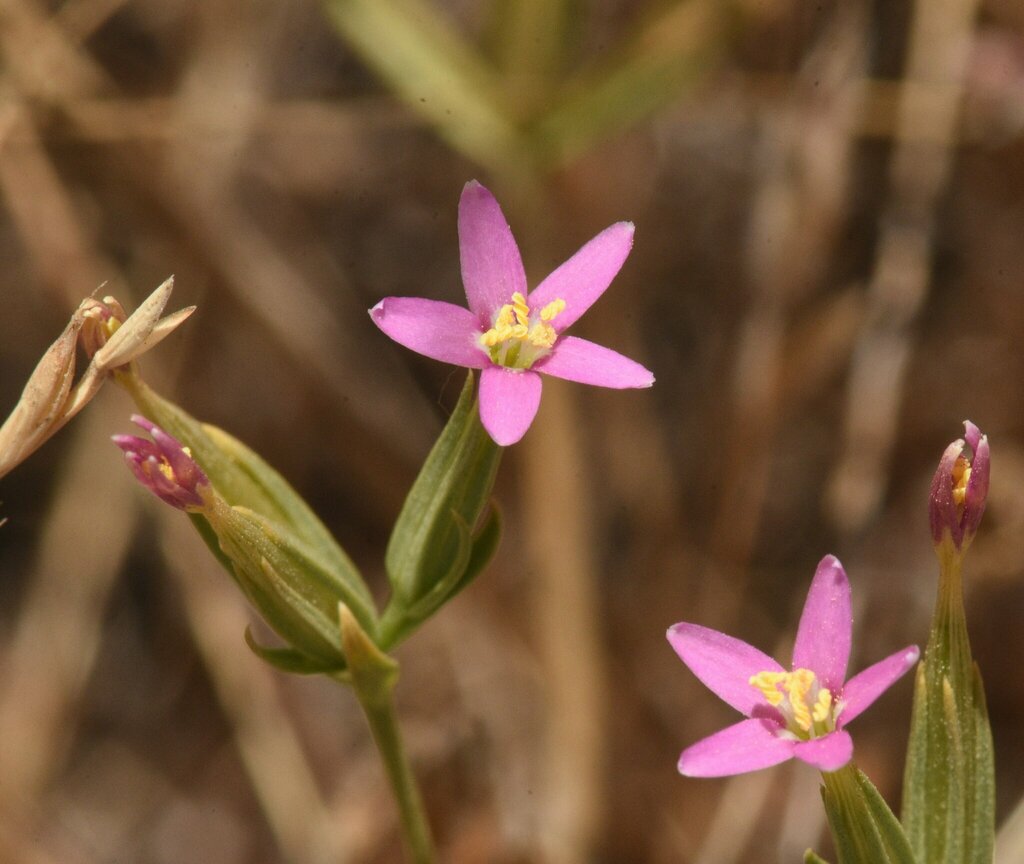
© Joe MDO (CC BY-NC) (iNat ob. 226058090)
Z. muehlenbergii Type B showing faint or streaked eye, Capital District, British Columbia
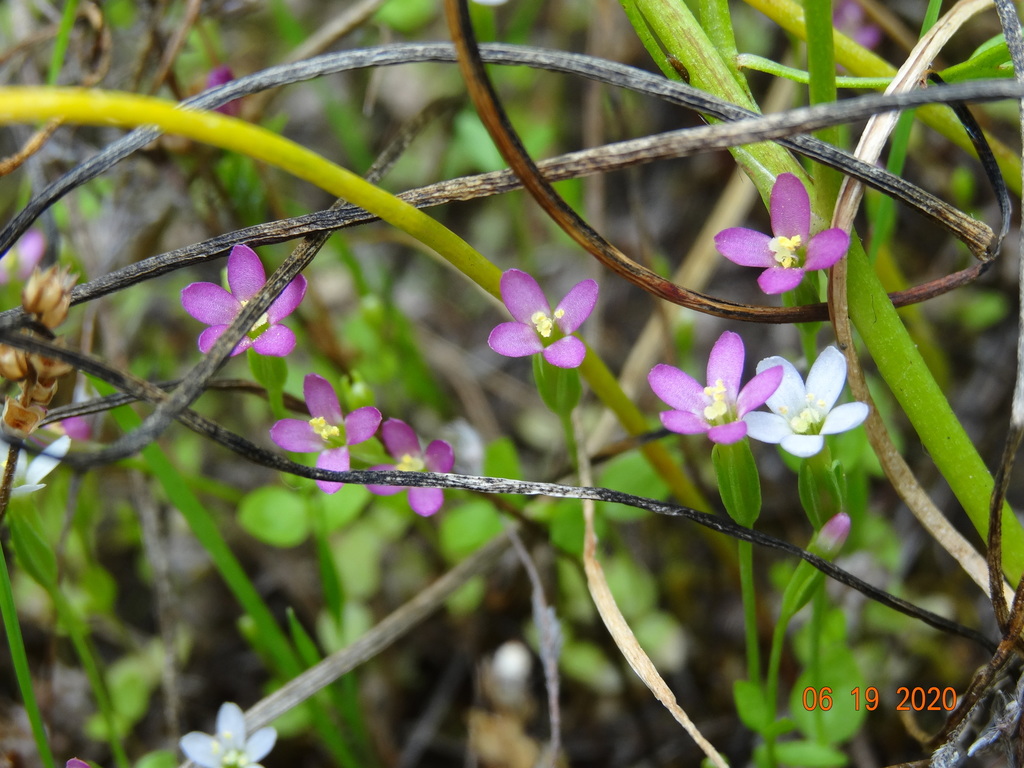
© Dan Tucker (CC BY-NC) (iNat ob. 50331884)
Corolla eye and orifice characteristics differentiating Z. muehlenbergii, Z. davyi and Centaurium sp. (illustrated further in Guide section):
- Z. muehlenbergii (A) - eye small, white, irregularly protruding, but distinct, into pigmented portion of corolla lobe; orifice usually open and angular
- Z. muehlenbergii (B) - eye variable, usually lightened or white laterally, sometimes dark centrally; orifice sometimes open but often more rounded than Type A
- Z. davyi - eye prominent, white; corolla orifice appearing variable
- Centaurium spp. - eye small white, distinct, often with three nebulous or sharp areas protruding into pigmented portion of corolla lobe; orifice constricted and rounded in C. tenuiflorum
Revisiting Research Grade observations
An examination of research grade specimens after I had identified the set of possible Z. muehlenbergii seems to indicate that, outside of British Columbia, most observations of Z. muehlenbergii were likely in fact Centaurium species, and most likely C. tenuiflorum. In July of 2024 there were approximately 530 research grade observations of Z. muehlenbergii (iNaturalist community 2024), though that number has decreased to 453 as of April 2025 (iNaturalist community 2025) as some identifiers have withdrawn their identifications. A smaller set from 2025 is also available from GBIF (GBIF 2025). I looked at a random sample of 100 of the original 530. Only 3 could be at least tentatively identified as Z. muehlenbergii based on my concept of the species at the time. The remaining 97 were likely C. tenuiflorum, but most would probably be identified to Centaurium due to uncertainty about differentiating C. tenuiflorum and C. erythraea. A small percentage would only be identified to subtribe since distinguishing features may not be visible. In another comparison, of the approximately 100 possible Z. muehlenbergii I found, only 27 were research grade as Z. muehlenbergii, and most of those were on Vancouver Island. It appeared for the most part that people had been misidentifying species of Centaurium (likely mostly C. tenuiflorum) as the apparently uncommon Z. muehlenbergii. Basically, it seemed that, outside of Vancouver Island, when people think of Z. muehlenbergii, they are probably picturing Centaurium. In fact, the default photo for the taxon (A. Kern, photo 14358094, iNat Ob. 10352116) is actually C. tenuiflorum, though that will likely change in the near future.Guide to differentiating species
The following section provides a guide for differentiating Z. muehlenbergii, Z. davyi, C. tenuiflorum, and to a lesser extent C. erythraea. As the open flowers are most prevalent in photos on iNaturalist, that is the primary focus. However, the calyx lobes (including keels), stigmas and pedicels are also discussed as they can also be helpful in some cases.Corolla color pattern and orifice
As introduced earlier, two aspects of the corolla can be helpful to differentiate live specimens, the corolla color pattern and corolla orifice. Neither of these aspects are well documented, likely because they are not preserved in herbarium specimens (see McDaniel 2025 for discussion of the corolla eye in Zeltnera). The differences in the color pattern typically concern the base of the corolla lobes. Sometimes there is a clearly white area, extending from the throat, and this differently colored region at the center of the flower is called an eye, which may vary in size or outline. Sometimes there are other patterns. These differences, though often somewhat irregular, can be consistent enough to be useful for differentiation of some species. The color of Zeltnera corolla lobes has been described as ranging from magenta to rose pink (Mansion 2004) or pink to rose-violet (Pringle 2023b), and may also include all white lobes in many species. Centaurium are often similarly colored. Z. muehlenbergii appears to have two different general patterns, which I have split into types A and B as discussed earlier and below. Centaurium in North America appear to have small, variously shaped white eyes while Z. davyi has a prominent white eye. These are described in detail in the table and subsections below.The second difference in the appearance of the corollas is the appearance of the corolla orifice, which can differ likely due to the structure of the corolla tube and how it transitions to the lobes, which was noted by Pringle (2010) mostly in relation to Z. muehlenbergii and Z. davyi. In Z. muehlenbergii there is only a very gradual widening from the narrow point in the corolla tube to the lobes, so that the orifice occurs at the abrupt transition from the distal part of the tube to the lobes. As there are five lobes, the orifice often appears pentagonal, or square when there are only four, though visibility to the this phenomenon may be obscured with smaller specimens. However, in C. tenuiflorum the distal part of the tube flares open so that the constricted, circular part of the tube is visible, so that the orifice does indeed appear more constricted and circular. In comparison, the orifice of Z. muehlenbergii often appears more spacious. The tube of Z. davyi also flares distally but the appearance, rounded versus angular, seems more variable, perhaps affected by the larger eye. Though types A and B of Z. muehlenbergii seem to have slight differences in the appearance of the orifice, there may ultimately be no correlation.
| Taxon | Lobe Color Pattern | Orifice |
|---|---|---|
| Z. muehlenbergii(A) | Colored lobes with small white eye either barely protruding to the lobes or an oblong projection centrally at the base of the lobe | appearing spacious, outline pentagonal or square |
| Z. muehlenbergii(B) | Colored lobes with basal area laterally white or lightened, intersected by color and sometimes darkened at base, sometimes just diffusely white | appearing somewhat open, outline rounded or sometimes angular |
| Centaurium spp. | Colored lobes with small white eye consisting of some form of 3 prongs, either sharp or nebulous | appearing tight and rounded in C. tenuiflorum, less so in C. erythraea |
| Z. davyi | Colored lobes with prominent white eye, rounded pentagonal or star shaped | NA |
Z. muehlenbergii type A
Type A appears to have an irregular small white eye, but the border between white in the throat and base of the lobes is distinct compared with the colored distal part of the lobes. The orifice also appears spacious and angular, forming either a pentagon or square. Most observations of this type appear around the Bay area, in the south in Santa Clara county and in the north in Marin county around Mount Tamalpais. I am not knowledgeable about the local conditions, but they seem to appear in what may be at least slightly drier areas and also sometimes areas noted for serpentine (near trails called Serpentine trail or also hidden in populations of Z. trichantha further north).There are unfortunately few photos currently available that illustrate this feature without zooming in. One can do this by accessing the original photos on iNaturalist.
Z. muehlenbergii with very small white eye with distinct jagged border and spacious orifice, Alameda county, California
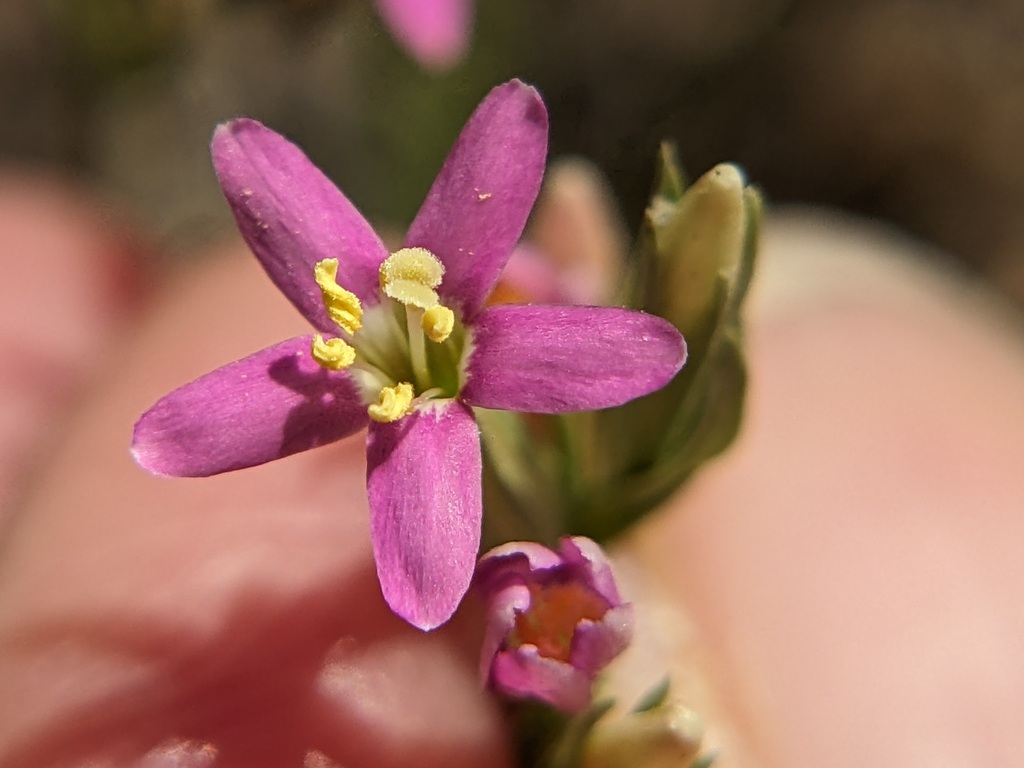
© Helen Hancock (CC BY-NC) (iNat Ob. 170202355)
Z. muehlenbergii with small white eye projecting into colored lobes (see large image here), Santa Clara county, California
© Joe MDO (CC BY-NC) (iNat Ob. 226058090)
Z. muehlenbergii with pentagonal corolla orifice, Marin county, California
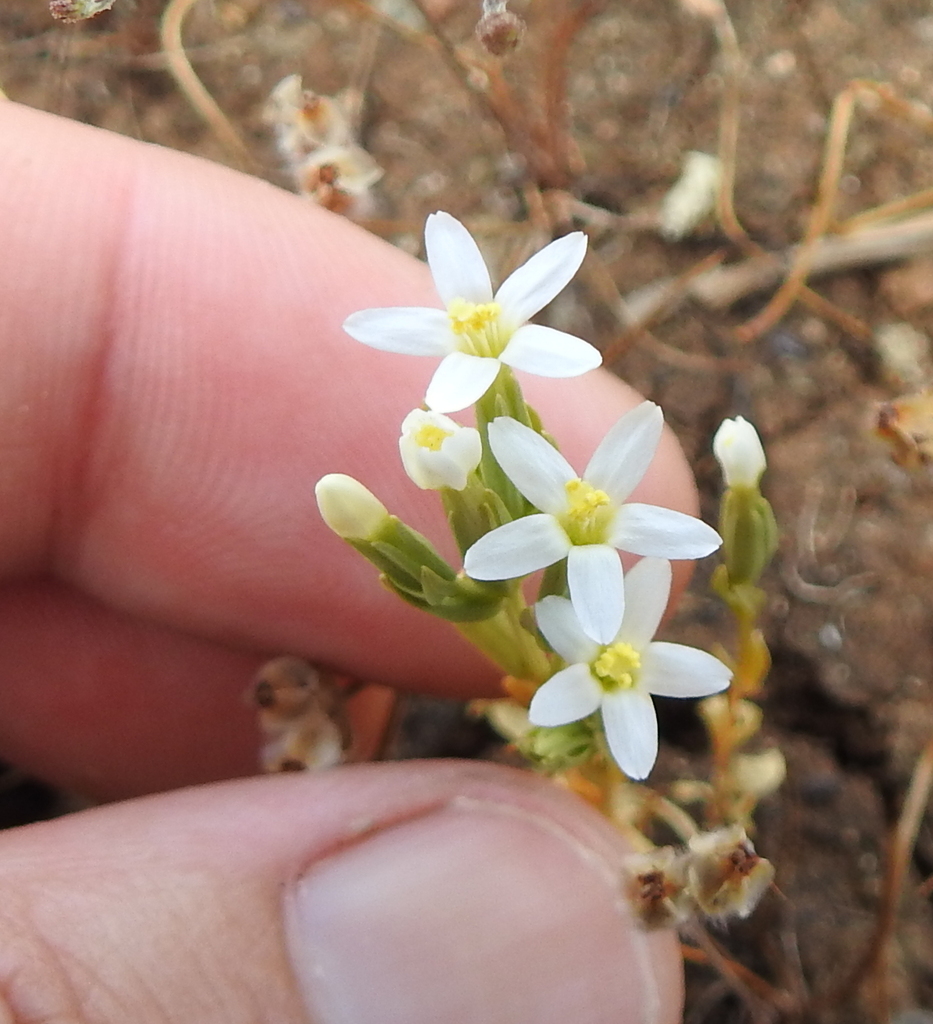
© Krissa Klein (CC BY-NC) (iNat Ob. 167484511)
Z. muehlenbergii type B
Type B seems to have more variation in the pigmentation pattern than Type A. The only pattern appears to be that the base of the corolla lobes is lighter laterally (or white) than centrally. The central part can vary from almost white to the same color as the distal parts of the lobe to noticeably darker at the base. This all seems to follow a pattern of being lighter laterally and darker centrally at the base of the lobes. The orifice in these specimens, though more spacious than in Centaurium species, appears a bit more rounded than in Type A. Most observations of this type currently are in the Capital District of British Columbia with sporadic occurrences in Oregon and mostly coastal California. They seem to occupy areas either known for being wet or even sandy areas. Pedicels, especially proximal ones, often appear quite long, though apparently consistent with early collections in Oregon and Washington often documented as being wet.Z. muehlenbergii lobes lightened laterally at base, Capital district, British Columbia
© Dan Tucker (CC BY-NC) (iNat Ob. 50331884)
Z. muehlenbergii lobes lightened laterally and darkened centrally at base, Marin county, California
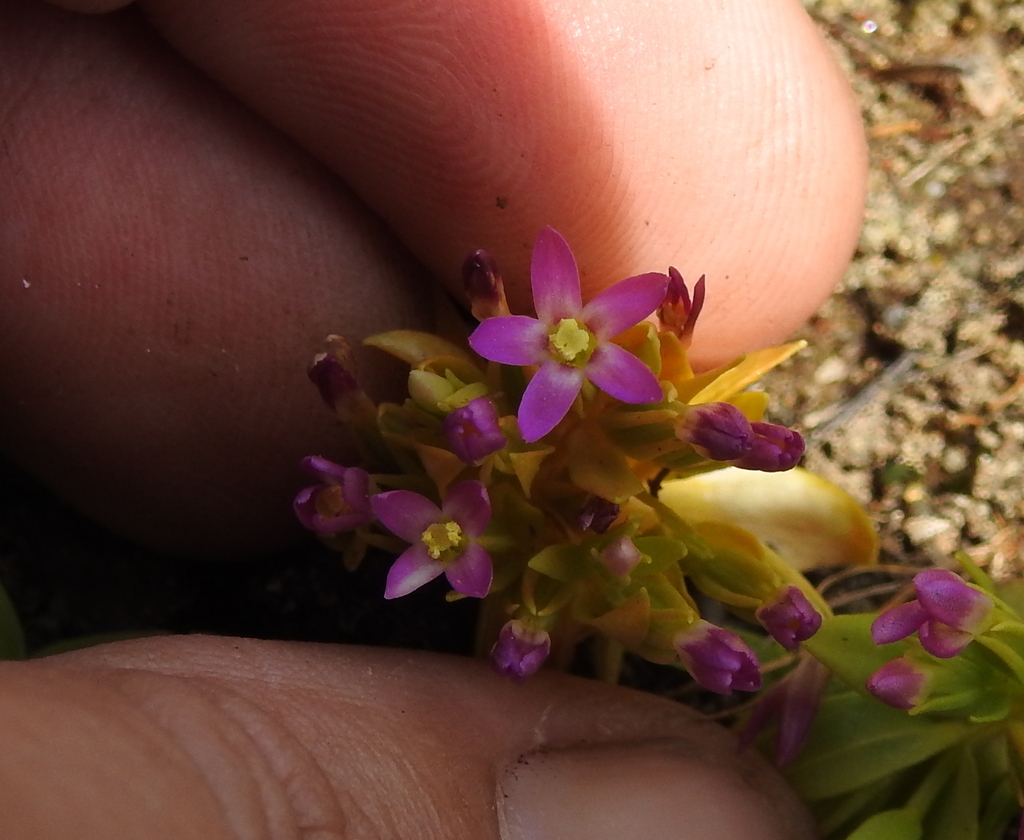
© Krissa Klein (CC BY-NC) (iNat Ob. 173368345)
C. tenuiflorum and C. erythraea
Centaurium specimens in North America reliably seem to have a small white eye. On each corolla lobe, the white pattern is usually some variation of being three pronged. In the case of C. tenuiflorum, the prongs tend to be more nebulous and irregular, often producing the appearance of a cog when viewed overall, but in some cases the prongs are more well defined and the appearance may be more pentagonal or star like. In Texas, some specimens have larger lateral prongs, which produces a different pattern. In C. erythraea and C. pulchellum, the prongs seem to be more defined, but this area needs more research. There may not be a reliable difference between the eyes of these Centaurium species to differentiate them on that basis.Differentiating C. tenuiflorum and C. eyrthraea from each other unfortunately relies on the presence or size of a basal rosette and the size of the corolla lobes (Pringle 2023a), two features which are rarely documented in iNaturalist observations. In my personal observations of C. tenuiflorum in Texas, I have sometimes found dried basal leaves that might be interpreted as a rosette, so it is unclear how to evaluate the sufficiency of the basal leaves even when they are present. The corollas of C. erythraea often do appear larger in photographs, with the lobes overlapping to some degree, but without measurements it is again difficult to determine where the border is. There may yet be more definitive visual cues to help differentiate these species, but I have not yet encountered them. On iNaturalist, it is likely the C. erythraea is restricted to more northerly areas such as the far north of California, Oregon, Washington, and British Columbia. C. tenuiflorum is likely more common in California around the Bay Area and Sacramento Valley, but many Centaurium specimens from Oregon often seem to appear quite similar and probably cannot be identified to species without closer examination.
Specimens of C. tenuiflorum also typically have a more narrow, rounded orifice than in Z. muehlenbergii. This is probably accentuated in most photos since that part of the tube is typically in shadow. This seems to less often be the case in C. erythraea perhaps due to differences in the openness of throat, but the eye is still present. In C. erythraea, the shape of the throat is often interrupted by visibility of the stamen filaments attaching to the corolla tube.
C. tenuiflorum with small, rounded, orifice and nebulous 3 pronged eye
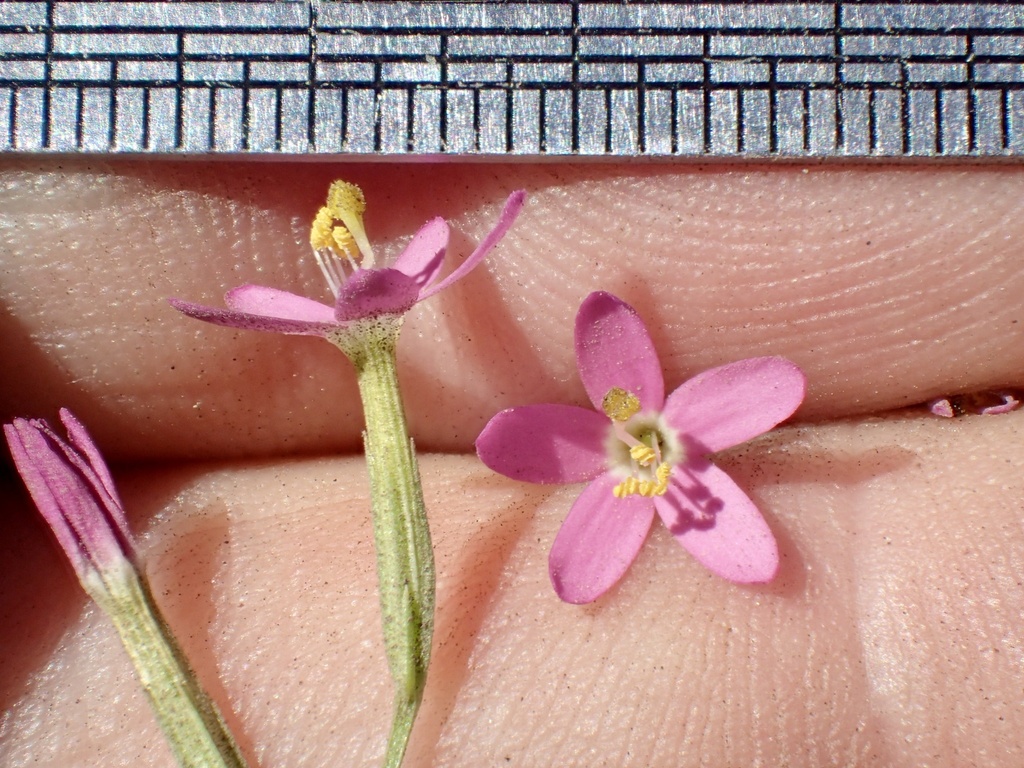
© Ron Vanderhoff (CC BY-NC) (iNat Ob. 226338560)
C. tenuiflorum with small, rounded, orifice and nebulous 3 pronged eye
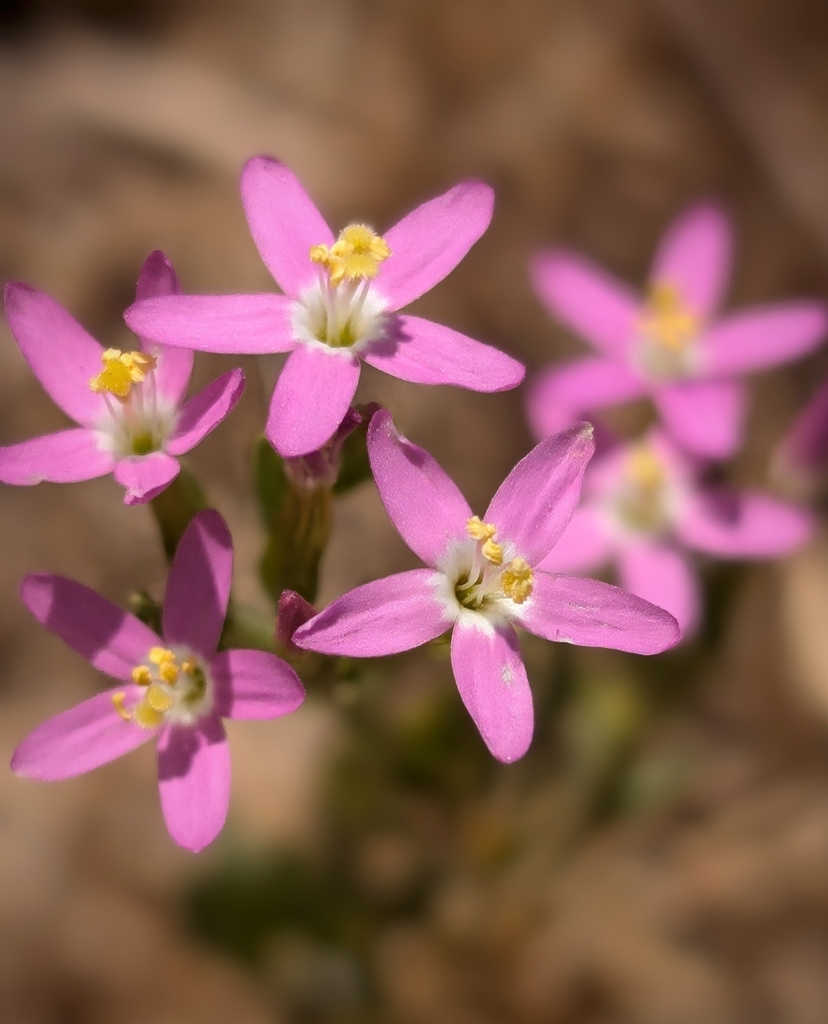
© Erica Fleniken (CC BY-NC) (iNat Ob. 223892634)
C. erythraea, Douglas county, Oregon
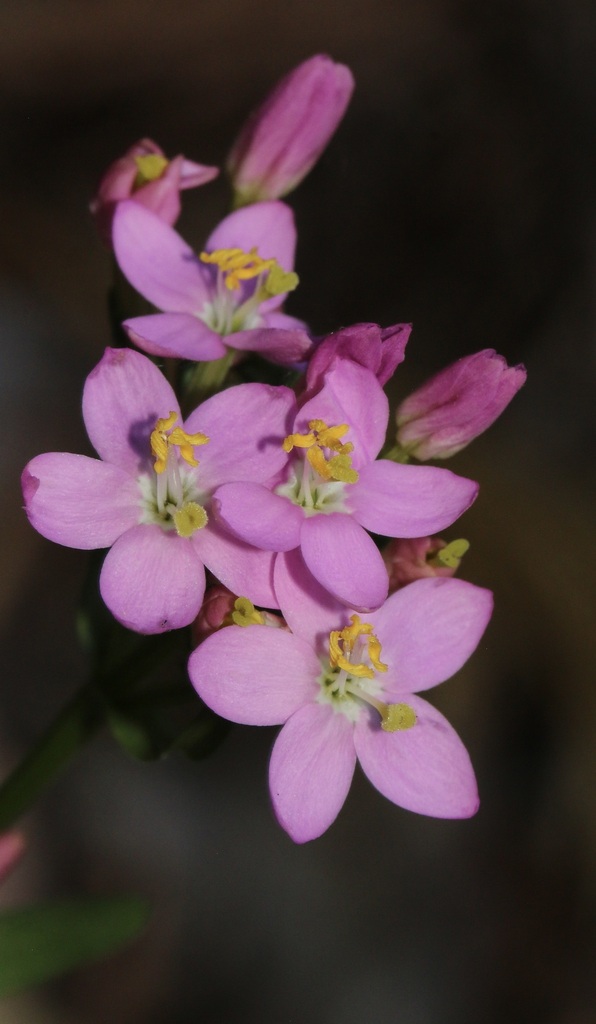
© Morgan Stickrod (CC BY-NC) (iNat Ob. 171270264)
Z. davyi
As I discussed recently (McDaniel 2025), Z. davyi likely contains a prominent white eye, which appears to have gone undocumented and can be used to distinguish it from Z. muehlenbergii. Though this still needs to be proven with live specimens, I am confident that this feature is present most of the time. The appearance of the orifice seems to vary somewhat in Z. davyi, but it is less important given the presence of the eye.Z. davyi corolla with prominent eye, Monterey county, California
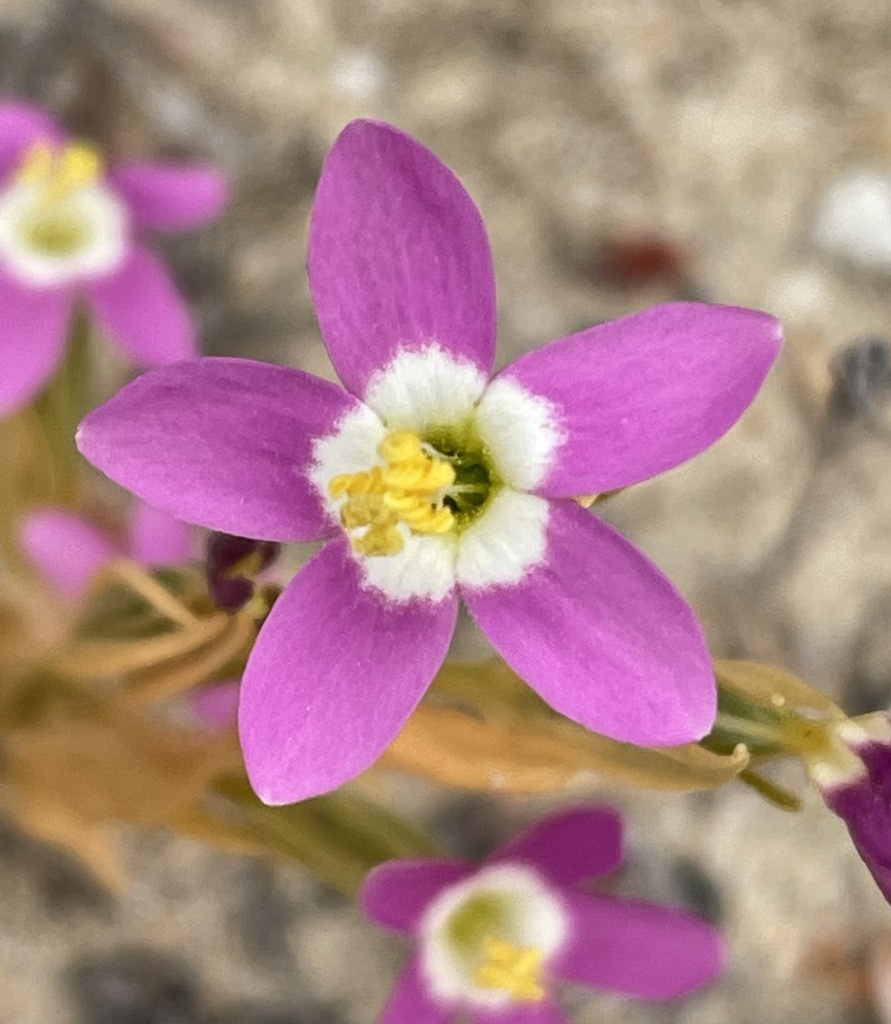
by Irene (aparrot1) (iNat Ob. 118970955)
Z. davyi corollas with prominent eye, San Luis Obispo county, California
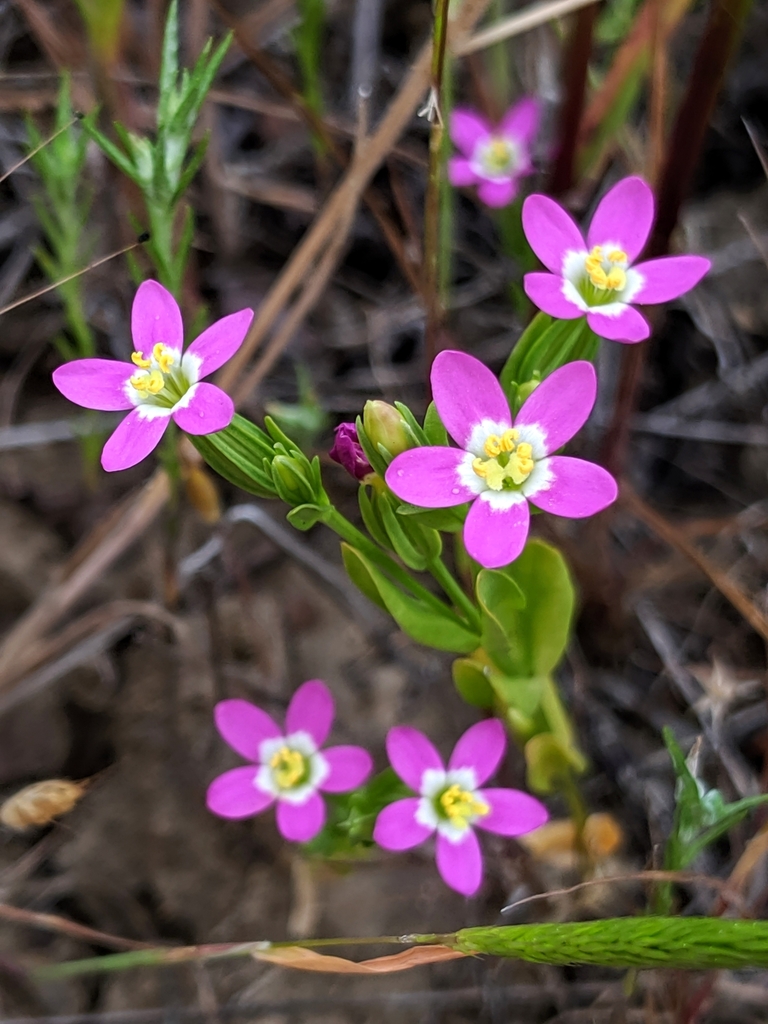
by Alex Heyman (iNat Ob. 24891586)
Calyx Lobes and Keels
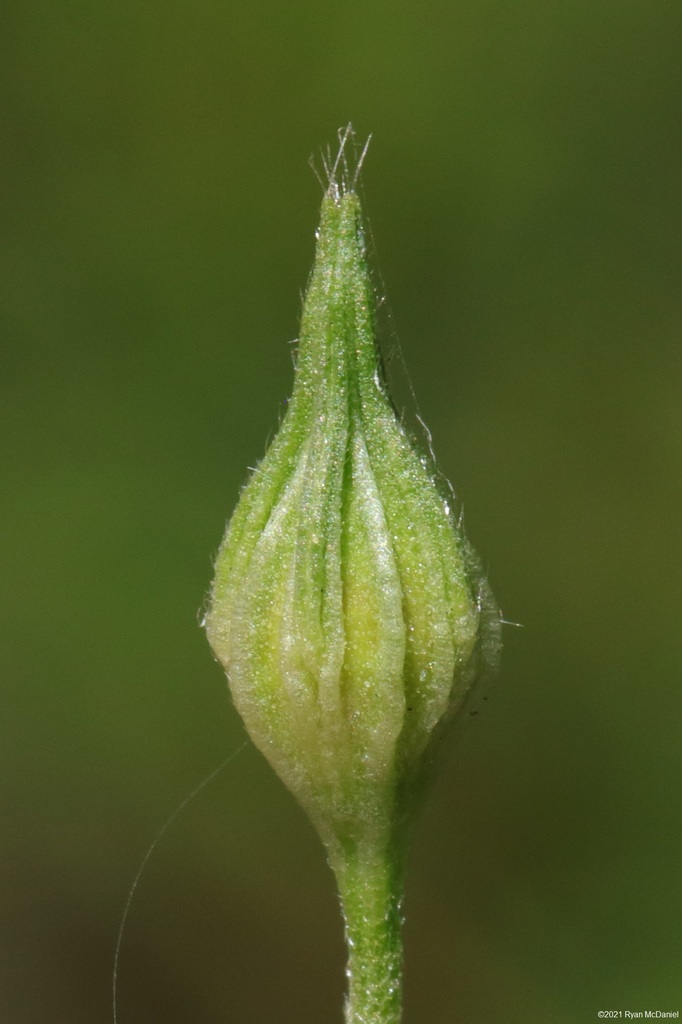
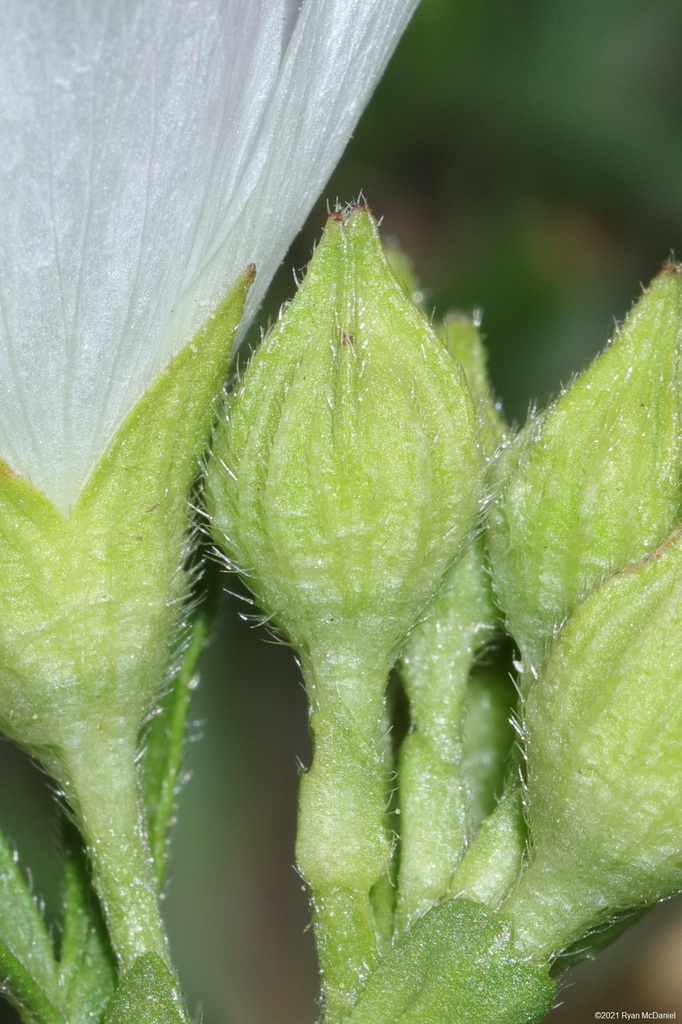
In photographs, the calyx lobes can be helpful for distinguishing Z. muehlenbergii from Centaurium, but not as useful for distinguishing Z. muehlenbergii from Z. davyi. While Pringle (2010) does provide a description of the differences of the calyx lobes between Z. muehlenbergii and C. tenuiflorum, some aspects of the descriptions seem self contradictory and others seem to contradict the drawings that were provided, so it is unclear what exactly is trying to be expressed. For example, he describes the calyx lobes of C. tenuiflorum both as acicular and tapering gradually from the base, which seems contradictory unless acicular is being used in fashion I would not expect. The drawing seems to be more acicular (needle-shaped), whereas photos I have taken (see below) seem to be consistent with tapering from the base.Regardless of the exact meaning of Pringle's descriptions, the calyx lobes do appear different in photos, if only subtlely so. In Z. muehlenbergii, the calyx lobes appear conspicuous, often covering much of the corolla tube, probably ridged or triangular in cross section or terete for really small specimens. In C. tenuiflorum, the calyx lobes are usually fairly inconspicuous, often difficult to separate from the tube, and likely more flat in cross section, though I have seen exceptions. It is possible that these differences are not preserved well in pressed specimens.
Z. muehlenbergii calyx lobes, Contra Costa county, California
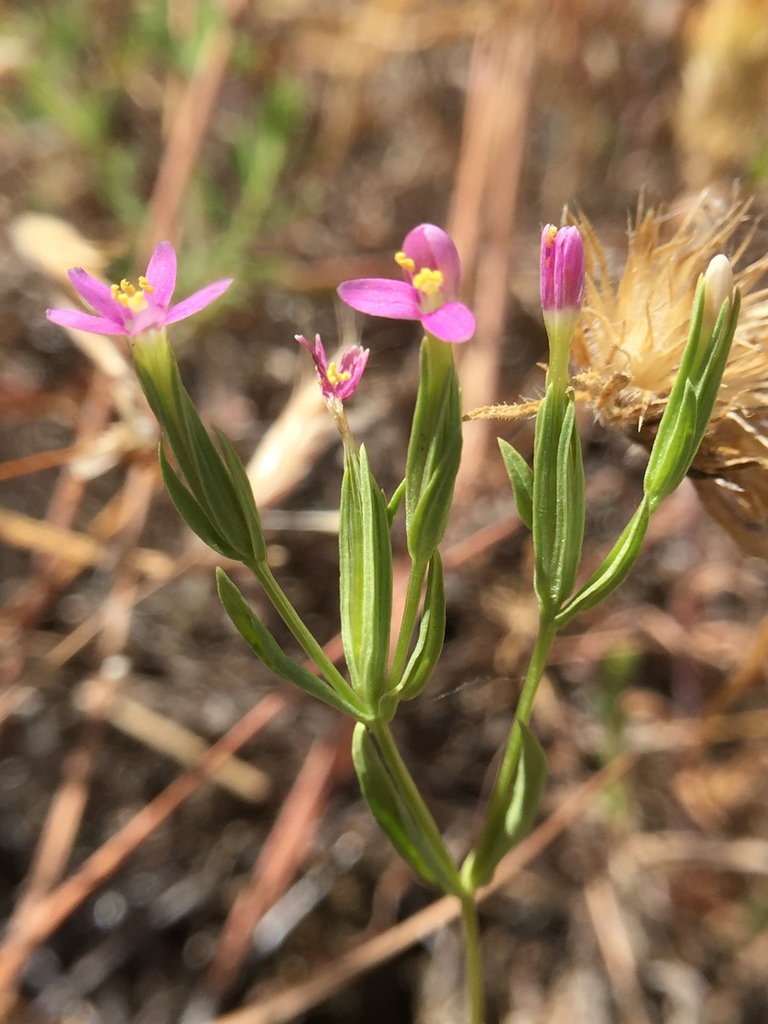
© Steve Beatty (CC BY-NC) (iNat Ob. 49905958)
C. tenuiflorum calyx lobes, Williamson county, Texas
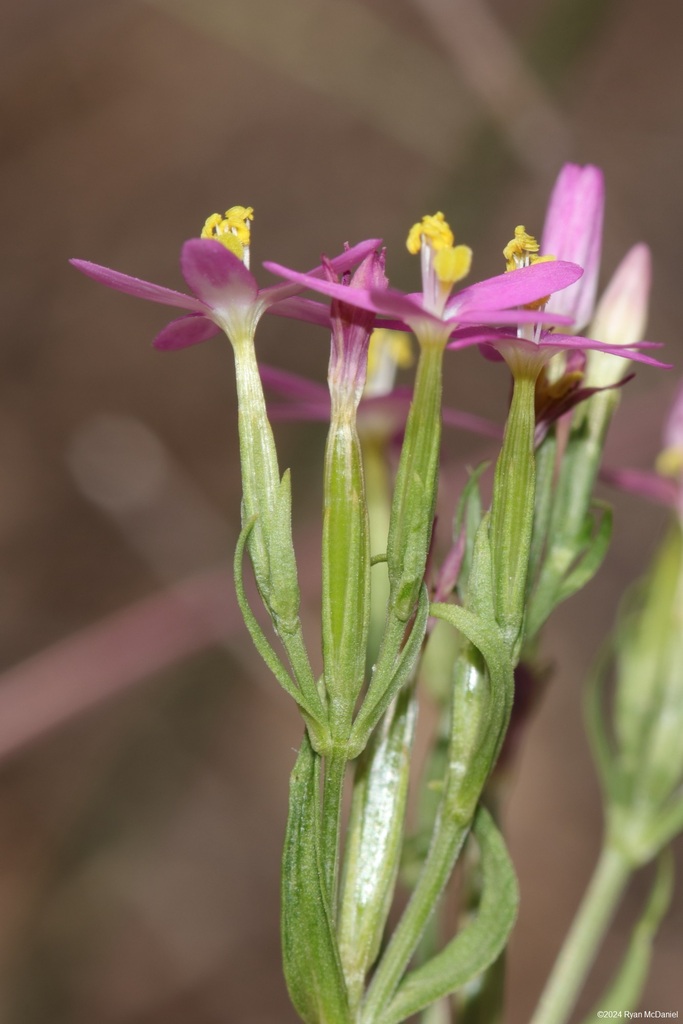
© Ryan McDaniel (All Rights Reserved) (iNat Ob. 238274255)
The calyx lobes are likely not as useful for distinguishing Z. muehlenbergii from Z. davyi, at least in photos, for several reasons. The first issue is that there are some discrepancies concerning keeled calyx lobes in accounts of both species. The most significant discrepancy is whether the calyx lobes of Z. muehlenbergii may actually be keeled or not. Pringle (2010) indicates that Z. muehlenbergii may sometimes have weakly developed keels, confined to the proximal part of the lobe, no greater than 0.25mm in width. However, Pringle (2023b), ommits this detail, and it is unknown if Pringle changed his opinion on Z. muehlenbergii or if it was left out for some other reason. Mansion (2004), while mentioning the keeled calyx lobes of Z. davyi, described those of Z. muehlenbergii as ridged, and it may be that there is just a very subtle difference when the keels are not as prominent. There were additional details and subtle discrepancies in Pringle's descriptions of Z. davyi. Pringle (2010) describes the keels as generally occurring for much of the lobe length and being 0.3-0.6mm wide, but that this may only apply to the outer calyx lobes. Pringle (2023b) slightly changes the description of the calyx lobes for Z. davyi, indicating they are keeled "proximally 0.3–0.6 mm wide", and ommits any differences between the inner and outer calyx lobes. Overall, these discrepancies leave the impression that Z. muehlenbergii may sometimes be more keeled than previously thought and Z. davyi may sometimes be less keeled, and that the line between the two may not be so distinct in borderline cases, especially when dealing sub millimeter differences. In practice, photos of the calyx lobes of Z. muehlenbergii sometimes do appear weakly keeled as in the photo above.
The second issue is that photographing the keels, even when present, is likely quite difficult, requiring the proper angle and lighting to highlight the change in width from the adaxial part of the lobe to the abaxial part. Though most photos of Z. davyi do show prominent calyx lobes, it is very difficult to discern whether the lobes are keeled or sharply ridged. The photo below, which is rare in that it actually shows a keeled calyx lobe, illustrates these difficulties. While one can see the keel on the central calyx lobe (running horizontally) due to shading, the feature is not necessarily discernible on other lobes of the same plant.
Z. davyi keeled calyx, San Mateo county, California
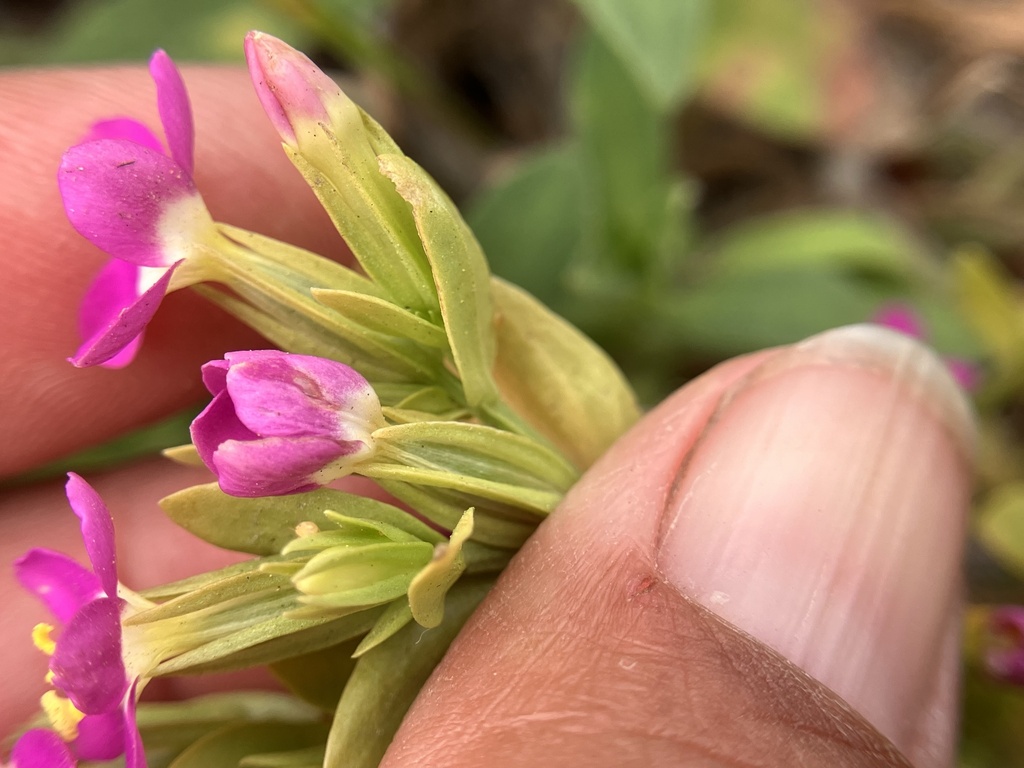
© Cat Chang (CC BY-NC) (iNat ob. 227902612)
Stigmas
One of the primary morphilogical differences between Zeltnera and Centaurium species is the stigma shape, as outlined in Mansion (2004). Though the drawings there do not include Z. muehlenbergii, Z. davyi or C. tenuiflorum, they do include similar species(e.g. C. erythraea) and general trends. Pringle (2010) provides line drawings of the stigma shape of Z. muehlenbergii and C. tenuiflorum, though Pringle (2012) mistakenly includes the drawings for both species under the drawing for Z. muehlenbergii (C. tenuiflorum on the left, Z. muehlenbergii on the right), perhaps a remnant from an earlier draft when the two species were considered conspecific. The drawings are of the abaxial side of the stigma lobe, when the stigma lobes are typically in a more erect, ascending position. The stigma of C. tenuiflorum is described as elliptic (Pringle 2023a) and Z. muehlenbergii fan shaped (Pringle 2023b).Unfortunately, photographing the stigma shape can be difficult because of the small size and specific perspective required to show the abaxial view. The small size usually requires equipment with macro capability or magnification. I use a 100mm macro lens on an APS-C format DSLR, but other equipment, including some more recent smart phone cameras, may be able to take photos sufficient for identification. Getting the right perspective usually requires handling and orienting the flower at a minimum. An additional complication is that on some specimens of Z. muehlenbergii the stigma lobes may barely exceed the corolla tube. While I have seen some photos of the stigma shape of C. tenuiflorum from California, captured either on accident or on purpose, I have yet to find a clear abaxial view of the one from Z. muehlenbergii. Therefore, I am providing a photo of one from Z. texensis, which appears similar to the line drawing found in Pringle(2010).
Z. texensis stigma lobe (abaxial view) perhaps similar to Z. muehlenbergii
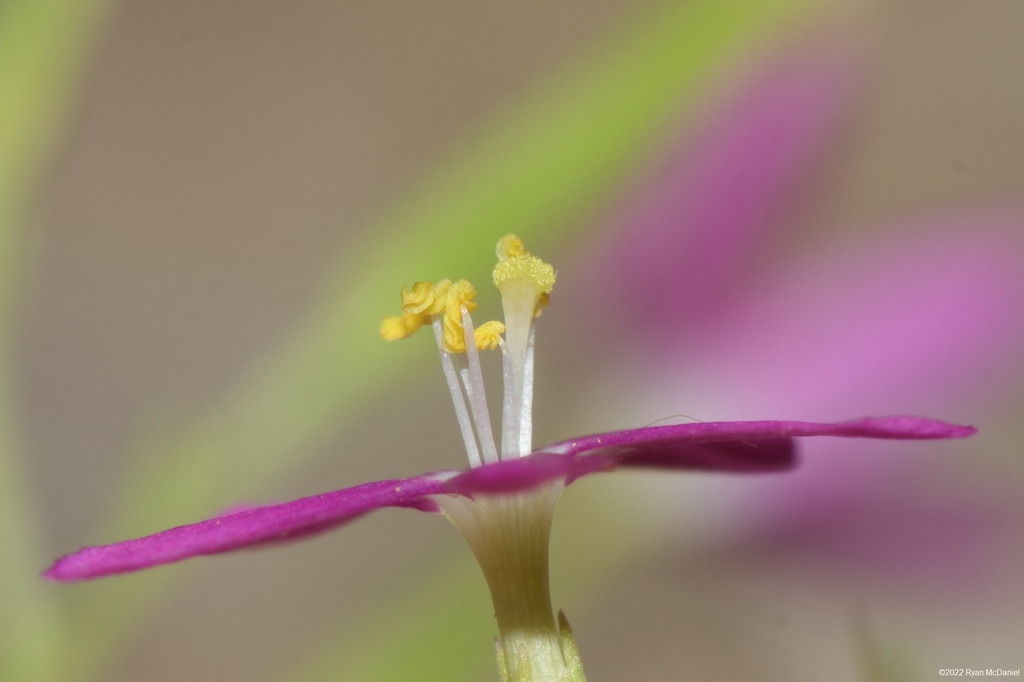
© Ryan McDaniel (All Rights Reserved) (iNat Ob. 118706199)
C. tenuiflorum stigma lobe (abaxial view)
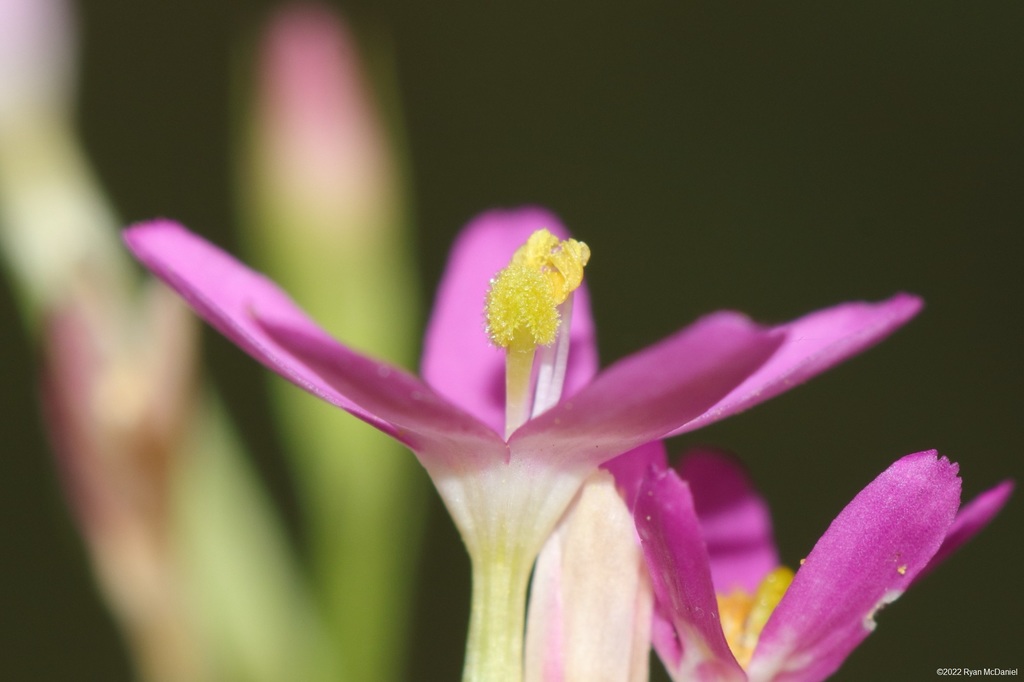
© Ryan McDaniel (All Rights Reserved) (iNat Ob. 119653908)
Z. muehlenbergii stigmas barely exceeding corolla orifice
© Dan Tucker (CC BY-NC) (iNat Ob. 50331884)
Another possible difference with the stigma lobes is that they may appear different in profile, though this is not documented. From some of the photos I have seen, it seems likely that the stigma lobes of both Z. davyi and Z. muehlenbergii may appear club shaped in profile, with the stigmatic surface oriented mostly upward on the dorsal surface, similarly to that of Z. calycosa shown below. In contrast, the stigmatic surface in C. tenuiflorum drapes down around the edges, giving the impression of being more like an arrow head.
Z. calycosa stigma lobe (profile view) perhaps similar to Z. davyi and Z. muehlenbergii
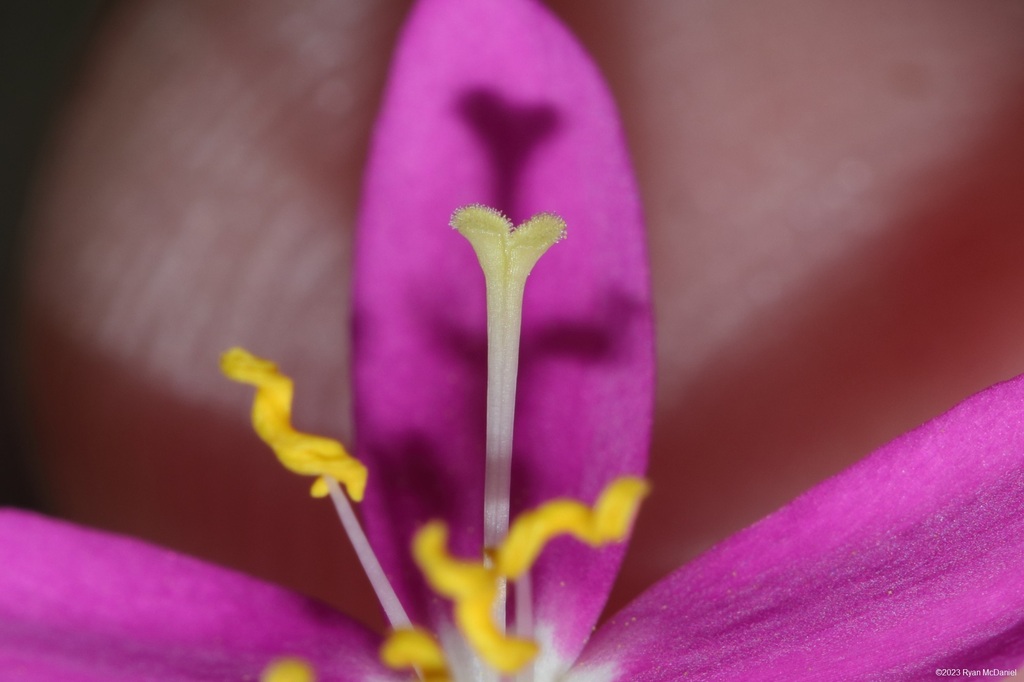
© Ryan McDaniel (All Rights Reserved) (iNat Ob. 168399955)
Z. muehlenbergii stigma from an angle, suggesting club shape
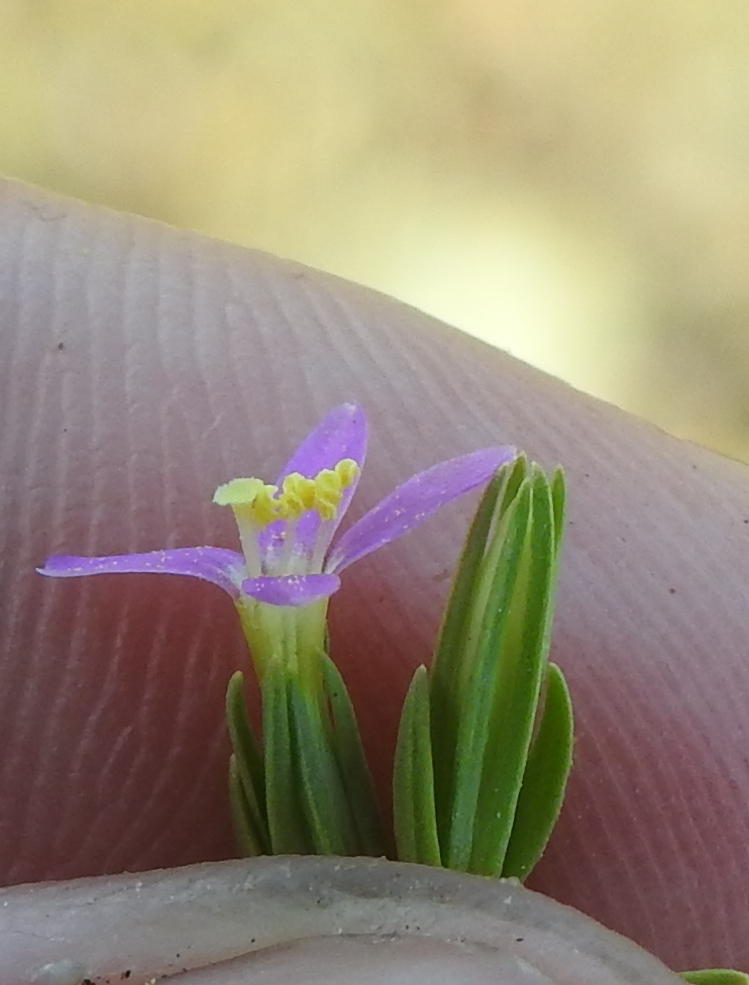
© Krissa Klein (CC BY-NC) (iNat Ob. 167483440)
C. tenuiflorum appressed stigma lobes
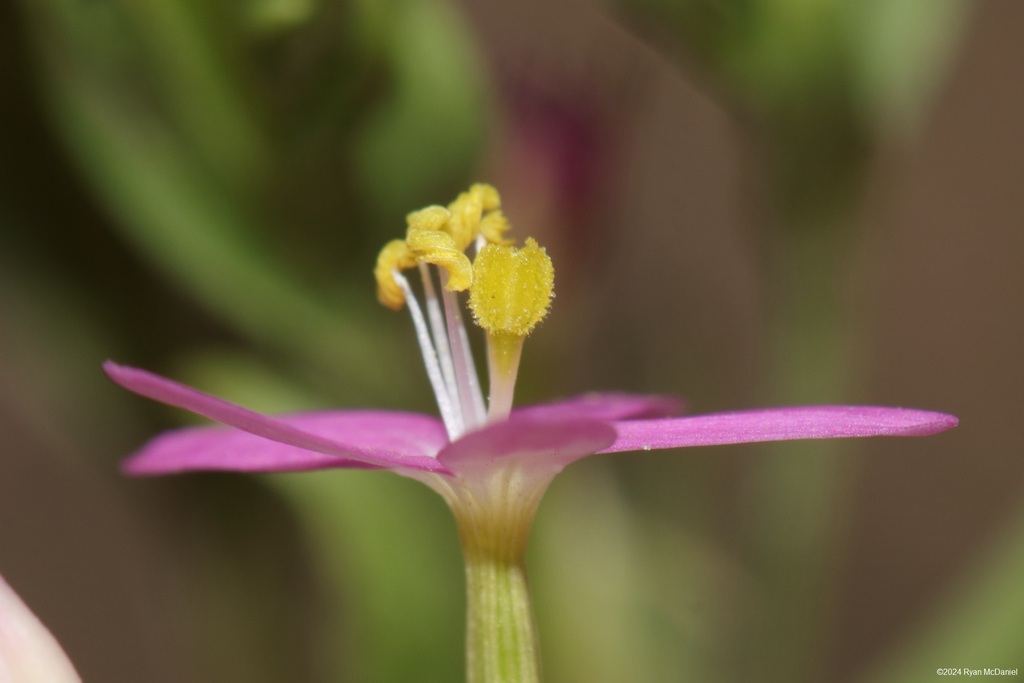
© Ryan McDaniel (All Rights Reserved) (iNat Ob. 238274255)
C. tenuiflorum separated stigma lobes and styles
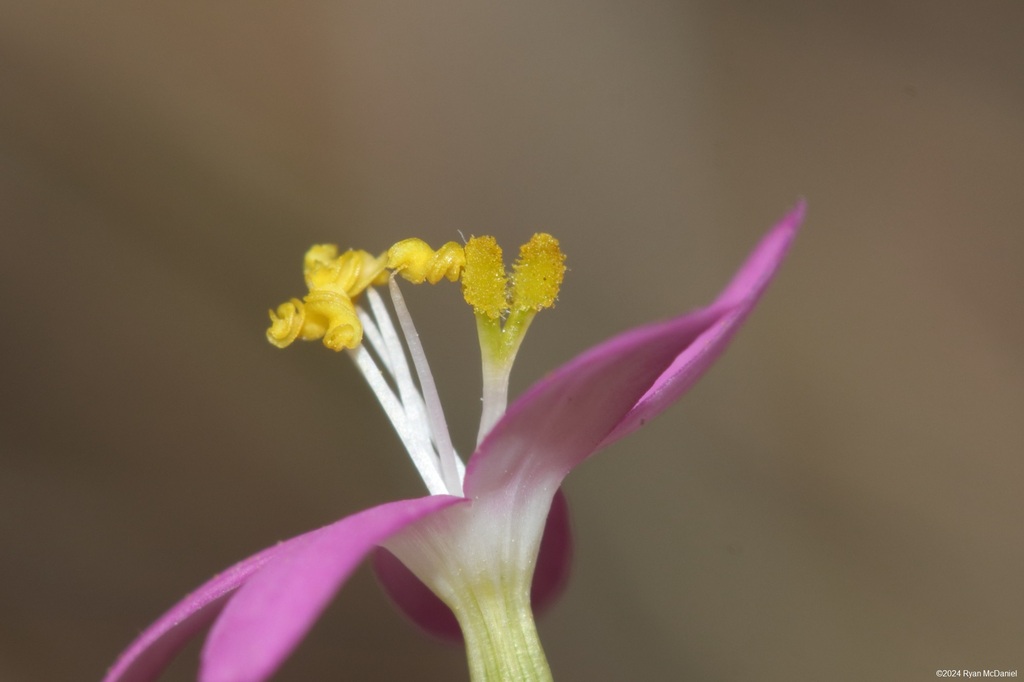
© Ryan McDaniel (All Rights Reserved) (iNat Ob. 238275714)
Though both Mansion (2004) and Pringle (2010) note differences in the degree of division of the styles as a possible differentiating feature, the above photos of C. tenuiflorum show the possible difficulties with using that chacteristic. The stigma lobes are often appressed and in this state it is difficult to discern if the styles are divided or not.
Pedicels
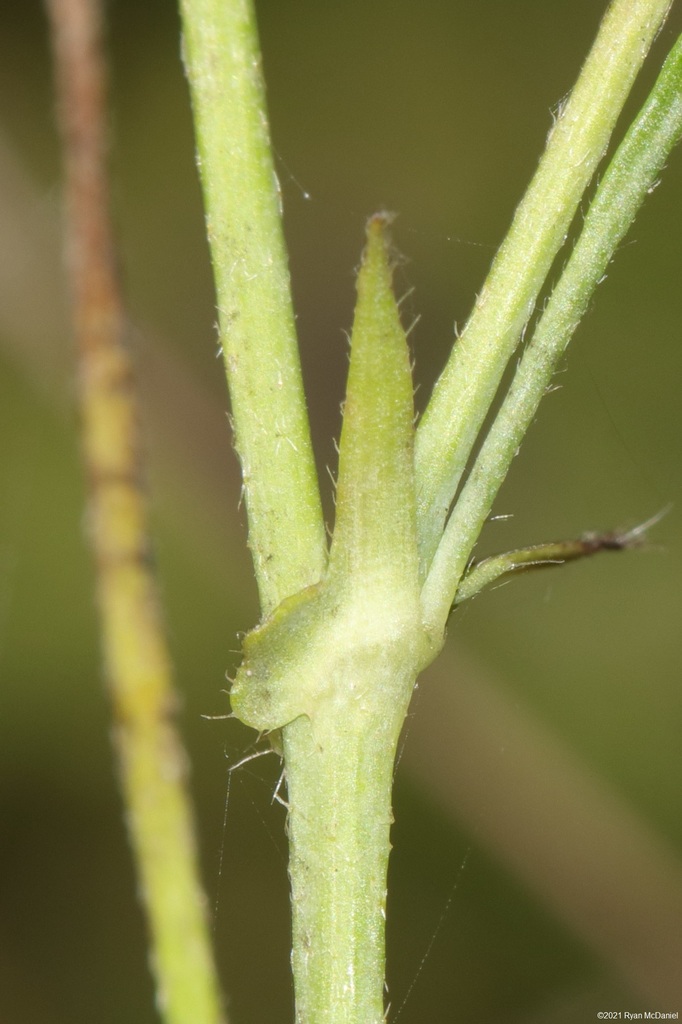
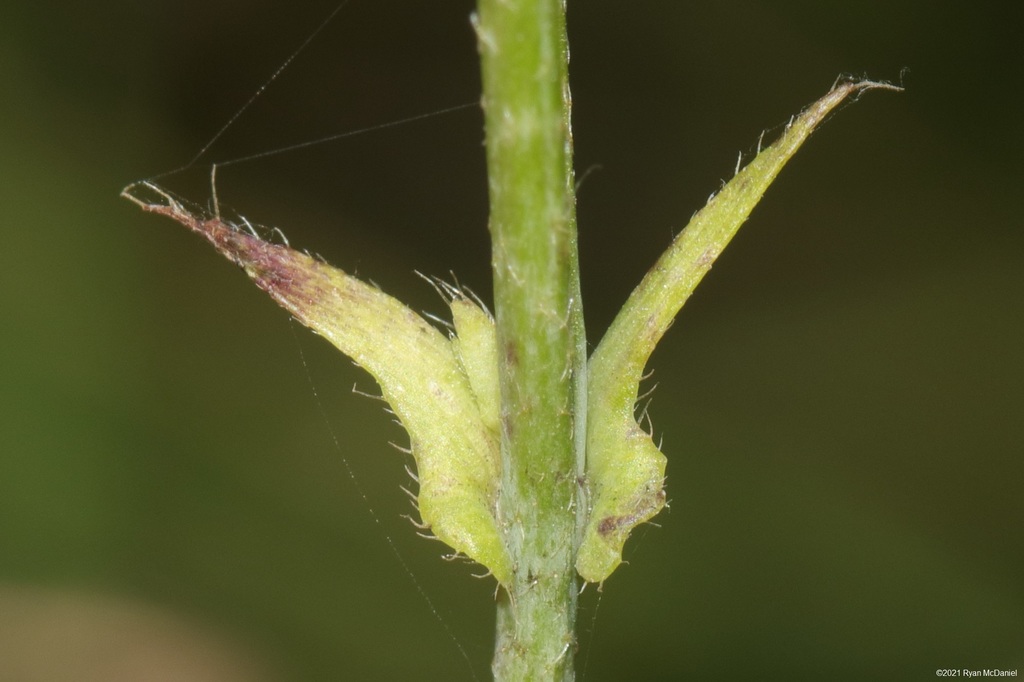
Pedicel length can sometimes be a helpful feature if it can be determined reliably. One issue with determining pedicel length is that sometimes small bracts subtending the calyx can be mistaken for calyx lobes, and when this happens branches can be misinterpreted as longer pedicels. This is especially problematic with C. tenuiflorum, which often has only a singular bract that blends in with the calyx due to proximity and similar size. Additionally, sometimes, as there may be only one, they may be obscured by the stem itself. However, if one can safely determine that there are longer pedicels (greater than 2mm) on the plant, then C. tenuiflorum and C. erythraea can be ruled out as possibilities.Using the pedicels to differentiate Z. muehlenbergii and Z. davyi can be difficult as usually one needs to establish the general trend rather than simply looking at one pedicel as both species can have relatively short pedicels and somewhat longer ones. Most observations rarely show more than a single one clearly.
List of likely Zeltnera muehlenbergii observations
The following is a list of around 100 likely Z. muehlenbergii observations as February 2025. Some may not have enough information for a species level identification.| iNat ID | State | County/District |
|---|---|---|
| 47317284 | British Columbia | Capital |
| 50331884 | British Columbia | Capital |
| 50479832 | British Columbia | Capital |
| 51522796 | British Columbia | Capital |
| 51522815 | British Columbia | Capital |
| 51702230 | British Columbia | Capital |
| 51702235 | British Columbia | Capital |
| 51763760 | British Columbia | Capital |
| 52532798 | British Columbia | Capital |
| 53011427 | British Columbia | Capital |
| 125735529 | British Columbia | Capital |
| 125735530 | British Columbia | Capital |
| 125914770 | British Columbia | Capital |
| 165438746 | British Columbia | Capital |
| 169468753 | British Columbia | Capital |
| 191019535 | British Columbia | Capital |
| 224948059 | British Columbia | Capital |
| 224948066 | British Columbia | Capital |
| 225097880 | British Columbia | Capital |
| 225097959 | British Columbia | Capital |
| 225112111 | British Columbia | Capital |
| 226035262 | British Columbia | Capital |
| 232078053 | British Columbia | Capital |
| 81333390 | British Columbia | Nanaimo |
| 81333393 | British Columbia | Nanaimo |
| 226595322 | British Columbia | Nanaimo |
| 170202355 | California | Alameda |
| 172236450 | California | Colusa |
| 49905958 | California | Contra Costa |
| 220969848 | California | Contra Costa |
| 26447706 | California | Lake |
| 169619161 | California | Lake |
| 1428758 | California | Marin |
| 3689410 | California | Marin |
| 6952045 | California | Marin |
| 28851716 | California | Marin |
| 29692736 | California | Marin |
| 48853399 | California | Marin |
| 51979621 | California | Marin |
| 80696130 | California | Marin |
| 81808246 | California | Marin |
| 83908760 | California | Marin |
| 85202915 | California | Marin |
| 112734244 | California | Marin |
| 112843231 | California | Marin |
| 118283065 | California | Marin |
| 167483440 | California | Marin |
| 167484511 | California | Marin |
| 168699150 | California | Marin |
| 171329527 | California | Marin |
| 173116824 | California | Marin |
| 173368345 | California | Marin |
| 180398634 | California | Marin |
| 222138030 | California | Marin |
| 230018760 | California | Marin |
| 225212437 | California | Mendocino |
| 228410903 | California | Modoc |
| 178907160 | California | Monterey |
| 167640967 | California | Napa |
| 158984218 | California | Sacramento |
| 120104459 | California | San Benito |
| 27477275 | California | San Luis Obispo |
| 29678896 | California | San Luis Obispo |
| 48923562 | California | San Luis Obispo |
| 225589971 | California | San Luis Obispo |
| 6412484 | California | San Mateo |
| 51636780 | California | San Mateo |
| 164358220 | California | San Mateo |
| 168085147 | California | San Mateo |
| 220765251 | California | San Mateo |
| 223270062 | California | San Mateo |
| 27195395 | California | Santa Clara |
| 27294255 | California | Santa Clara |
| 163928042 | California | Santa Clara |
| 166117585 | California | Santa Clara |
| 168210143 | California | Santa Clara |
| 171274683 | California | Santa Clara |
| 178955957 | California | Santa Clara |
| 221029742 | California | Santa Clara |
| 221202496 | California | Santa Clara |
| 222680887 | California | Santa Clara |
| 226058090 | California | Santa Clara |
| 226066237 | California | Santa Clara |
| 3150046 | California | Santa Cruz |
| 3293061 | California | Santa Cruz |
| 6791568 | California | Santa Cruz |
| 12941949 | California | Santa Cruz |
| 47234072 | California | Santa Cruz |
| 47358361 | California | Santa Cruz |
| 50300534 | California | Santa Cruz |
| 119487187 | California | Santa Cruz |
| 169528011 | California | Santa Cruz |
| 221658101 | California | Santa Cruz |
| 221751755 | California | Santa Cruz |
| 12700723 | California | Sonoma |
| 47548217 | California | Sonoma |
| 165235896 | California | Sonoma |
| 219667177 | California | Sonoma |
| 216216116 | California | Tehama |
| 234047614 | Idaho | Owyhee |
| 222566425 | Oregon | Columbia |
| 1640104 | Oregon | Coos |
| 224086462 | Oregon | Josephine |
| 225779623 | Oregon | Josephine |
| 227139720 | Oregon | Josephine |
| 124135889 | Oregon | Lane |
| 126752846 | Oregon | Lane |
| 225835132 | Oregon | Linn |
Moving Foward on iNaturalist
As of this publication (May 2025), I have not yet started changing identifications of most research grade specimens of Z. muehlenbergii, though I plan to start doing so soon after posting this. The default taxon photos of Z. muehlenbergii, which currently are actually C. tenuiflorum, also will need to be changed. As most current observations of Z. muehlenbergii are actually Centaurium, this may result in removal of Z. muehlenbergii from the iNaturalist computer vision model at some point in the near future until enough observations are accumulated to add it back in, which is at least partly why I have included the above list of likely observations so that others my also participate in identification.It is also my hope that this post will enable observers to better document these taxa in the future, hopefully providing further evidence as to whether the observations treated here as Z. muehlenbergii are in fact that taxon or whether they may represent more than one taxon. The west coast of North America is unfortunately a long way from Texas, so I don't know if I will be able to document these species or not myself.
This post may be revised in the future as needed.
Copyright
Unless otherwise noted, text and photos used in this post are the property of Ryan McDaniel, all rights reserved. Thank you to all those who have observed these taxa and whose photos I have used in the post.| iNaturalist Photo | iNaturalist Observation | Description | Creator/Copyright holder | Licence |
|---|---|---|---|---|
| 400861188 | 226058090 | Z. muehlenbergii showing more jagged stark eye, Santa Clara county, California | Joe MDO (joemdo) | CC BY-NC |
| 79872047 | 50331884 |
Z. muehlenbergii showing faint or streaked eye, Capital District, British Columbia; Z. muehlenbergii stigmas barely exceeding corolla orifice |
Dan Tucker (dbltucker) | CC BY-NC |
| 295168890 | 170202355 | Z. muehlenbergii with distinct jagged border and spacious orifice, Alameda county, California | Helen Hancock (helenh) | CC BY-NC |
| 290145407 | 167484511 | Z. muehlenbergii corolla orifice, Marin county, California | Krissa Klein (graysquirrel) | CC BY-NC |
| 401401076 | 226338560 | C. tenuiflorum with small, rounded, orifice and nebulous 3 pronged eye | Ron Vanderhoff (ronvanderhoff) | CC BY-NC |
| 396754300 | 223892634 |
C. tenuiflorum with small, rounded, orifice and nebulous 3 pronged eye |
Erica Fleniken (ericalsf) | CC BY-NC |
| 297176554 | 171270264 | C. erythraea, Douglas county, Oregon | Morgan Stickrod (morganstickrod) | CC BY-NC |
| 201068337 | 118970955 | Z. davyi corolla with prominent eye | Irene (aparrot1) | No rights reserved |
| 38503346 | 24891586 | Z. davyi corollas with prominent eye | Alex Heyman (arheyman01) | No rights reserved |
| 79237160 | 49905958 | Z. muehlenbergii calyx lobes | Steve Beatty (steve-beatty) | CC BY-NC |
| 424183073 | 238274255 | C. tenuiflorum calyx lobes | Ryan McDaniel (rymcdaniel) | All Rights Reserved |
| 404357447 | 227902612 | Z. davyi calyx keels | Cat Chang (catchang) | CC BY-NC |
| 200593025 | 118706199 | Zeltnera texensis stigma abaxial view | Ryan McDaniel (rymcdaniel) | All Rights Reserved |
| 202295989 | 119653908 | Centaurium tenuiflorum stigma abaxial view | Ryan McDaniel (rymcdaniel) | All Rights Reserved |
| 291839238 | 168399955 | Z. calycosa stigma lobe (profile view) | Ryan McDaniel (rymcdaniel) | All Rights Reserved |
| 290143690 | 167483440 | Zeltnera muehlenbergii stigma from an angle | Krissa Klein (graysquirrel) | CC BY-NC |
| 424182640 | 238274255 | C. tenuiflorum appressed stigma lobes | Ryan McDaniel (rymcdaniel) | All Rights Reserved |
| 424185048 | 238275714 | C. tenuiflorum separated stigma lobes and styles | Ryan McDaniel (rymcdaniel) | All Rights Reserved |
References
Abrams, L. R. 1951. An Illustrated Flora of the Pacific States Washington, Oregon, and California, Vol 3. Gerianaceae to Scrophylariaceae/geraniums to figworts. Stanford University Press, Stanford, CA. https://doi.org/10.5962/bhl.title.4657.Bentham, G. 1839-?. Plantas Hartwegianas :imprimis mexicanas adjectis nonnullis Grahamianis enumerat novasque. G. Pamplin, London, U.K. https://doi.org/10.5962/bhl.title.437.
Broome, C. R. 1973. Systematics of Centuarium (Gentianaceae) of Mexico and Central America. Ph.D. Thesis, Duke University, Durham, North Carolina.
Cooke, W.B. and C.G. Shaw. 1952. The Suksdorf Fungus Collections. Research Studies of the State College of Washington. Vol XX, no 4.
https://rex.libraries.wsu.edu/esploro/outputs/report/The-Suksdorf-Fungus-Collections/99901025838801842#file-0
Dunn, R. A. 1967. A Revision of the Genus Centaurium of the Continental United States. Ph.D. Thesis, The Catholic University of America, Washington, D.C, USA.
Eckel, P.M. 2023. A Grammatical Dictionary of Botanical Latin. https://www.mobot.org/mobot/latindict/keyDetail.aspx?keyWord=umlaut
Excoff, P. 2025. iNaturalist observation: https://www.inaturalist.org/observations/27477275. Accessed on 16 Feb 2025.
Garry Oak Ecosystems Recovery Team. 2024. SAR factsheet Zeltnera Muhlenbergii. https://goert.ca/wp/wp-content/uploads/SAR-factsheet-zeltnera-muehlenbergii.pdf
GBIF.org (24 February 2025) GBIF Occurrence Download https://doi.org/10.15468/dl.s4s72n
Grisebach, A.H.R. 1839. Genera et Species Gentianaearum Adjectis Observationibus Quibusdam Phytogeographycis. J. G. Cotta, Stuttgart and Tübingen. https://doi.org/10.5962/bhl.title.51527.
Historical Society of Pennsylvania. n.d. Biographical/Historical Note in Henry Ernest Muhlenberg papers. https://www2.hsp.org/collections/manuscripts/m/Muhlenberg0443.html. Accessed February 21, 2025.
Hickman, J.C. 1993. Centaurium in J.C. Hickman (ed.) The Jepson Manual: higher plants of California. University of California Press, Berkeley, CA.
Howell, T. 1903. A Flora of Northwest America. Portland, OR. https://doi.org/10.5962/bhl.title.21101.
iNaturalist community. 2024 - 2025. Gentianaceae of California, Oregon, Washington, Idaho, and British Columbia. accessed 2024-2025.
iNaturalist community. 2024. Research Grade observations of Zeltnera muehlenbergii. Exported on 30 July 2024.
iNaturalist community. 2025. Research Grade observations of Zeltnera muehlenbergii. Exported on 6 May 2025.
Jepson, W. L. 1925. A Manual of the Flowering Plants of California. Associated Students Store, University of California, Berkley, CA. https://www.biodiversitylibrary.org/bibliography/176756.
Mansion, G. 2004. A new classification of the polyphyletic genus Centaurium Hill (Chironiinae, Gentianaceae): description of the New World endemic Zeltnera, and reinstatement of Gyrandra Griseb and Schenkia Griseb. Taxon 53: 719-740.
Mansion, G. & L. Zeltner. 2004. Phylogenetic Relationships within the New World Endemic Zeltnera (Gentianaceae-Chironiinae) Inferred from Molecular and Karyological Data. American Journal of Botany 91:2069-2086.
Mansion, G., Zeltner, L., & Bretagnolle, F. 2005. Phylogenetic patterns and polyploid evolution within the Mediterranean genus Centaurium (Gentianaceae - Chironieae). Taxon 54(4): 931-950.
McDaniel, R. T. 2022. Zeltnera texensis and Centaurium species in Texas. https://www.inaturalist.org/journal/rymcdaniel/66657-zeltnera-texensis-and-centaurium-species-in-texas.
McDaniel, R. T. 2025. Zeltnera davyi and its undocumented eye. https://www.inaturalist.org/journal/rymcdaniel/106865-zeltnera-davyi-and-its-undocumented-eye.
McKelvey, S. D. 1955. Botanical exploration of the trans-Mississippi West 1790-1850. The Arnold Arboretum of Harvard University, Jamaica Plain, MA. Courtesy of HathiTrust, https://www.hathitrust.org/.
Miles,W. 2002. Stewardship account for Muehlenberg's Centaury. https://goert.ca/wp/wp-content/uploads/steward-account-zeltnera-muehlenbergii.pdf
Pringle, J. S. 2010. The identity and nomenclature of the Pacific North American species Zeltnera muhlenbergii (Gentianaceae) and its distinction from Centaurium tenuiflorum with which it has been confused. Madrono 57: 184-202.
Pringle, J. S. 2012. Zeltnera, in Jepson Flora Project (eds.) Jepson eFlora, https://ucjeps.berkeley.edu/eflora/eflora_display.php?tid=81825, accessed on August 19, 2024.
Pringle, J. S. 2023a. Centaurium. In: Flora of North America Editorial Committee, eds. 1993+. Flora of North America North of Mexico. 20+ vols. New York and Oxford. Vol. 14. http://www.efloras.org/florataxon.aspx?flora_id=1&taxon_id=106016
Pringle, J. S. 2023b. Zeltnera. In: Flora of North America Editorial Committee, eds. 1993+. Flora of North America North of Mexico. 20+ vols. New York and Oxford. Vol. 14. http://www.efloras.org/florataxon.aspx?flora_id=1&taxon_id=318122
Wittrock, V. B. 1886a. Erythraeae exsiccatae Fasc. II. Botaniska Notiser 1886: 65-71. https://www.biodiversitylibrary.org/bibliography/6050.
Wittrock, V. B. 1886b. Erythraeae exsiccatae Fasc. II. Botanisches Centralblatt (1886) 26: 315-319. https://www.biodiversitylibrary.org/bibliography/6954.