December 7, 2025

Opuntia stricta: algunes consideracions

Opuntia stricta és una espècie invasora del Nou Món que s'està tornant cada vegada més comuna en els hàbitats salvatges de les regions del Mediterrani i Macaronesia. Dins de la seva àrea de distribució a la conca mediterrània presenta una considerable variabilitat morfològica, especialment pel que fa a la seva espinositat, la qual cosa porta a freqüents errors d' identificació amb la molt més rara Opuntia dillenii. A més, alguns individus que abans s'anomenaven O. stricta presenten algunes característiques morfològiques típiques d'una espècie poc coneguda del sud dels Estats Units: Opuntia anahuacensis. Aquesta espècie es distingeix principalment pels articles de la tija, que generalment són més grans i tenen un nombre lleugerament més gran d' areoles, així com pel major nombre d' areoles a la vora apical dels fruits.
Per a una comparació entre Opuntia stricta i O. anahuacensis, recomanem consultar els següents enllaços:
https://www.opuntiads.com/opuntia-stricta/
https://www.opuntiads.com/opuntia-anahuacensis/
Al Mediterrani, les plantes que corresponen estretament al concepte d'Opuntia stricta són molt més comunes a la part occidental de la conca, mentre que Opuntia anahuacensis està molt més estesa des de l'est d'Espanya fins a l'est.
En aquest context, identificar plantes com Opuntia anahuacensis s' ha d' entendre com assegurar que totes les variacions morfològiques observades siguin reconegudes i no considerades com a variabilitat d' una sola espècie. Si necessites més aclariments sobre aquest tema, no dubtis a preguntar.

Malauradament, en alguns casos, opinions diferents sobre la identificació d'un organisme poden provocar conflictes. Per aquest motiu, prefereixo inserir aquest comentari en lloc d'identificar aquesta planta com a Opuntia anahuacensis.

(Nota: traduït amb traductor automàtic)

Posted on December 7, 2025 04:40 PM by italopithecus | 0 comments | Leave a comment

December 5, 2025

A help with Glandularia identification

Recently a Glandularia has been observed growing in the wild in Italy.
https://www.actaplantarum.org/forum/viewtopic.php?t=160990

I would be happy to propose an identification but I have great difficulties in telling apart the species with large corolla and leaves divided in narrow segments like Glandularia bipinnatifida, G. aristigera, G. laciniata, G. tenera, V. dissecta, G. selloi and possibly others.

Who can help?

Thanks

Posted on December 5, 2025 04:43 PM by italopithecus | 6 comments | Leave a comment

November 28, 2025

Opuntia stricta : quelques considérations

Opuntia stricta est une espèce invasive du Nouveau Monde qui devient de plus en plus commune dans les habitats sauvages des régions méditerranéennes et macaronésiennes. Dans son aire de répartition dans le bassin méditerranéen, elle présente une variabilité morphologique remarquable, notamment en ce qui concerne sa spinescence, ce qui conduit à de fréquentes erreurs d'identification avec les bien plus rares Opuntia dillenii. De plus, certains individus auparavant appelés O. stricta présentent certaines caractéristiques morphologiques typiques d'une espèce peu connue du sud des États-Unis : Opuntia anahuacensis. Cette espèce se distingue principalement par ses coussinets, généralement plus grands et comportant un nombre légèrement plus élevé d'aréoles, ainsi que par le plus grand nombre d'aréoles sur le bord apical des fruits. Notamment, Opuntia anahuacensis est sans épines ou, plus rarement, n'a qu'une ou quelques épines sur certaines aréoles. Pour une comparaison entre Opuntia stricta et O. anahuacensis, il est recommandé de consulter les liens suivants :
https://www.opuntiads.com/opuntia-stricta/
https://www.opuntiads.com/opuntia-anahuacensis/

En Méditerranée, les plantes correspondant étroitement au concept d'Opuntia stricta sont beaucoup plus courantes dans la partie ouest du bassin, tandis qu'Opuntia anahuacensis est bien plus répandue de l'est de l'Espagne vers l'est.
Dans ce contexte, identifier les plantes comme Opuntia anahuacensis devrait viser à s'assurer que toutes les variations morphologiques observées soient reconnues plutôt que d'être rejetées comme une variabilité au sein d'une seule espèce.
Si vous avez besoin de plus de précisions sur ce sujet, n'hésitez pas à demander.

(Note : traduite avec traducteur automatique)

Posted on November 28, 2025 12:28 PM by italopithecus | 0 comments | Leave a comment

Opuntia stricta: algunas consideraciones

Opuntia stricta es una especie invasora del Nuevo Mundo que se está volviendo cada vez más común en los hábitats salvajes de las regiones del Mediterráneo y Macaronesia. Dentro de su área de distribución en la cuenca mediterránea presenta una considerable variabilidad morfológica, especialmente en lo que respecta a su espinosidad, lo que lleva a frecuentes errores de identificación con la mucho más rara Opuntia dillenii. Además, algunos individuos que antes se llamaban O. stricta presentan algunas características morfológicas típicas de una especie poco conocida del sur de Estados Unidos: Opuntia anahuacensis. Esta especie se distingue principalmente por los artículos del tallo, que generalmente son más grandes y tienen un número ligeramente mayor de areolas, así como por el mayor número de areolas en el borde apical de los frutos. Además, Opuntia anahuacensis no tiene espinas o, más raramente, tiene solo una o unas pocas espinas en algunas areolas.
Para una comparación entre Opuntia stricta y O. anahuacensis, recomendamos consultar los siguientes enlaces:
https://www.opuntiads.com/opuntia-stricta/
https://www.opuntiads.com/opuntia-anahuacensis/

En el Mediterráneo, las plantas que corresponden estrechamente al concepto de Opuntia stricta son mucho más comunes en la parte occidental de la cuenca, mientras que Opuntia anahuacensis está mucho más extendida desde el este de España hasta el este.

En este contexto, identificar plantas como Opuntia anahuacensis debe entenderse como asegurar que todas las variaciones morfológicas observadas sean reconocidas y no consideradas como variabilidad de una sola especie. Si necesitas más aclaraciones sobre este tema, no dudes en preguntar.

(Nota: traducido con traductor automático)

Posted on November 28, 2025 12:24 PM by italopithecus | 0 comments | Leave a comment

Opuntia stricta: alcune considerazioni

Opuntia stricta è una specie invasiva del Nuovo Mondo che sta diventando sempre più comune negli habitat selvatici delle regioni mediterranee e macaronesia.
All'interno del suo areale nel bacino del Mediterraneo presenta una notevole variabilità morfologica, in particolare per quanto riguarda la sua spinosità, portando a frequenti identificazioni errate con la molto più rara Opuntia dillenii. Inoltre, alcuni individui precedentemente chiamati O. stricta presentano alcune caratteristiche morfologiche tipiche di una specie poco conosciuta del sud degli Stati Uniti: Opuntia anahuacensis. Questa specie si distingue principalmente per gli articoli del fusto, generalmente più grandi e con un numero leggermente maggiore di areole, così come per il maggior numero di areole sul bordo apicale dei frutti. Inoltre, Opuntia anahuacensis è priva di spine o, più raramente, ha solo una o poche spine su alcune areole. Per un confronto tra Opuntia stricta e O. anahuacensis, si consiglia di consultare i seguenti link:
https://www.opuntiads.com/opuntia-stricta/
https://www.opuntiads.com/opuntia-anahuacensis/

Nel Mediterraneo, piante che corrispondono strettamente al concetto di Opuntia stricta sono molto più comuni nella parte occidentale del bacino, mentre Opuntia anahuacensis è molto più diffusa dalla Spagna orientale verso est.

In questo contesto, identificare le piante come Opuntia anahuacensis va inteso col fine di garantire che tutte le variazioni morfologiche osservate vengano riconosciute e non considerate alla stregua di variabilità di una singola specie.
Se hai bisogno di ulteriori chiarimenti su questo argomento, sentiti libero di chiedere.

Posted on November 28, 2025 12:20 PM by italopithecus | 0 comments | Leave a comment

Opuntia stricta: some considerations

Opuntia stricta is an invasive species from the New World that is becoming increasingly common in wild habitats across the Mediterranean and Macaronesian regions.

Within its range in the Mediterranean Basin, it exhibits remarkable morphological variability, particularly concerning its spinescence, leading to frequent misidentifications with the much rarer Opuntia dillenii.

Moreover, certain individuals previously referred to as O. stricta exhibit some morphological characteristics typical of a poorly known species from the southern United States: Opuntia anahuacensis. This species is distinguished primarily by its pads, which are generally larger and have a slightly higher number of areoles, as well as by the greater number of areoles on the apical rim of the fruits. Notably, Opuntia anahuacensis is spineless or, more rarely, has only one or a few spines on some areoles. For a comparison of Opuntia stricta and O. anahuacensis, it is recommended to consult the following links:
https://www.opuntiads.com/opuntia-stricta/
https://www.opuntiads.com/opuntia-anahuacensis/

In the Mediterranean, plants closely matching the concept of Opuntia stricta are much more common in the western part of the basin, while Opuntia anahuacensis is far more prevalent from eastern Spain eastwards.

In this context, identifying plants as Opuntia anahuacensis should aim to ensure that all observed morphological variations are acknowledged rather than being dismissed as variability within a single species.
If you need further clarification on this topic, feel free to ask.

Posted on November 28, 2025 12:19 PM by italopithecus | 0 comments | Leave a comment

August 20, 2025

On the group of Opuntia stricta in the Mediterranean / Sul gruppo di Opuntia stricta nel Mediterraneo

Plants that morphologically are undoubtedly very close to the concept of Opuntia stricta (Haw.) Haw. have become increasingly common in the Mediterranean Basin. These plants show a high morphological variability in relation to many characters. Below there is a non-exhaustive list:

  • size of the cladodes
  • shape of the cladodes
  • number of areolas in a row
  • presence or absence of spines and their number per areole
  • Shape of the fruits
  • number of areoles on the apical margin of the fruit

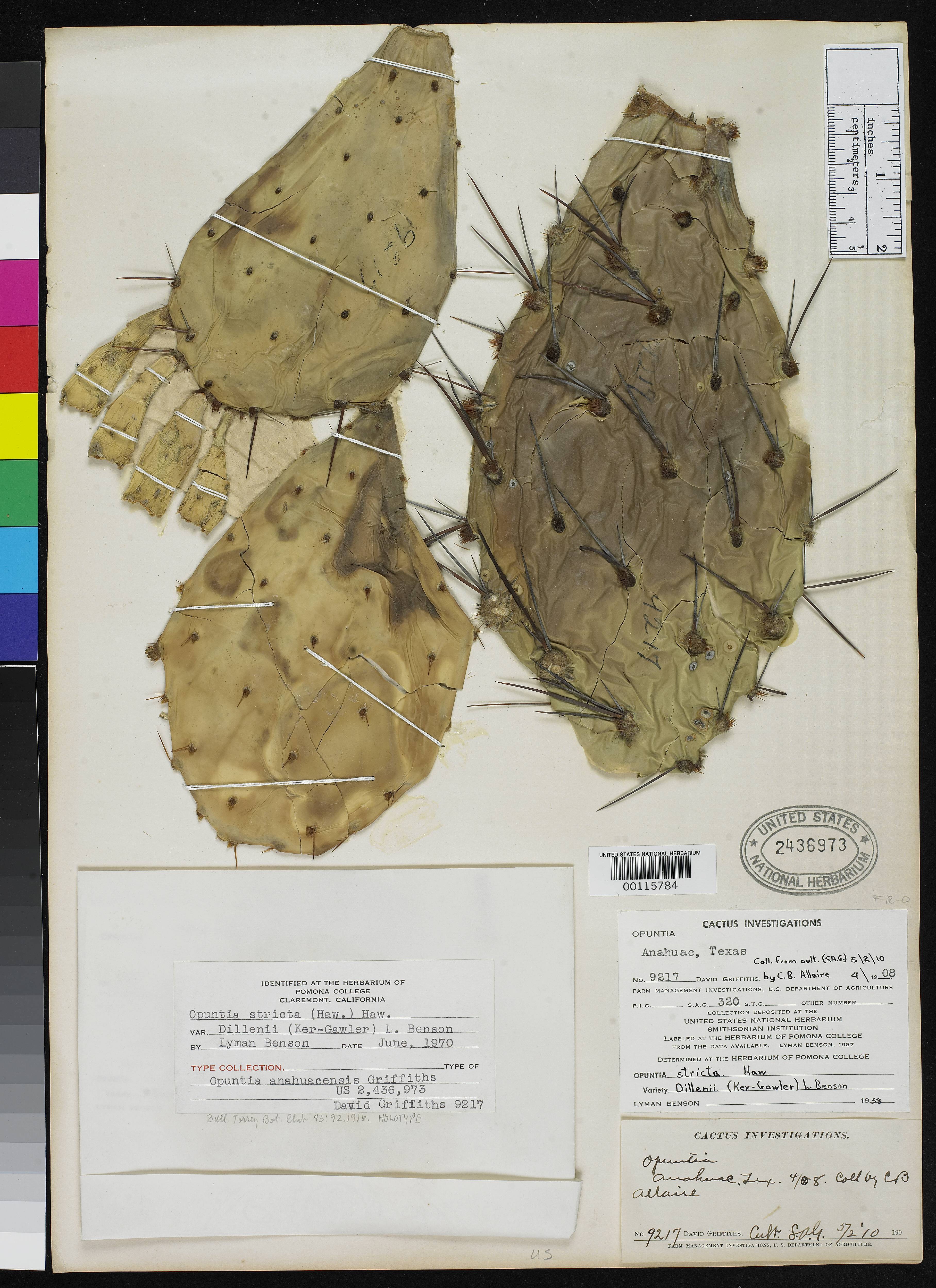
A few years ago, identifications were provided for some observations that were not in line with what had been reported so far for the Mediterranean area. In fact, some plants had been identified as Opuntia anahuacensis Griffiths, a species endemic to the southern United States and described for southern Texas. These identifications were provided by a user of iNaturalist who is an expert in North American cacti. From the comparison with the holotype (https://opuntiads.com/records/opuntia-anahuacensis-holo.jpg ; sample on the left), as well as with the photos on the OPUNTIADS website (https://www.opuntiads.com/opuntia-anahuacensis/) and with the observations made in the area where this species is native (https://www.inaturalist.org/observations?nelat=35.8331973579449&nelng=-67.42859926074743&swlat=20.073753656556804&swlng=-101.88172426074743&taxon_id=809289) the similarity with some plants is remarkable.

In general, Opuntia anahuacensis, on the basis of some preliminary observations, would seem to be distinguished from the typical Opuntia stricta for the cladodes which are on average a little larger, with more areoles in an oblique row, for the number of spines per areole never exceeding one or, more rarely, two but, above all, for the greater number of areoles on the apical rim of the fruits which is always greater than five.

It must certainly be said that the issue is extremely complicated, both for the inherent variability of Opuntia stricta, and for the fact that in the same area of the United States there are also other morphologically similar species. On the basis of this, it seems necessary, first of all, to evaluate the distribution in the Mediterranean of the plants that would fall within the concept of Opuntia anahuacensis. Subsequently, it is likely that supporting their morphological distinction from Opuntia stricta by means of morphometric investigations could provide useful indications. Similarly, genetic investigations could provide solid data to understand the relationships that exist between the Mediterranean plants and those of the New World.

Piante che morfologicamente sono senza dubbio molto vicine al concetto di Opuntia stricta (Haw.) Haw. sono diventate sempre più comuni nell'area del Bacino del Mediterraneo. Tali piante, mostrano un'elevata variabilità morfologica relativamente a molti caratteri. Di seguito una lista non esaustiva:

  • dimensioni dei cladodi
  • forma dei cladodi
  • numero di areole in fila
  • presenza o assenza di spine e loro numero per areola
  • forma dei frutti
  • numero di areole sul margine apicale del frutto

Alcuni anni or sono, furono fornite delle identificazioni per alcune osservazioni che non erano in linea con quanto segnalato sino ad allora per l'area del Mediterraneo. Infatti, alcune piante erano state identificate come Opuntia anahuacensis Griffiths, specie endemica del Sud degli Stati Uniti e descritta per il Texas meridionale. Tali identificazioni sono state fornite da un utente di iNaturalist esperto di Cactaceae nordamericane.
Dal confronto con il l'olotipo (https://opuntiads.com/records/opuntia-anahuacensis-holo.jpg ; campione a sinistra), così come anche con le foto presenti nel sito OPUNTIADS (https://www.opuntiads.com/opuntia-anahuacensis/) e con le osservazioni fatte nell'area in cui tale specie è autoctona (https://www.inaturalist.org/observations?nelat=35.8331973579449&nelng=-67.42859926074743&swlat=20.073753656556804&swlng=-101.88172426074743&taxon_id=809289) la somiglianza con alcune piante mediterranee risulta notevole.

In generale, Opuntia anahuacensis sulla base delle osservazioni preliminari, sembrerebbe distinguersi dalla Opuntia stricta tipica per i cladodi in media un po' più grandi, con più areole in fila obliqua, per il numero di spine per areola mai superiore a uno o, più raramente, due ma, soprattutto, per il numero di areole maggiore sul margine apicale dei frutti che è sempre maggiore di cinque.

Va certamente detto che la questione è estremamente complicata, sia per la variabilità insita di Opuntia stricta, sia per il fatto che nella stessa area degli Stati Uniti esistono anche altre specie morfologicamente simili. Sulla base di ciò, appare necessario, anzitutto, valutare la distribuzione nel Mediterraneo delle piante che rientrerebbero nel concetto di Opuntia anahuacensis. In seguito, è verosimile che supportare la loro distinzione morfologica rispetto a Opuntia stricta mediante indagini morfometriche potrebbe fornire delle indicazioni utili. Parimenti, delle indagini genetiche potrebbero fornire dati solidi per comprendere i rapporti che esistono tra le piante mediterranee e quelle del Nuovo Mondo.

Posted on August 20, 2025 12:08 PM by italopithecus | 0 comments | Leave a comment

August 2, 2024

Looking for volunteers to make measurements on Opuntia stricta and O. anahuacensis

The distinction between Opuntia stricta (Haw.) Haw. and O. anahuacensis Griffiths may be sometimes straighforward but the latter is often not recognized in floras and electronic databases as an independent taxon.
At least in the Mediterranean basin it seems that there is a rather precise zonation of the two species.
I think that measurements on various morphological characters on a sufficiently large number of specimens could allow to support the recognition of the two taxa as different species. As regards, I have drawn a preliminary list of possible characters.
Where I live plants corresponding to the concept of O. anahuacensis are predominant, while in western Mediterranean it seems the opposite.
I am wondering if there are some volunteers from the locus classicus (southern Texas) and western and central-eastern Mediterranean to join a research group to try to make such study.
Whoever thinks to be able to help in any manner is welcome.
Also comments and suggestions are welcome.
Feel free to forward this post to anyone, provided that this person is willing to help.

I hope not to have bothered you with this post and thanks for the attention.

@duarte @nelson_conceicao @joaotiagotavares @deinonyco @sandro_bogdanovic @sebcato @davidferguson @dragolacerto @aidancampos @ilop7 @eric_keith @adkonings

Posted on August 2, 2024 11:59 AM by italopithecus | 11 comments | Leave a comment

March 6, 2024

How to ask for an identification of a broomrape, genera Orobanche and Phelipanche (fast way) - Come richiedere l'identificazione di un succiamele, generi Orobanche e Phelipanche (metodo veloce)

Very briefly:

1) the plant photographed by its side. NB: a) try to focus on the base of the plant so the whole plant should be on focus; b) remember to photograph the whole plant so the inflorescence : stem ratio is visibile; c) if possible include the species growing beside.

2) a photo of the corolla by its side. NB: the profile of the corolla and the calyx must be well visible.

3) a photo of the corolla gorge

4) collect just one flower (calyx + corolla), keep it in a notebook. NB: at home measure corolla and calyx length just putting them on the millimeter paper.

5) make a list of the species that grow beside

NB: avoid to photograph the plant from above.

Molto brevemente:

1) la pianta fotografata di lato. NB: a) cerca di mettere a fuoco sulla base della pianta in modo che l'intera pianta sia a fuoco; b) ricordati di fotografare l'intera pianta in modo che sia visibile il rapporto infiorescenza : fusto; c) se possibile includi le specie che crescono accanto.

2) una foto della corolla di lato. NB: il profilo della corolla e il calice devono essere ben visibili.

3) Una foto della fauce della corolla

4) Raccogli un solo fiore (calice + corolla), conservalo in un quaderno. NB: a casa misura la lunghezza della corolla e del calice semplicemente mettendoli sulla carta millimetrata.

5) fai un elenco delle specie che crescono accanto.

NB: evita di fotografare la pianta dall'alto.

Posted on March 6, 2024 05:32 PM by italopithecus | 4 comments | Leave a comment

October 27, 2023

Xanthium sottogenere Xanthium (Xanthium strumarium, X. orientale ecc.) - Xanthium subgenus Xanthium (Xanthium strumarium, X. orientale etc.)

Gli Xanthium sono specie piuttosto frequenti in contesti, ad esempio, come aree umide, zone ruderali e dune litoranee a partire dall'estate inoltrata. Le specie del sottogenere Xanthium quali X. strumarium e X. orientale sono identificabili esclusivamente quando i concettacoli (quelle strutture spinose che potrebbero essere scambiate per frutti e che, in realtà, contengono due frutti) sono ben sviluppati. L'intelligenza artificiale di iNaturalist cerca di suggerire un'identificazione più probabile anche con piante non fruttificanti. In quei casi c'è una buona probabilità che si tratti di X. orientale ma non è detto al 100%. Quindi, per non incorrere in errori, cercate di identificare a livello di specie solo piante fruttificanti.
Senza voler scendere in eccessivi particolari, qui di seguito una chiave per distinguere queste due specie:

1 - Spine del concettacolo con numerosi peli ispidi, solitamente numerose e dense tanto da coprire la superficie del concettacolo, più raramente relativamente rade. Spine apicali divergenti. Concettacoli lunghi fino a tre centimetri: Xanthium orientale

1' - Spine del concettacolo prive di peli ispidi, da numerose e dense a rade. Spine apicali convergenti oppure divergenti. Concettacoli non più lunghi di 2(2,2 cm): 2 gruppo di X. strumarium

2 - Spine apicali convergenti. Spine del concettacolo relativamente rade. Concettacoli non più lunghi di 1(1,5 cm): X. strumarium
2' - Spine apicali solitamente divergenti. Spine del concettacolo dense. Concettacoli lunghi fino a 2 cm o raramente poco più: altre specie

In molti casi, per qualche motivo, Xanthium orientale è stato incluso in X. strumarium e si è ridotto tutto il sottogenere al solo X. strumarium. Attualmente sembra che si possano considerare con buona sicurezza due specie ben distinte. Inoltre, X. strumarium in buona parte d'Europa è una specie teoricamente autoctona e, comunque, estremamente rara, mentre X. orientale è decisamente comune e più o meno ovunque invasivo.

Letteratura:

  • Jeanmonod D., 1996. Xanthium subg. Xanthium et Helichrysum italicum, deux cas taxonomiques ardus. Candollea 53:435–457
  • Tomasello S., 2018. How many names for a beloved genus? Coalescent based species delimitation in Xanthium L. (Ambrosiinae, Asteraceae). Molec. Phylogen. Evol. 127: 135–145

Xanthium species are prettyfrequent species in contexts, for example, such as wetlands, ruderal areas and coastal dunes from late summer. Species of the subgenus Xanthium such as X. strumarium and X. orientale are identifiable only when the conceptacles (those spiny structures that could be mistaken for fruits and which, in fact, contain two fruits) are well developed. iNaturalist's artificial intelligence tries to suggest the most likely identification even with non-fruiting plants. In those cases, there is a good chance that it is X. orientale, but it is not 100% certain. So, in order not to make mistakes, try to identify at the species level only fruit-bearing plants. Without going into too much detail, here is a key to distinguish these two species:

1 - Spines of the conceptacle with numerous bristly hairs, usually numerous and dense enough to cover the surface of the conceptacle, more rarely relatively sparse. Apical spines divergent. Conceptacles up to three centimeters long: Xanthium orientale
1' - Spines of the conceptacle without bristly hairs, numerous and dense to sparse. Apical spines convergent or divergent. Conceptacles no longer than 2(2.2 cm): 2 group of X. strumarium
2 - Apical spines convergent. Conceptacle spines relatively sparse. Conceptacles no longer than 1 (1.5 cm): X. strumarium
2' - Apical spines usually divergent. Conceptacle spines dense. Conceptacles up to 2 cm long or rarely a little more: other species

In many cases, for some reasons, Xanthium orientale has been included in X. strumarium and the entire subgenus has been reduced to just X. strumarium. At present, it seems that we can safely consider two distinct species. Moreover, X. strumarium in most of Europe is a theoretically autochthonous and, in any case, extremely rare species, while X. orientale is very common and more or less everywhere invasive.

Literature:

  • Jeanmonod D., 1996. Xanthium subg. Xanthium et Helichrysum italicum, deux cas taxonomiques ardus. Candollea 53:435–457
  • Tomasello S., 2018. How many names for a beloved genus? Coalescent based species delimitation in Xanthium L. (Ambrosiinae, Asteraceae). Molec. Phylogen. Evol. 127: 135–145
Posted on October 27, 2023 02:16 PM by italopithecus | 0 comments | Leave a comment