August 12, 2025

OAK GALL INK RECIPE

Ingredients:
• 1 pint water
• 2 oz dried oak galls
• 1 oz ferrous sulphate
• 1/2 oz Gum Arabic

Instructions

  1. Crush the dried oak galls using a mortar and pestle. The finer the grind, the better, as this increases surface area, helping to release the most possible tannic and Gallic acids.
  2. Pour the water over the crushed oak galls and let them soak for 24 hours.
  3. Strain the solution through cheesecloth and discard the crushed galls.
  4. Add the ferrous sulphate and stir. Within seconds, the mixture will turn black and your ink is almost ready.
  5. Now add the Gum Arabic and stir thoroughly.
  6. Store in a sturdy glass bottle.
Posted on August 12, 2025 02:15 PM by lisa281 | 0 comments | Leave a comment

March 20, 2025

Helpful Identification Guides

Updated: June, 2024

TOPICS AUTHOR
* Acanthocephalus: Spine-Headed/Leaf-footed Bugs Zootaxa article
*Agalinis: Identifying Agalinis spp. (False Foxgloves) in Texas @pfau_tarleton
* Anemones: Guide to ID @pfau_tarleton
* Assassin Bugs ( Zelus spp.) @pfau_tarleton
* Broomrape Species @blue_celery
* Broomweed: Amphiachyris dracunculoides and look-alikes @rymcdaniel
* Brambles: Dewberries and Blackberries ( Rubus species of Texas) @kimberlietx
* Bumblebees @pfau_tarleton
* Callirhoe (Winecups) @rymcdaniel
* Crotons @nathantaylor
* Dandelions @nathantaylor
* Draba and related genera @pfau_tarleton
* Elms: American vs. Slippery @lisa281
* Elms: Cedar vs. Winged @lisa281
* Elms: Chinese vs. Siberian @lisa281
* Elm spring samaras: American, Slippery, and Winged Elm @lisa281
* Erigeron (Fleabane and Horseweed) @lisa281
* Frogfruits (Phyla) @lisa281
* Galls: Texas Woolly Oak Galls @kimberlietx
* Gallformers (Website for Gall ID) @megachile
* Hawks - Cooper's vs Sharp-shinned Cornell
* Leaves: Glossary of Leaves @kimberlietx
* Medicago (Medicks) @nathantaylor
* Mosses: Identifying Goblet Mosses @rmedina
* Moths: Guide to Petrophila Moths in Texas @gcwarbler
* Moth Wing Features @mamestraconfigurata
* MULBERRY: Red vs. White Purdue
* Mushrooms: Simplified Key to Major Groups of Mushrooms Michael Kuo @ MushroomExpert.Com
* Mushrooms: Photographing for better ID Billy Stone, BRIT
* Packera and Senecio (Groundsels) @lisa281
* Physalis spp. @m_whitson
* Privets ( Ligustrum spp.) @lisa281
* Sesbania (Riverhemps) @lisa281
* Soapberry vs. Pistache @baldeagle
* Solidago (Goldenrods) @bouteloua
* Spurges of the DFW area @nathantaylor
* Sumac (Rhus spp.) YouTube video @conboy
* Sumacs: Key to ID the Rhus spp of North America @conboy
* Swallowtail Butterflies: The Four Dark Swallowtails Blog: Louisiana Naturalist
* Tetrigidae Pygmy Grasshoppers @aispinsects
* Thistles: Identifying Texas Thistles Katie Stern at Perennial Ecology
*Three-Banded Leafhoppers Erythroneura spp. @kimberlietx
* Tick Identification TickEncounter Resource Center
* Trees: Identify sometimes difficult trees (and other tree ID info.) @lanechaffin
* Trees: First Steps in Tree ID (You Tube Video) @lisa281
*Triodanis spp. Venus's Looking Glass @kimberlietx
* Turkey Tail and Lookalikes @sarahduhon
* Using AI to learn about botany @scarletskylight
* Zeltnera and Centaurium species @rymcdaniel
Posted on March 20, 2025 10:35 PM by lisa281 | 1 comment | Leave a comment

March 4, 2020

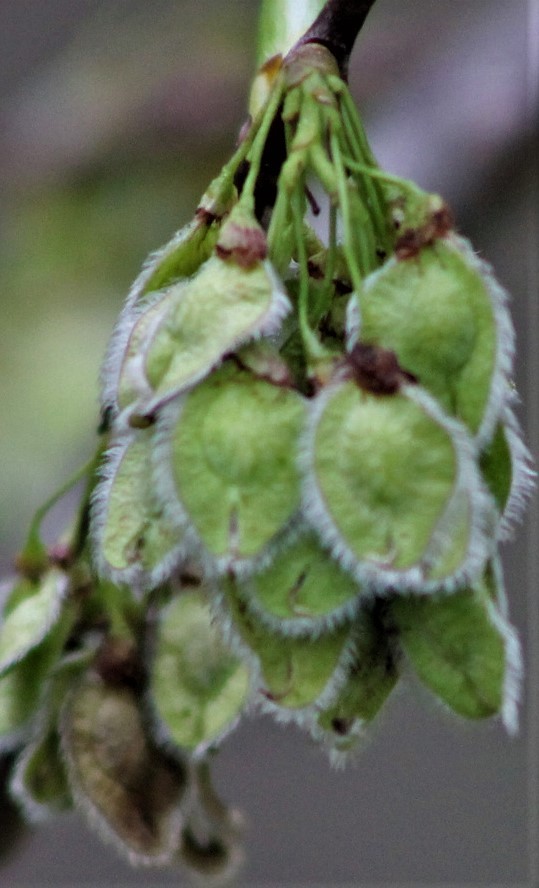
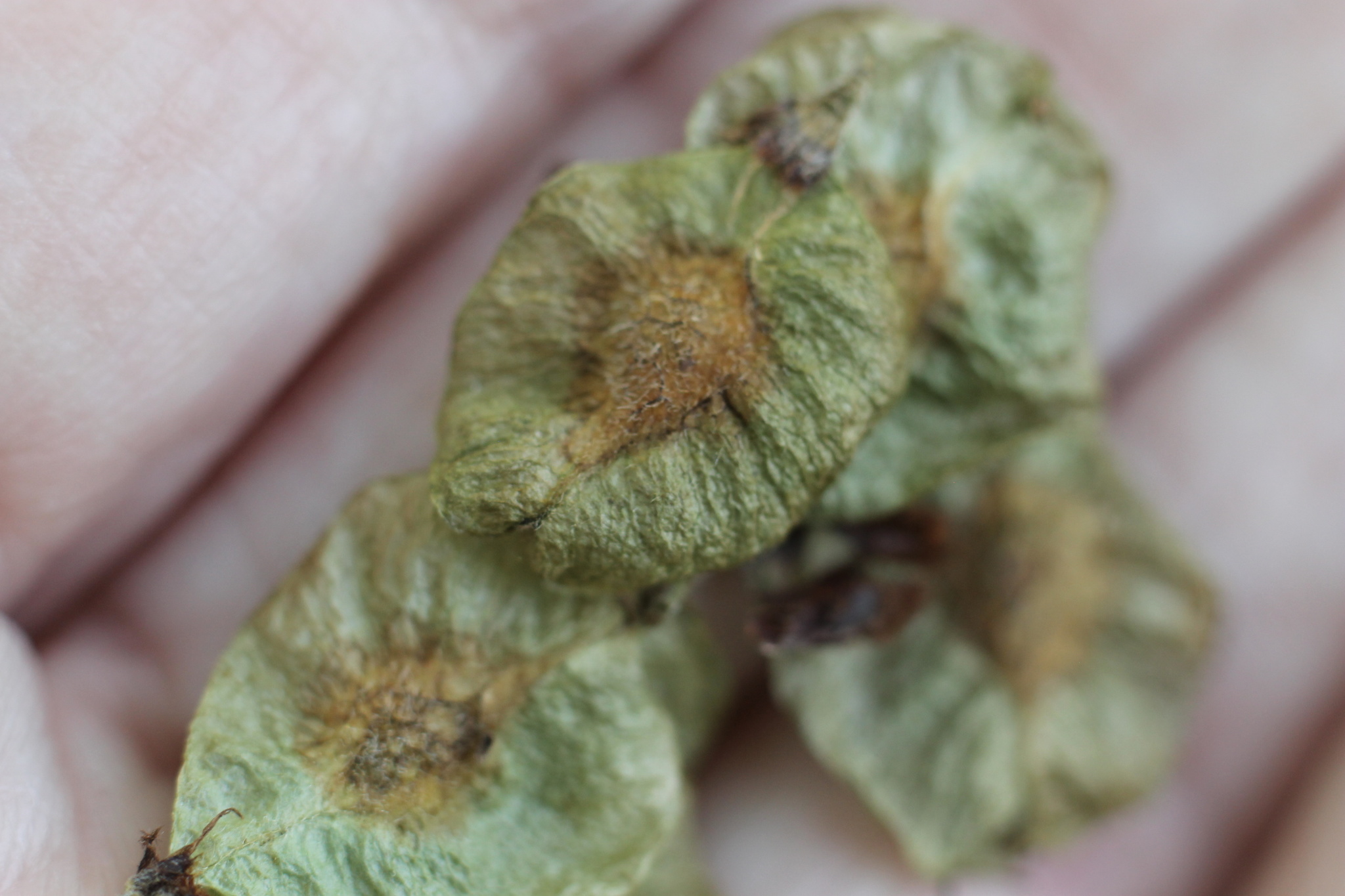
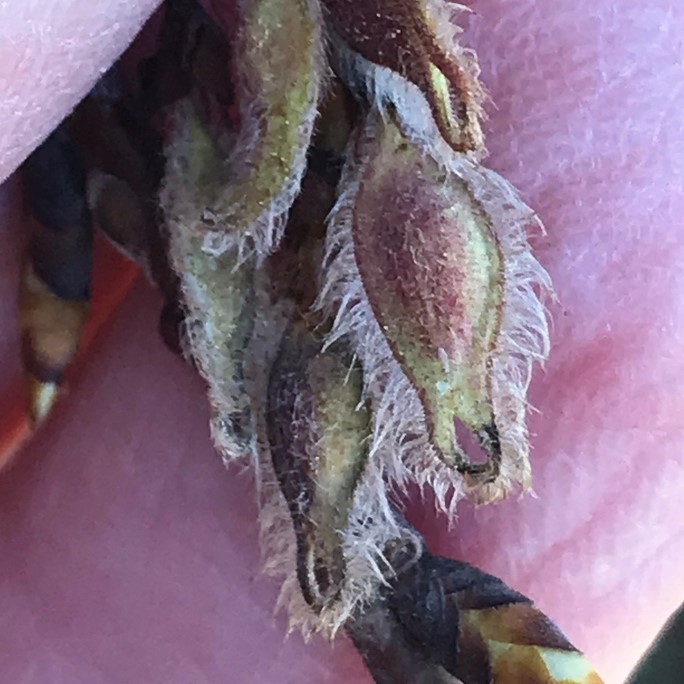
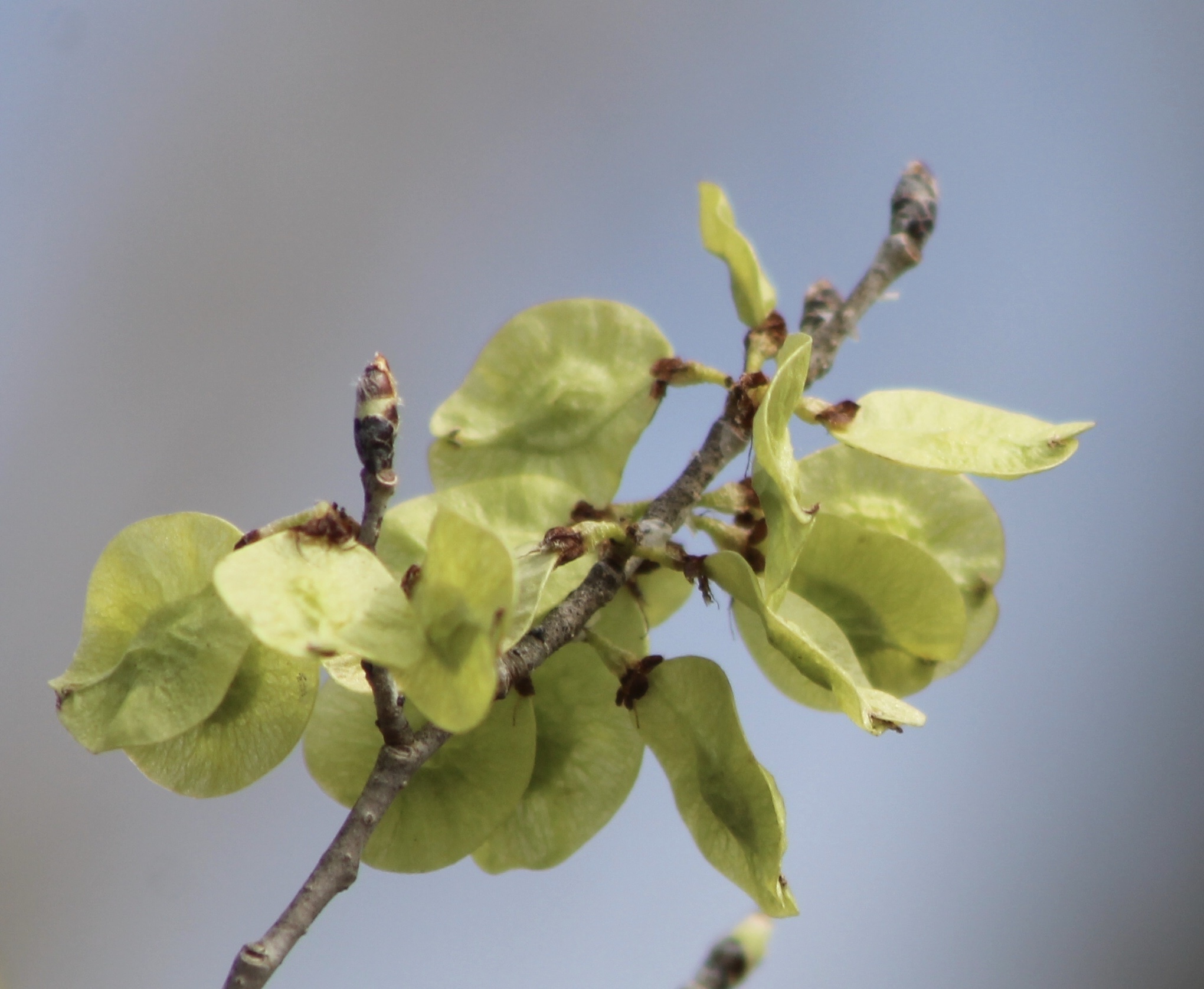
Elm: Identify Four Elms by Spring Samaras

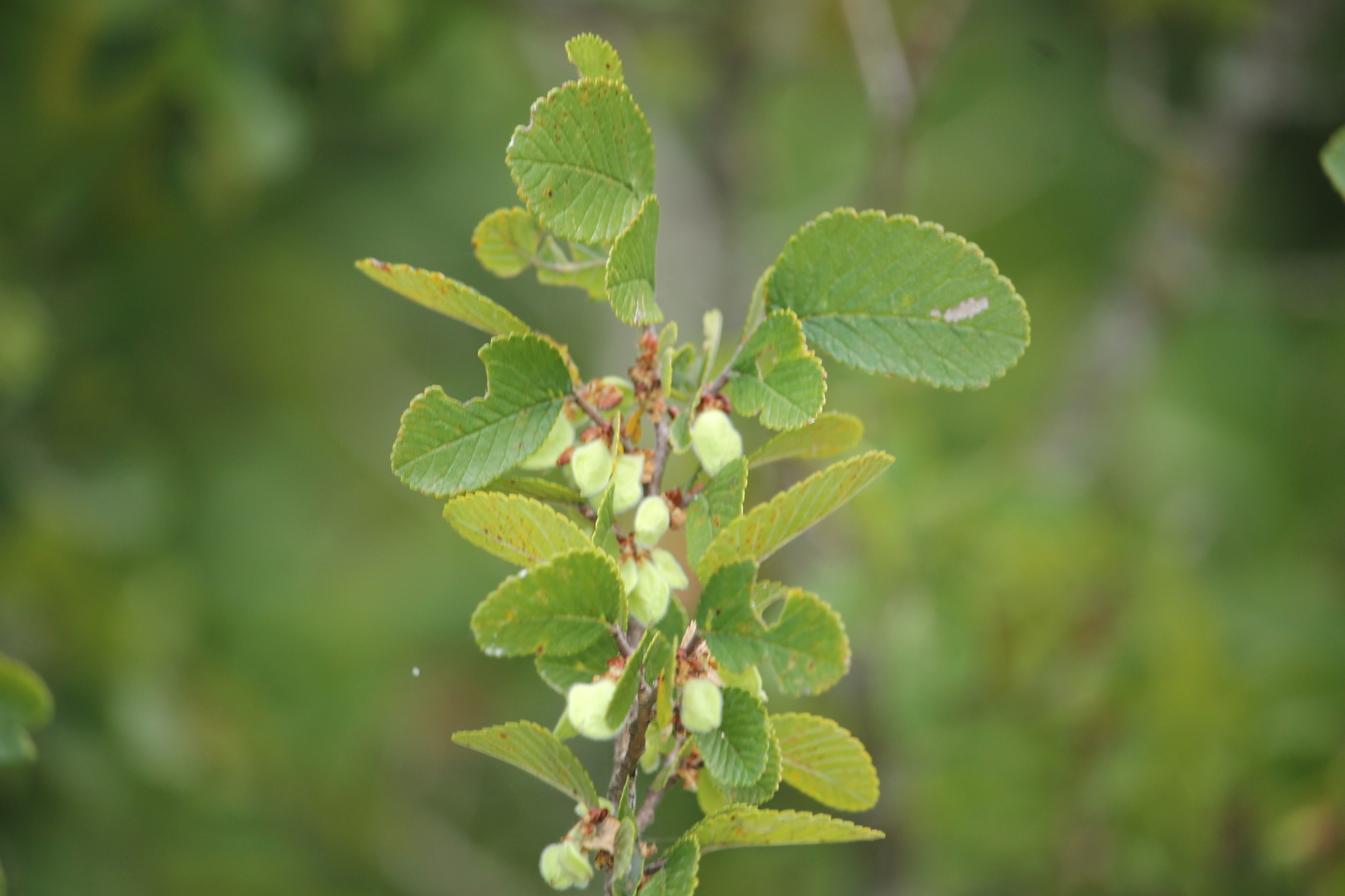
These four elms include three native elms, plus one introduced (and uncommon) elm. These elms all flower and fruit in the spring, before leaves arrive. The fruit of elms is a flat, rounded samara, with a central seed surrounded by a thin wing. Here's how to identify American Elm, Slippery Elm, Winged Elm, and Siberian Elm from these samaras.

American Elm (Ulmus americana)

Slippery Elm (U. rubra)

Winged Elm (U. alata)

Siberian Elm (U. pumila)

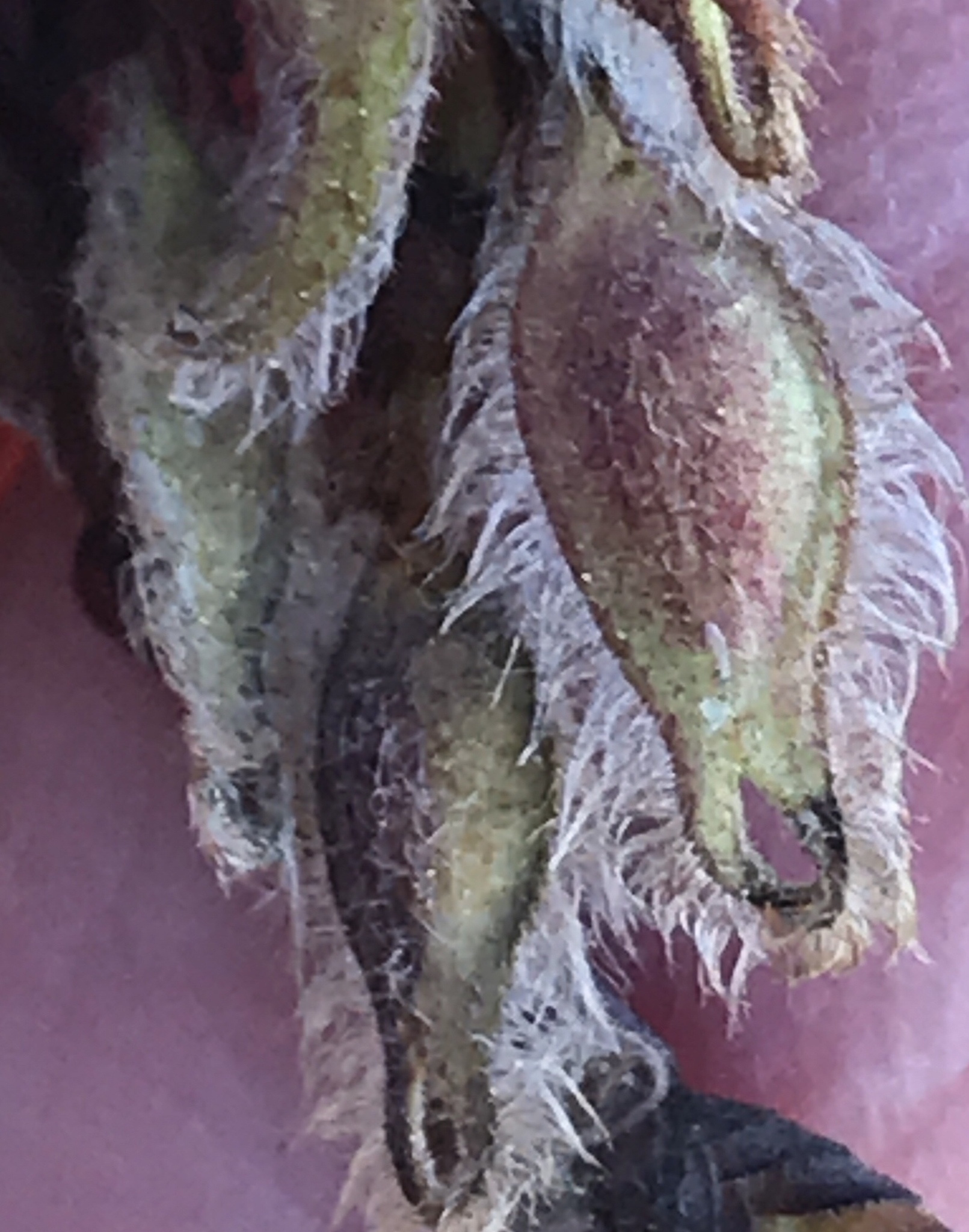
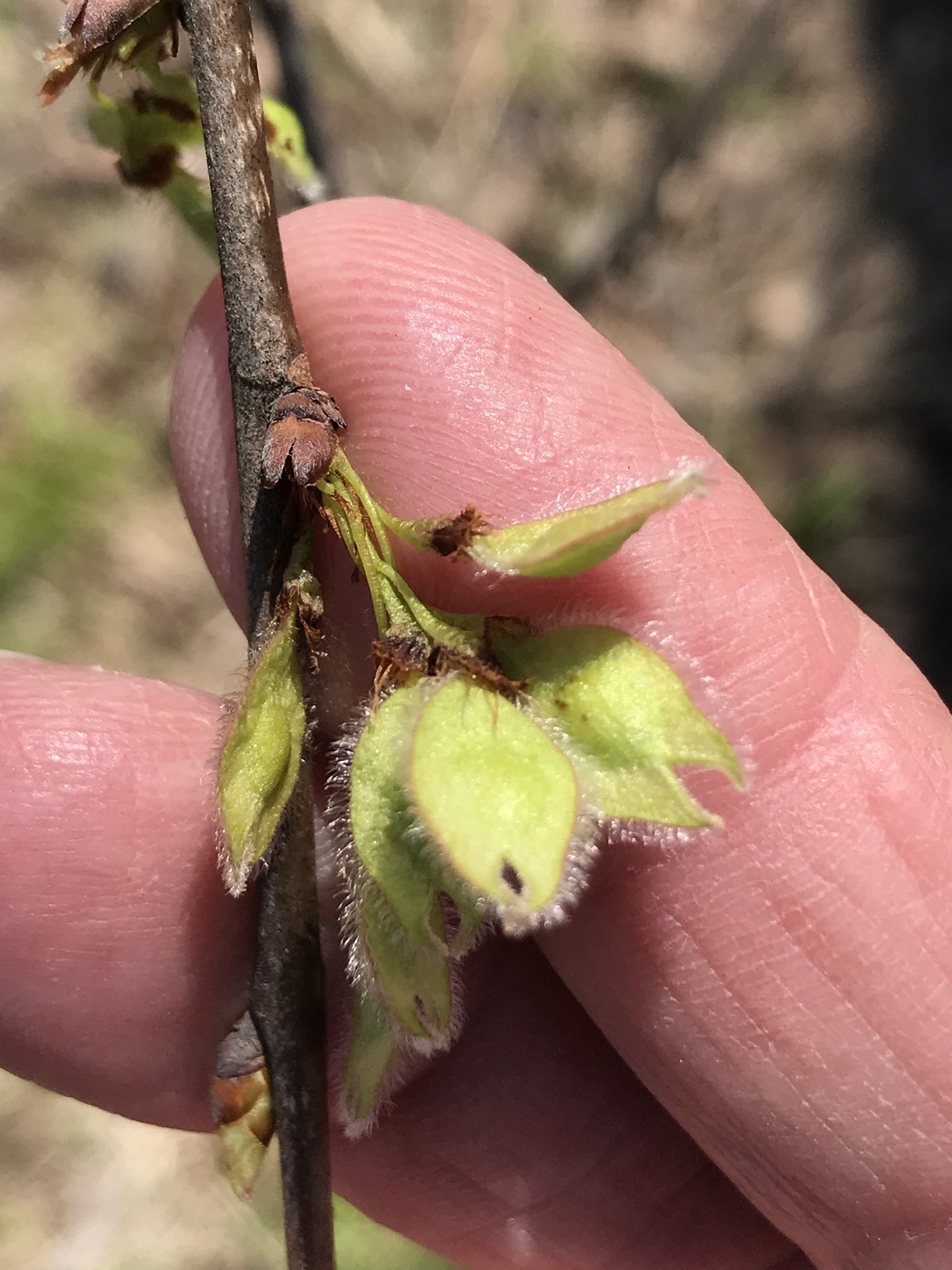
Samaras have cilia around the edges, but smooth on front and back surfaces Samaras have NO cilia around the edges , just fuzz on front and back surfaces, in the center over the seed Samaras have cilia around the edges AND fuzz on front and back surfaces; often reddish Samaras have NO cilia around the edges, and also NO fuzz on the front or back surfaces
Samaras are elongated (longer than wide) and deeply notched Samaras are round (about as long as wide) and not deeply notched Samara are lanceolate (long and narrow) and have deep "claw-like" notch at the bottom, Samara are round and have very small notch at the bottom,


BACK TO: A Collection of Helpful Identification Guides

Posted on March 4, 2020 02:10 PM by lisa281 | 10 comments | Leave a comment

February 26, 2020

Helpful Identification Guides

Updated: June, 2024

TOPICS AUTHOR
* Acanthocephalus: Spine-Headed/Leaf-footed Bugs Zootaxa article
*Agalinis: Identifying Agalinis spp. (False Foxgloves) in Texas @pfau_tarleton
* Anemones: Guide to ID @pfau_tarleton
* Assassin Bugs ( Zelus spp.) @pfau_tarleton
* Broomrape Species @blue_celery
* Broomweed: Amphiachyris dracunculoides and look-alikes @rymcdaniel
* Brambles: Dewberries and Blackberries ( Rubus species of Texas) @kimberlietx
* Bumblebees @pfau_tarleton
* Callirhoe (Winecups) @rymcdaniel
* Crotons @nathantaylor
* Dandelions @nathantaylor
* Earthworms: How to Photograph for iNaturalist @thirty_legs
* Draba and related genera @pfau_tarleton
* Elms: American vs. Slippery @lisa281
* Elms: Cedar vs. Winged @lisa281
* Elms: Chinese vs. Siberian @lisa281
* Elm spring samaras: American, Slippery, and Winged Elm @lisa281
* Erigeron (Fleabane and Horseweed) @lisa281
* Frogfruits (Phyla) @lisa281
* Galls: Texas Woolly Oak Galls @kimberlietx
* Gallformers (Website for Gall ID) @megachile
* Hawks - Cooper's vs Sharp-shinned Cornell
* Leaves: Glossary of Leaves @kimberlietx
* Medicago (Medicks) @nathantaylor
* Mosses: Identifying Goblet Mosses @rmedina
* Moths: Guide to Petrophila Moths in Texas @gcwarbler
* Moth Wing Features @mamestraconfigurata
* MULBERRY: Red vs. White Purdue
* Mushrooms: Simplified Key to Major Groups of Mushrooms Michael Kuo @ MushroomExpert.Com
* Mushrooms: Photographing for better ID Billy Stone, BRIT
* Packera and Senecio (Groundsels) @lisa281
* Physalis spp. @m_whitson
* Privets ( Ligustrum spp.) @lisa281
* Sesbania (Riverhemps) @lisa281
* Soapberry vs. Pistache @baldeagle
* Solidago (Goldenrods) @bouteloua
* Spurges of the DFW area @nathantaylor
* Sumac (Rhus spp.) YouTube video @conboy
* Sumacs: Key to ID the Rhus spp of North America @conboy
* Swallowtail Butterflies: The Four Dark Swallowtails Blog: Louisiana Naturalist
* Tetrigidae Pygmy Grasshoppers @aispinsects
* Thistles: Identifying Texas Thistles Katie Stern at Perennial Ecology
*Three-Banded Leafhoppers Erythroneura spp. @kimberlietx
* Tick Identification TickEncounter Resource Center
* Trees: Identify sometimes difficult trees (and other tree ID info.) @lanechaffin
* Trees: First Steps in Tree ID (You Tube Video) @lisa281
*Triodanis spp. Venus's Looking Glass @kimberlietx
* Turkey Tail and Lookalikes @sarahduhon
* Using AI to learn about botany @scarletskylight
* Zeltnera and Centaurium species @rymcdaniel
Posted on February 26, 2020 12:25 PM by lisa281 | 40 comments | Leave a comment

February 11, 2020

The Elm Project, Part 3: Cedar Elm vs. Winged Elm


CEDAR ELM (Ulmus crassifolia) vs. WINGED ELM (U. alata)
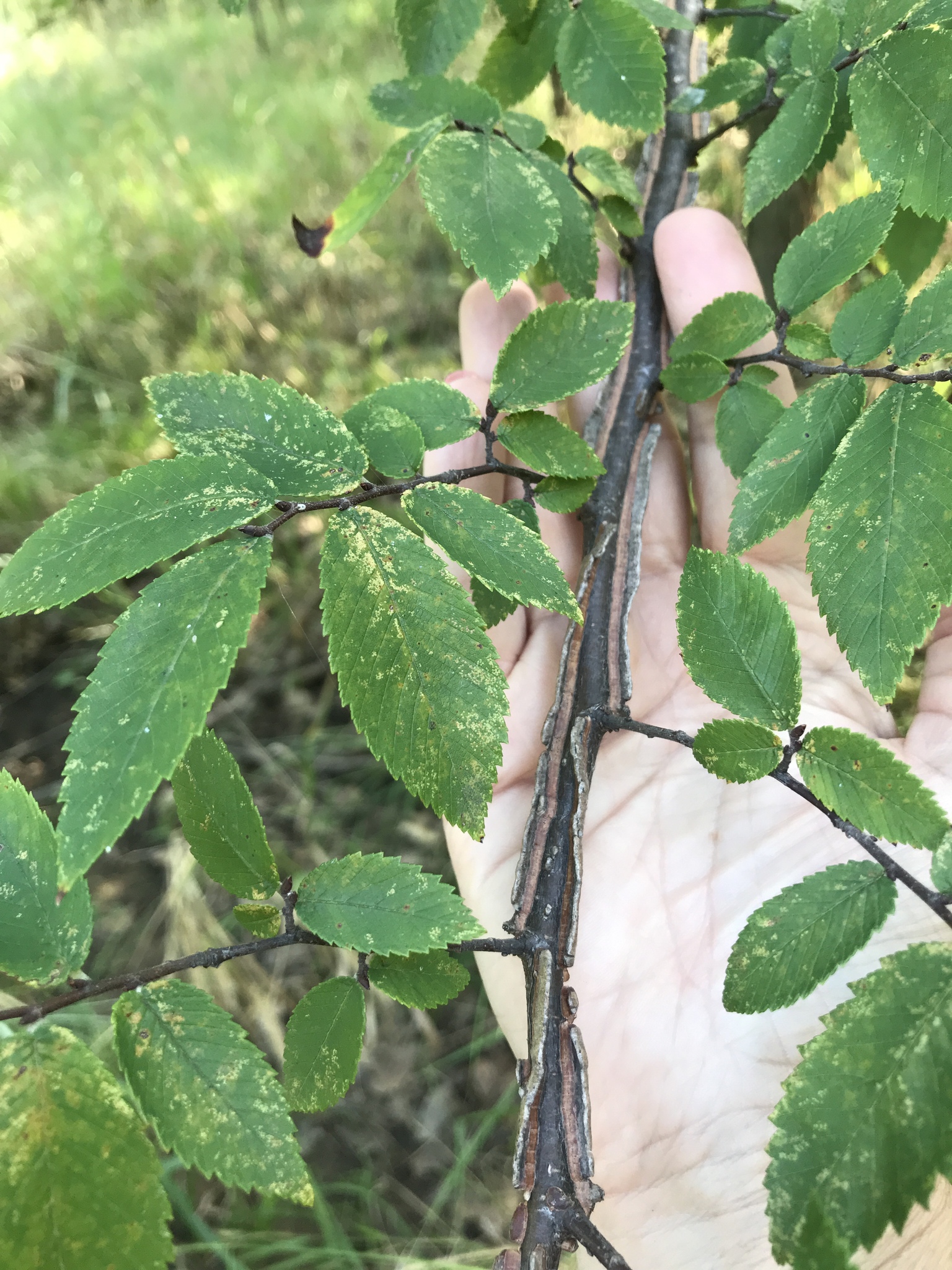
These two elms also drove me crazy for a while! In a better, simpler world, all elms with wings would be Winged Elms, but this is not the case. These both can have corky “wings” on their twigs, so despite the name, you can’t identify a Winged Elm by these alone. Both of these elms have small leaves, asymmetrical bases and (usually) double-toothed margins. However, Winged Elm usually has many winged twigs, while in Cedar Elm they occur mostly on young trees, and many large Cedar Elms have none at all. The ranges of these two overlap, and Cedar Elm’s range includes the eastern half of Texas. In North Central Texas, cedar Elm is much more common than Winged Elm. Winged Elm’s range covers only the eastern quarter of Texas, so only part of North Central Texas. The trees range as far west as the East Cross Timbers region, which cuts through Denton and Tarrant counties. Winged Elms prefer sandy soil and do not grow well in clay. We find them quite commonly east of the metroplex, but rarely, if ever, in the Blackland Prairie area. In west Denton county, where we get into the Cross Timbers area, we’ve found quite a few.

  1. The most sure-fire way of distinguishing these two is seasonal: Cedar Elm is the only native elm that flowers in the fall, while Winged Elm flowers in the spring. In North Texas, the small, round samaras of Cedar Elm are evident through most of September, and often hang on even later. -- Here's an observation showing the autumn samaras of a Cedar Elm:
    Autumn samaras of Cedar Elm, Sept. 5, 2021

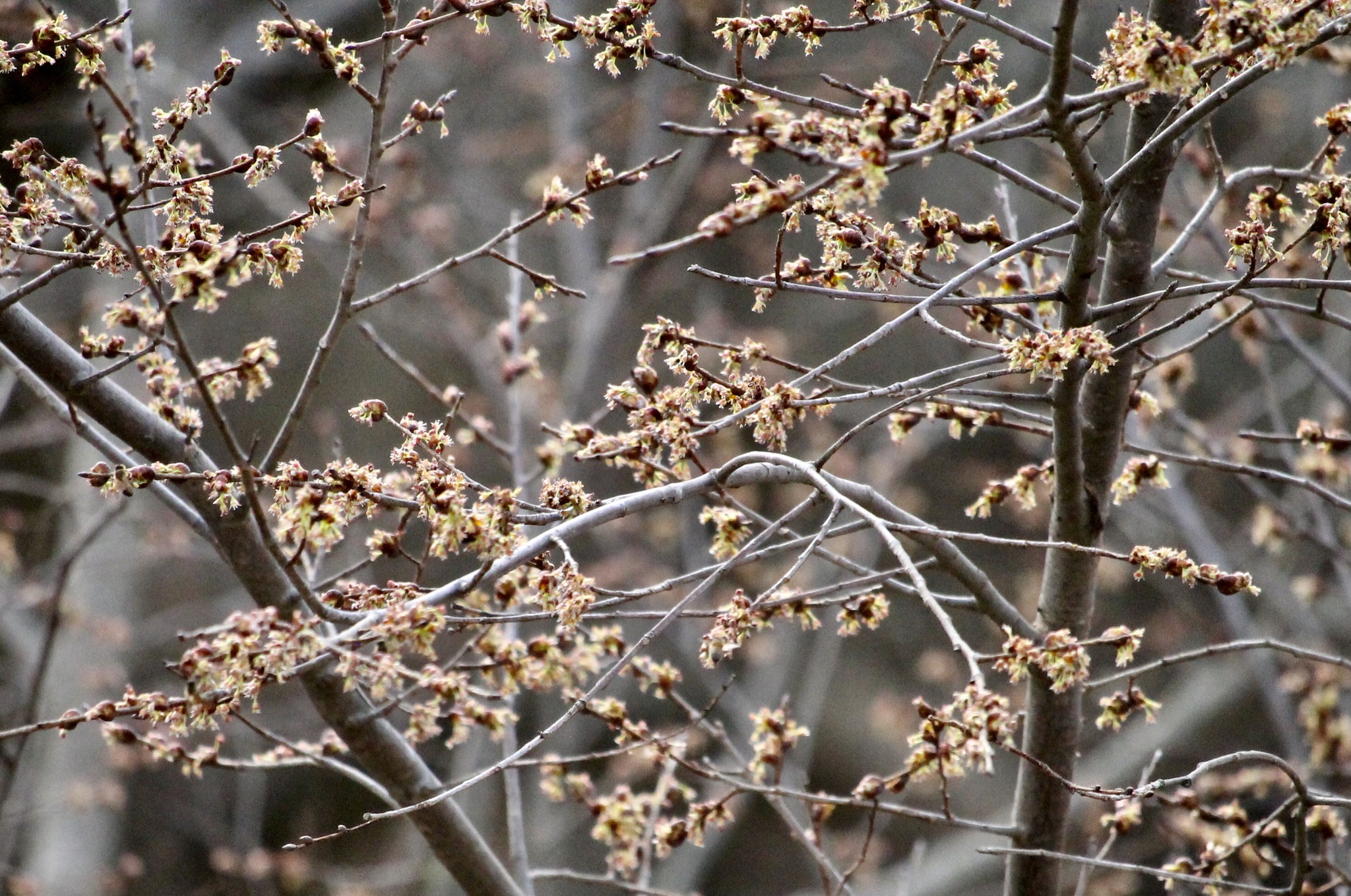
  2. Winged Elm produces flowers and seeds in the spring, around March, before the leaves appear. Winged Elm is the only elm in North Texas that has corky wings on branches AND makes its seeds in the spring. Here are the spring samaras of a Winged Elm:
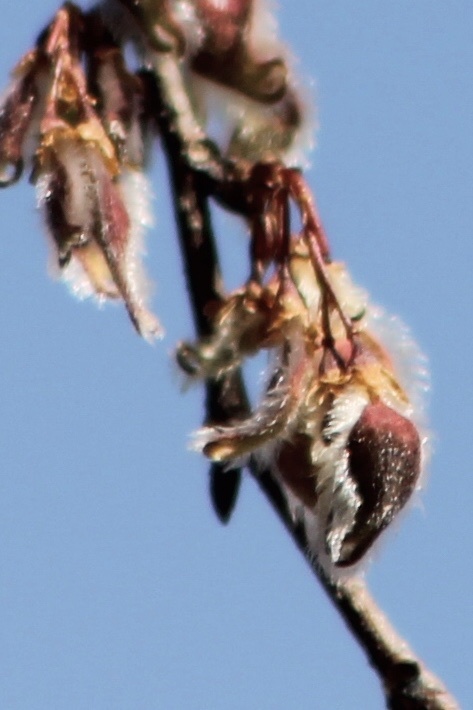
    Spring samaras of Winged Elm

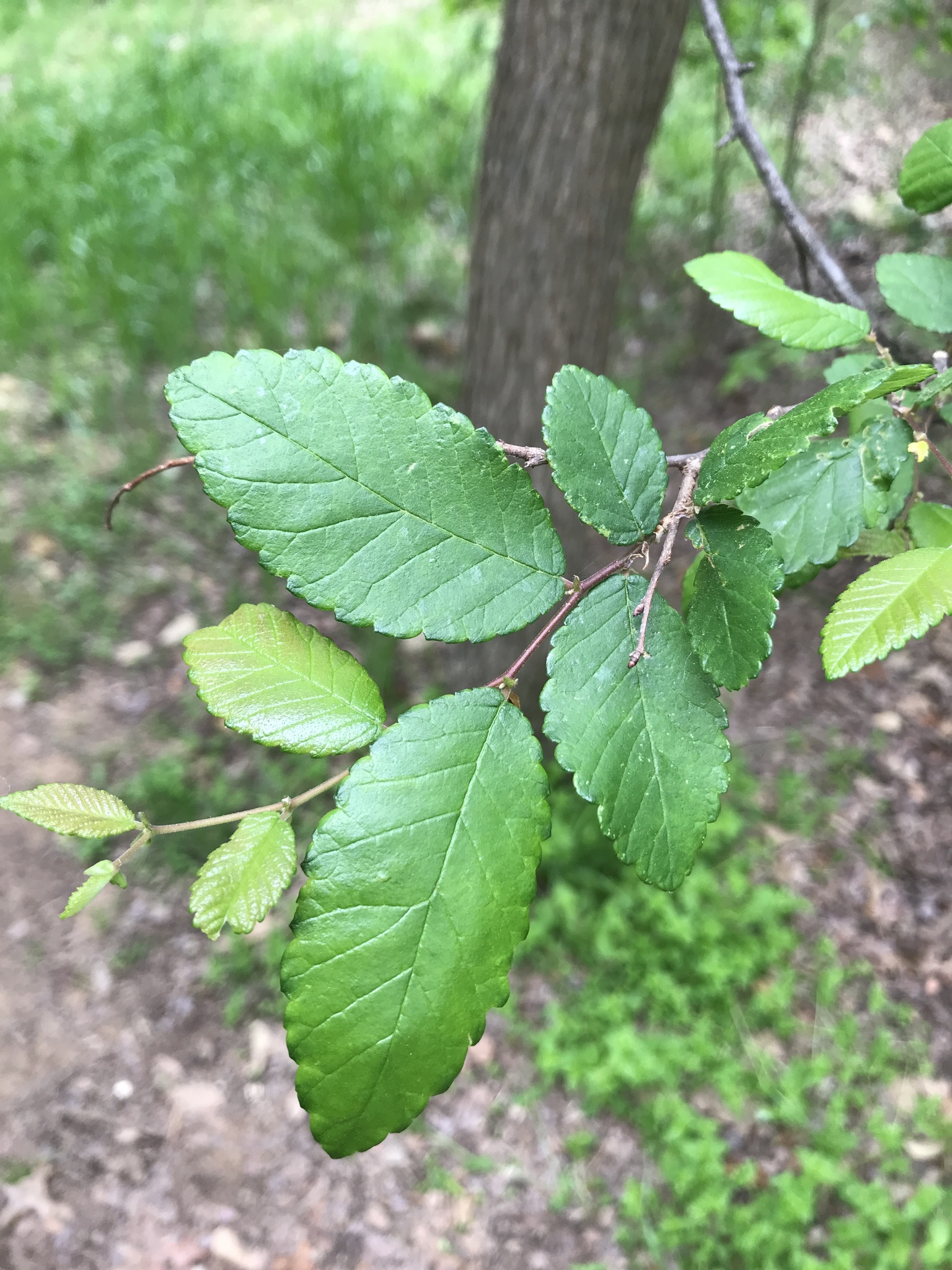
  3. For the rest of the year, Cedar Elm leaves tend to be somewhat smaller than those of Winged Elm, and have a blunt tip. Cedar Elm leaves are also stiff and thick, while Winged Elm leaves are thinner and smoother on top. That’s hard to see in pictures, but it’s pretty obvious when you handle the leaves.
    Leaves of Winged Elm

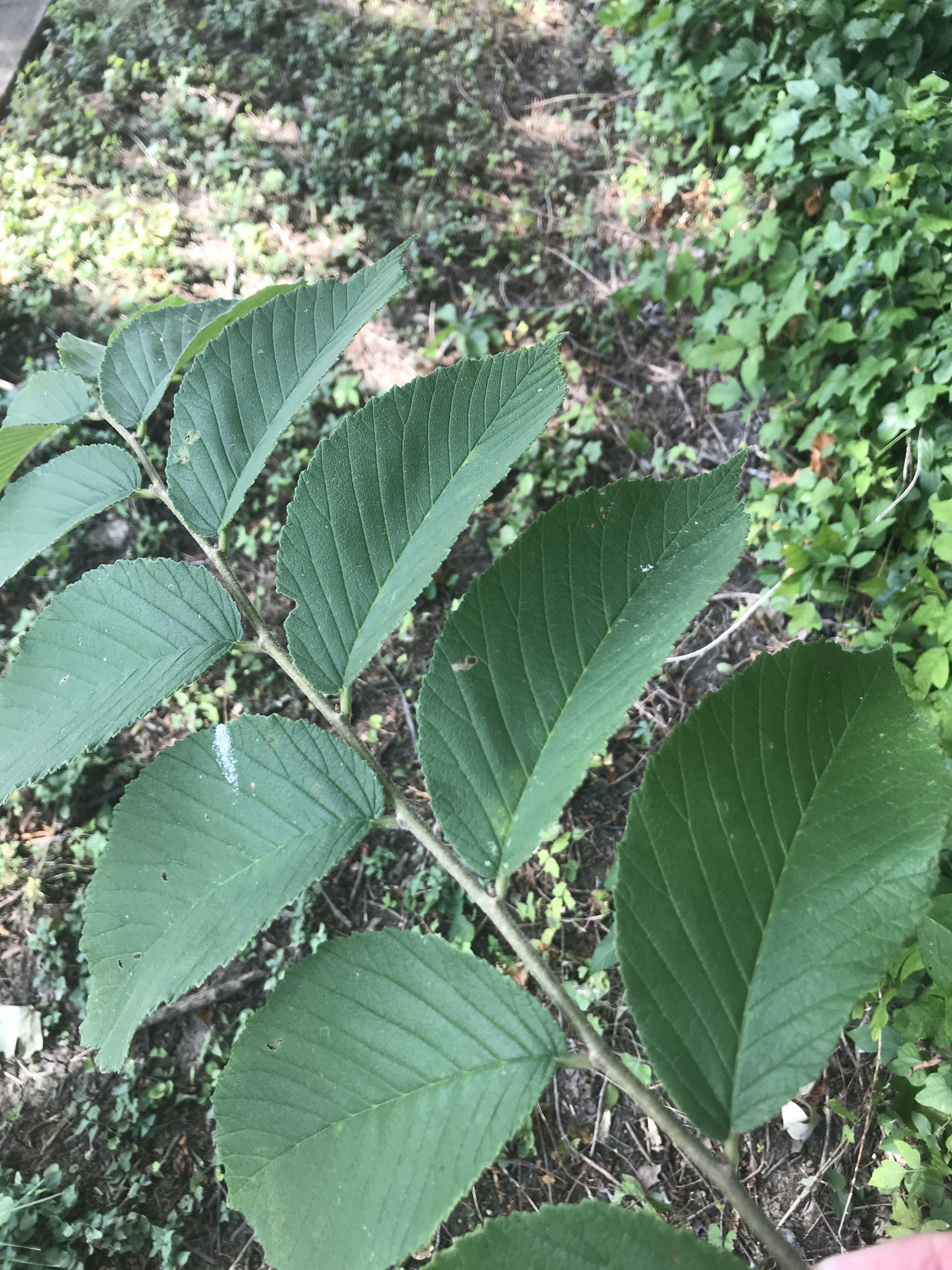
  4. The leaf shape differs: Cedar Elm leaves (above)are more rounded or blunt at the tip, while Winged Elm leaves (below) are pointed at the tip. Here's a picture of a Winged Elm twig with leaves:
    Leaves of Winged Elm

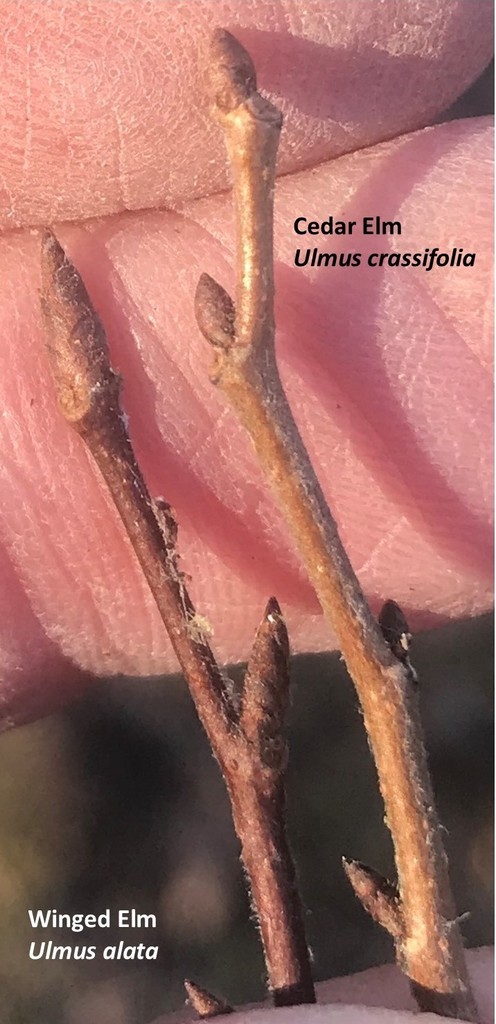
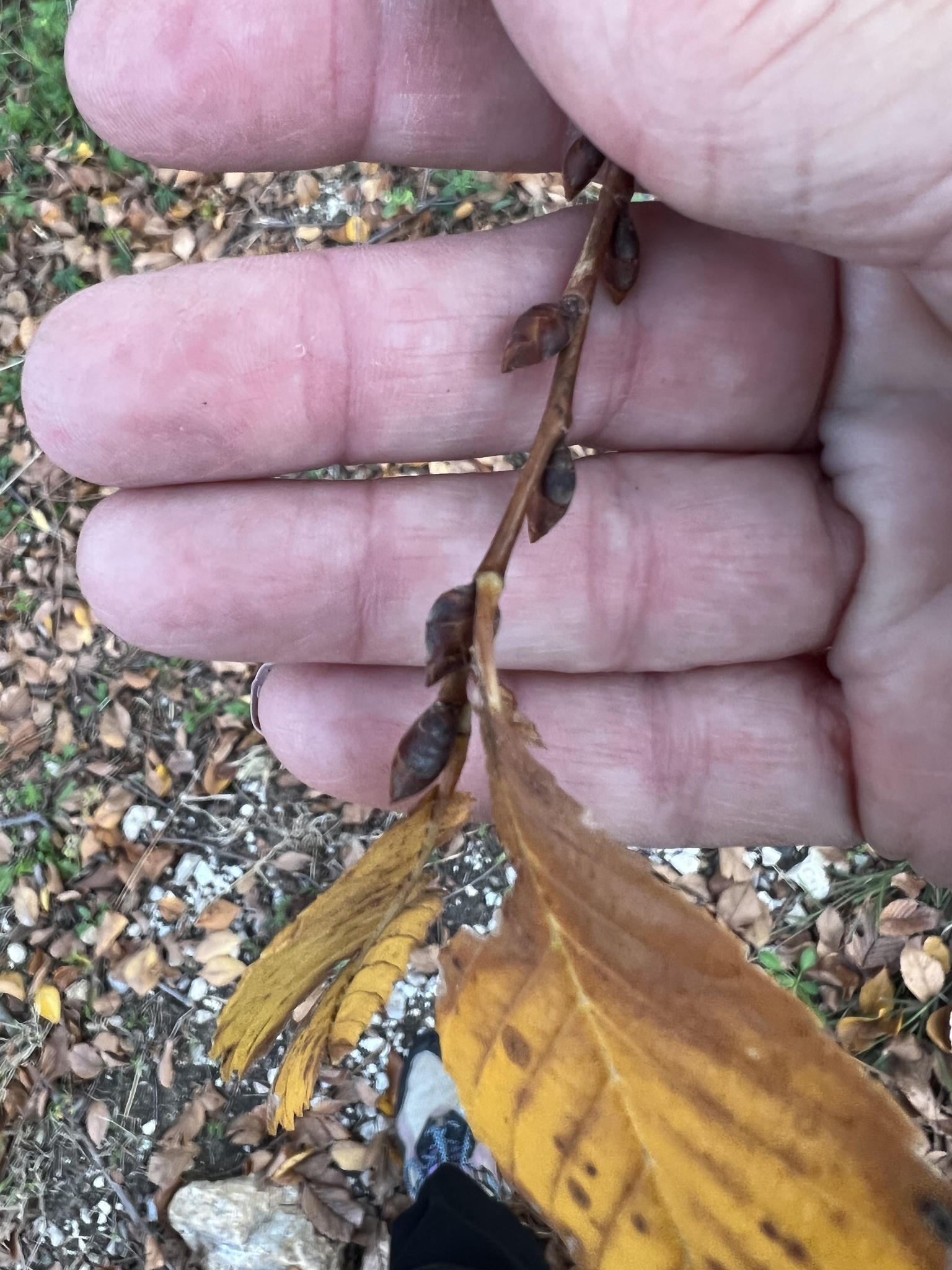
  5. Winter twigs: the twigs of Winged Elm are redder, and the buds are larger.
    Winter twigs of Winged Elm vs. Cedar Elm

  6. The flowers and samaras of Winged Elm, like those of American Elm and Slippery Elm, appear in the spring before leaves open. They are fuzzy on both front and back surfaces, as well as having fine hairs extending from the margins. The samaras aren’t tightly clustered like those of the Slippery Elm, but don’t droop on long stalks like those of American Elm either. • Here’s a picture of Winged Elm samaras, with cilia around the margins AND fuzz on the front and back surfaces:

BACK TO: A Collection of Helpful Identification Guides

Posted on February 11, 2020 10:30 PM by lisa281 | 6 comments | Leave a comment

February 10, 2020

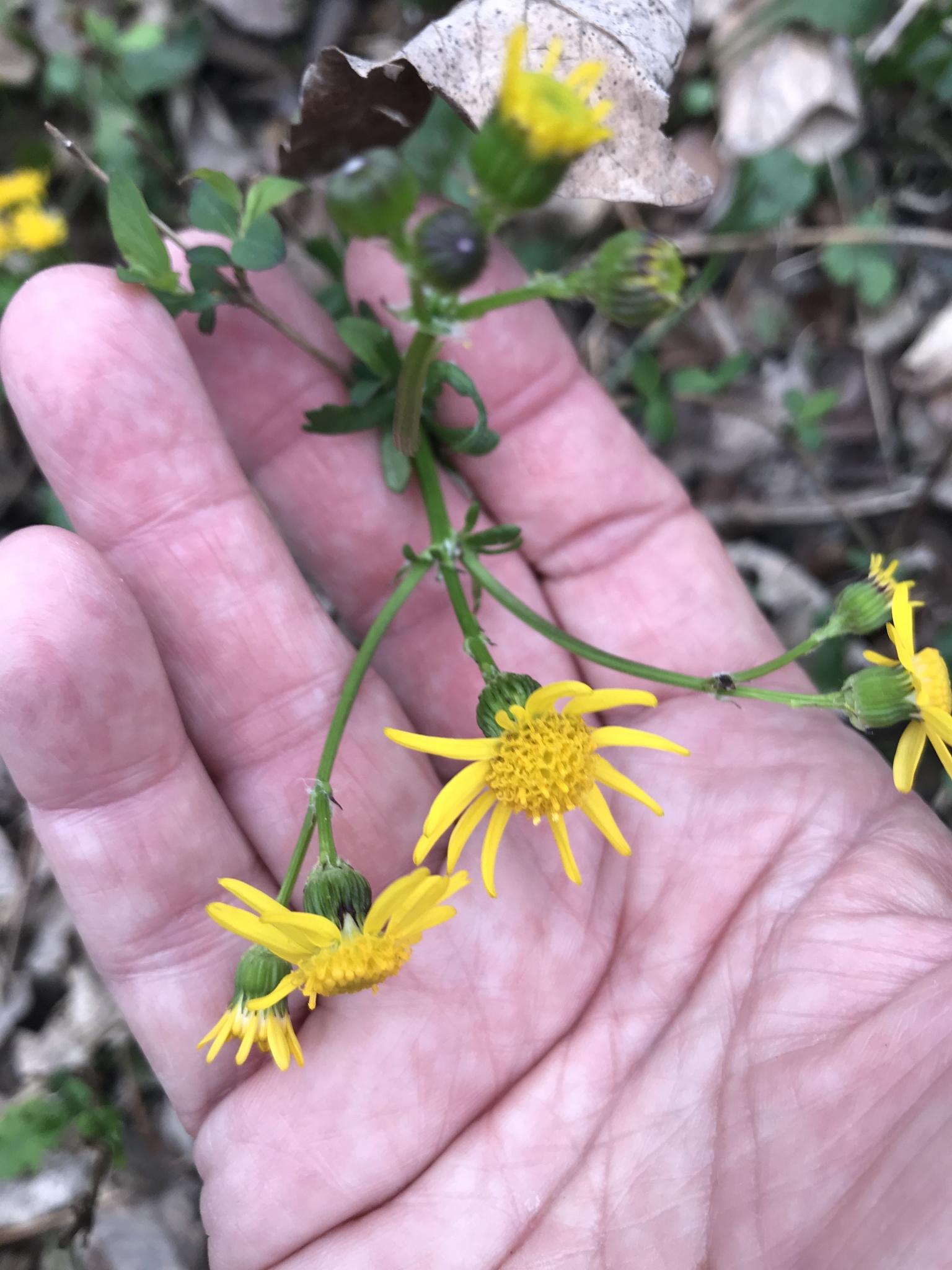
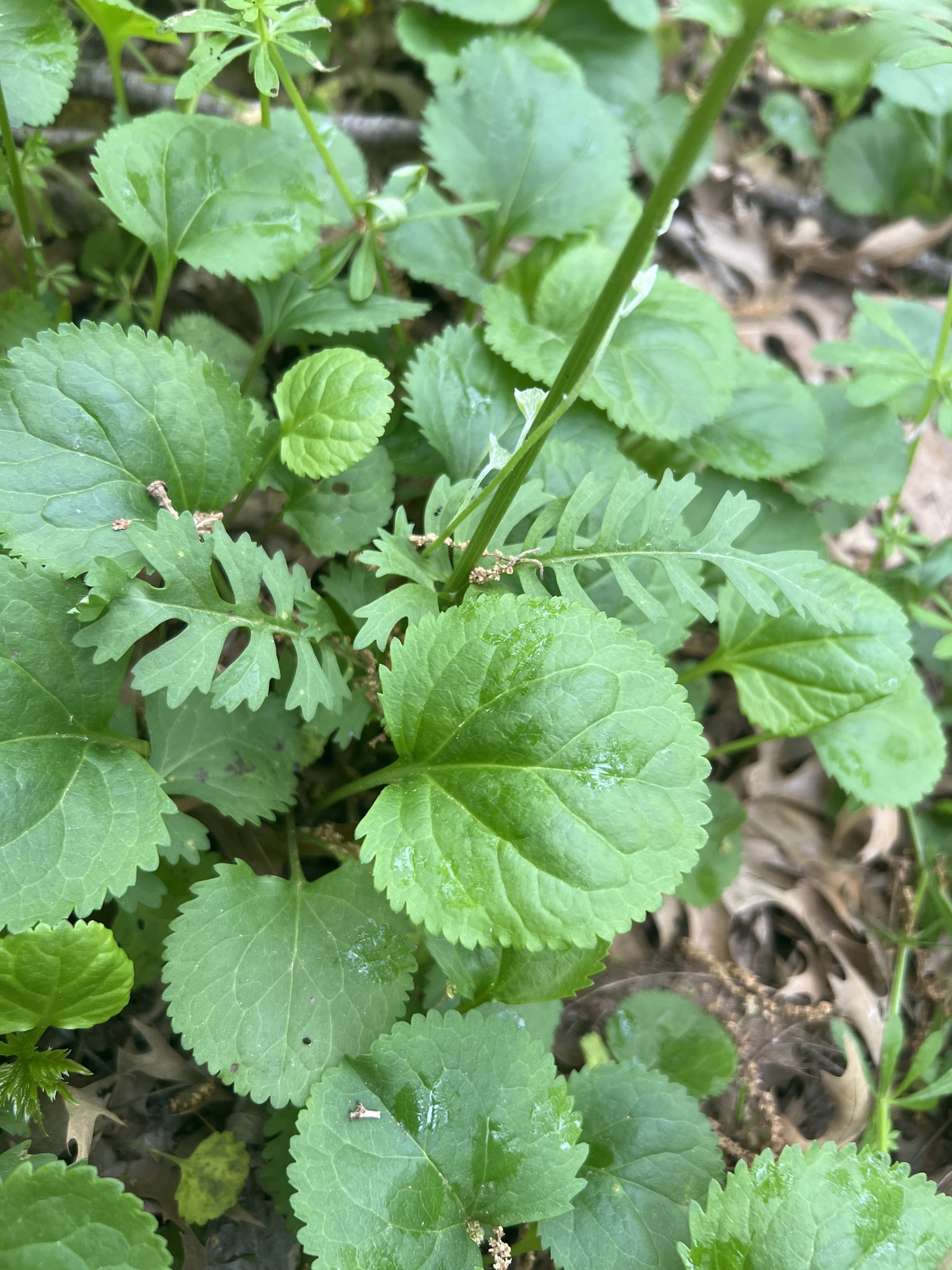
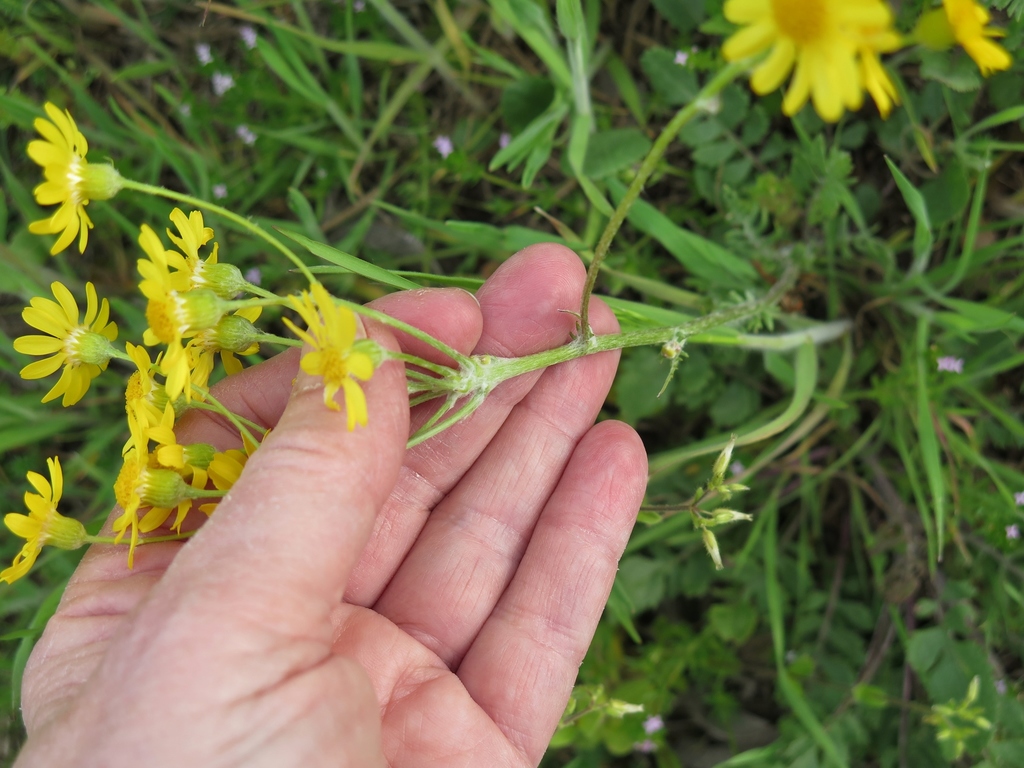
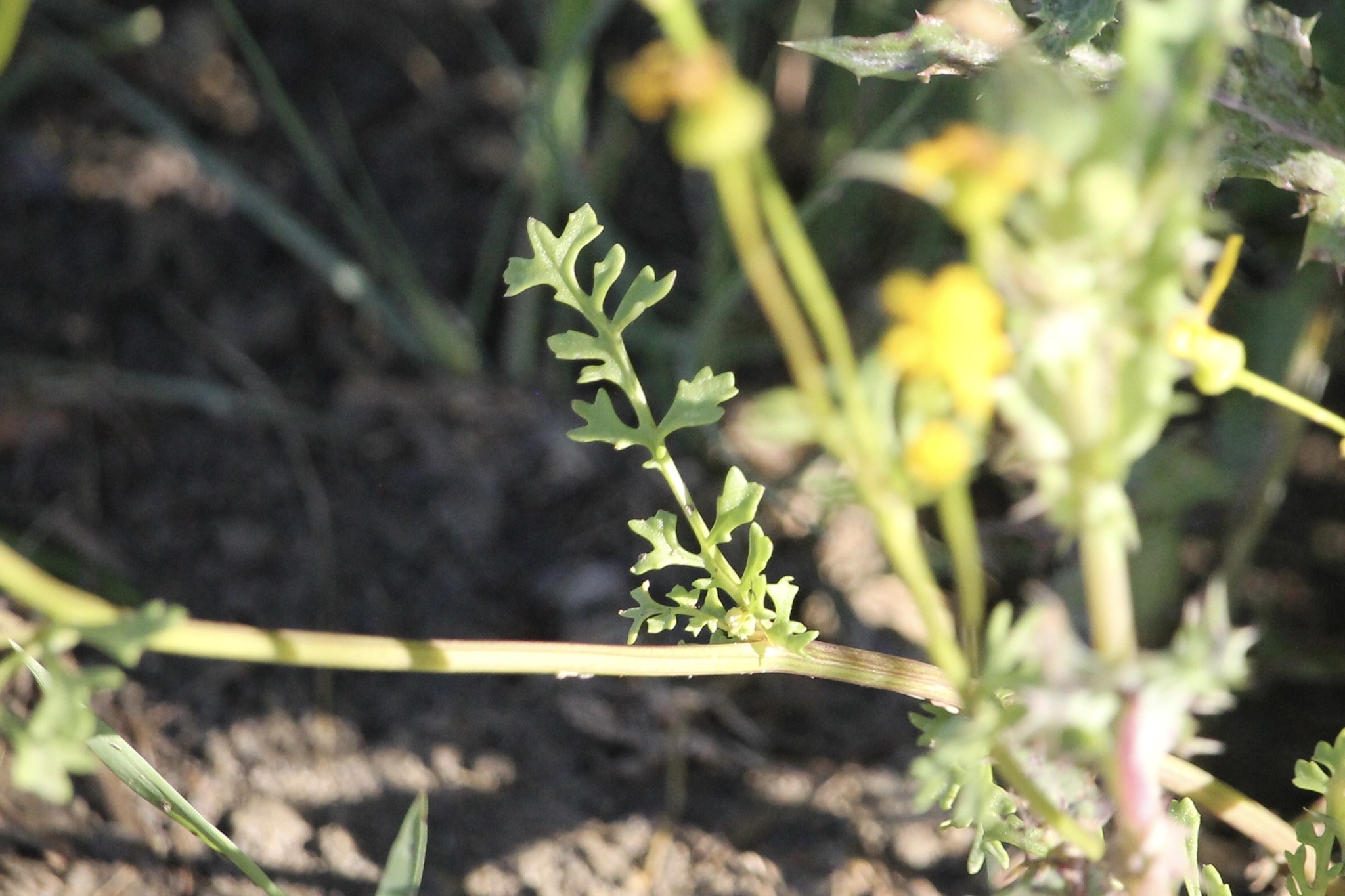
Packera and Senecio (Groundsels and Ragworts)

This is one of those groups where I can remember the Latin name more easily than the common name. I think Packera is easier to remember than groundsel. I remember getting a pretty good handle on these in 2019, but after not thinking about them since early spring almost a year ago, I couldn’t remember what the differences were! So, it was back to the big book (Flora of North Central Texas) to sort it all out AGAIN. I thought I’d write it down this time, just in case I’ve forgotten by the time these roll around next spring (which seems more than likely!)

There are two Senecio species to be found around nc TX:

S. ampullaceus (Texas Groundsel) and S. vulgaris (Common Groundsel). These two are distinguished from the Packera species by their clasping leaves. I have never observed Texas Groundsel, but the S. vulgaris is very common – hence the name, I guess!
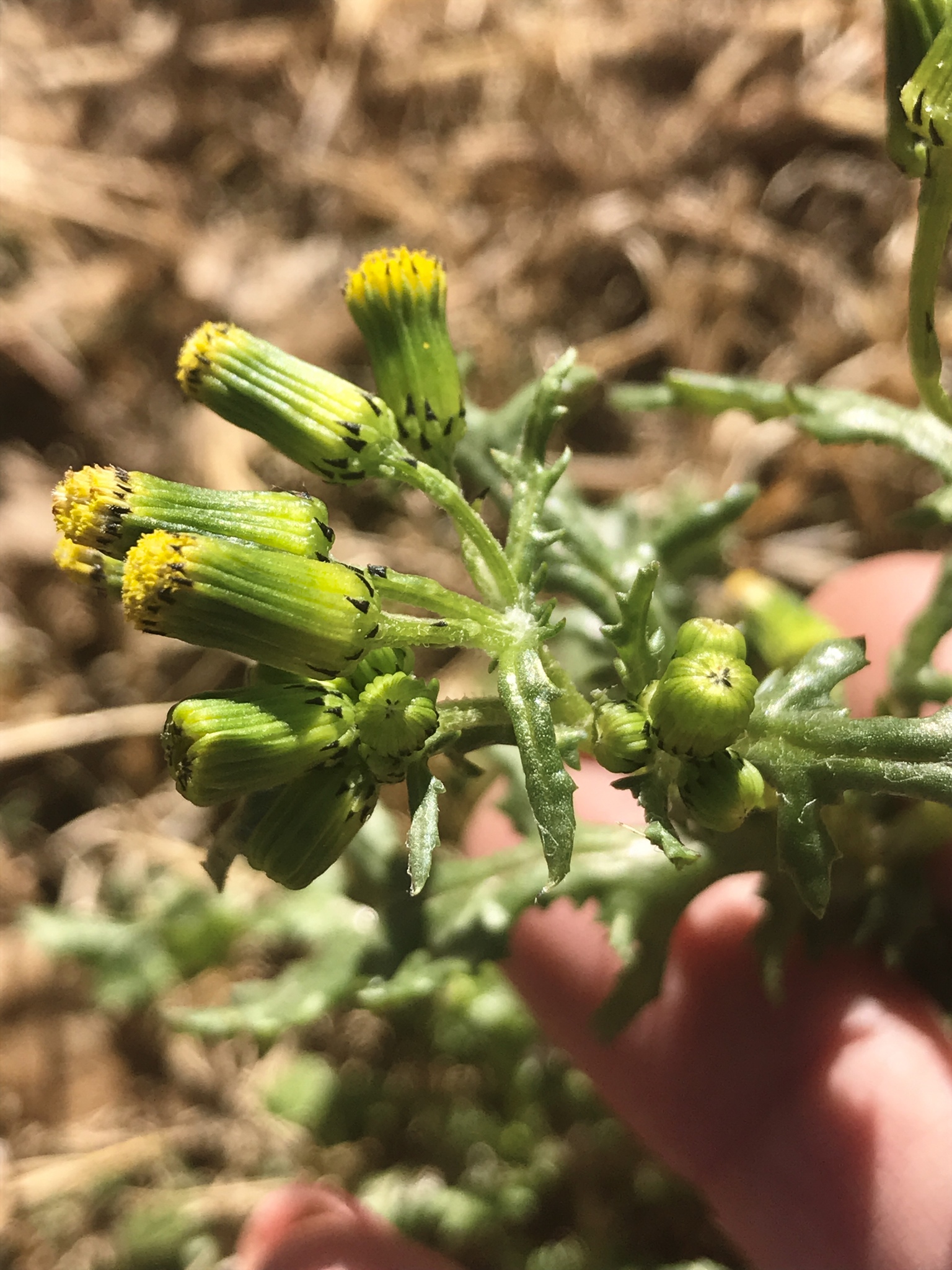
(1) S. vulgaris: ray flowers usually missing, leaves pinnately lobed, phyllaries black-tipped. (COMMON GROUNDSEL)
(2) S. ampullaceus: ray flowers prominent, leaves shallowly toothed, phyllaries green-tipped (TEXAS GROUNDSEL)

There are four Packera species found in nc TX.

The first two Packera species have their largest leaves crowded near the base, and upper leaves greatly reduced and often different in shape from lower leaves. Both are fairly common here.

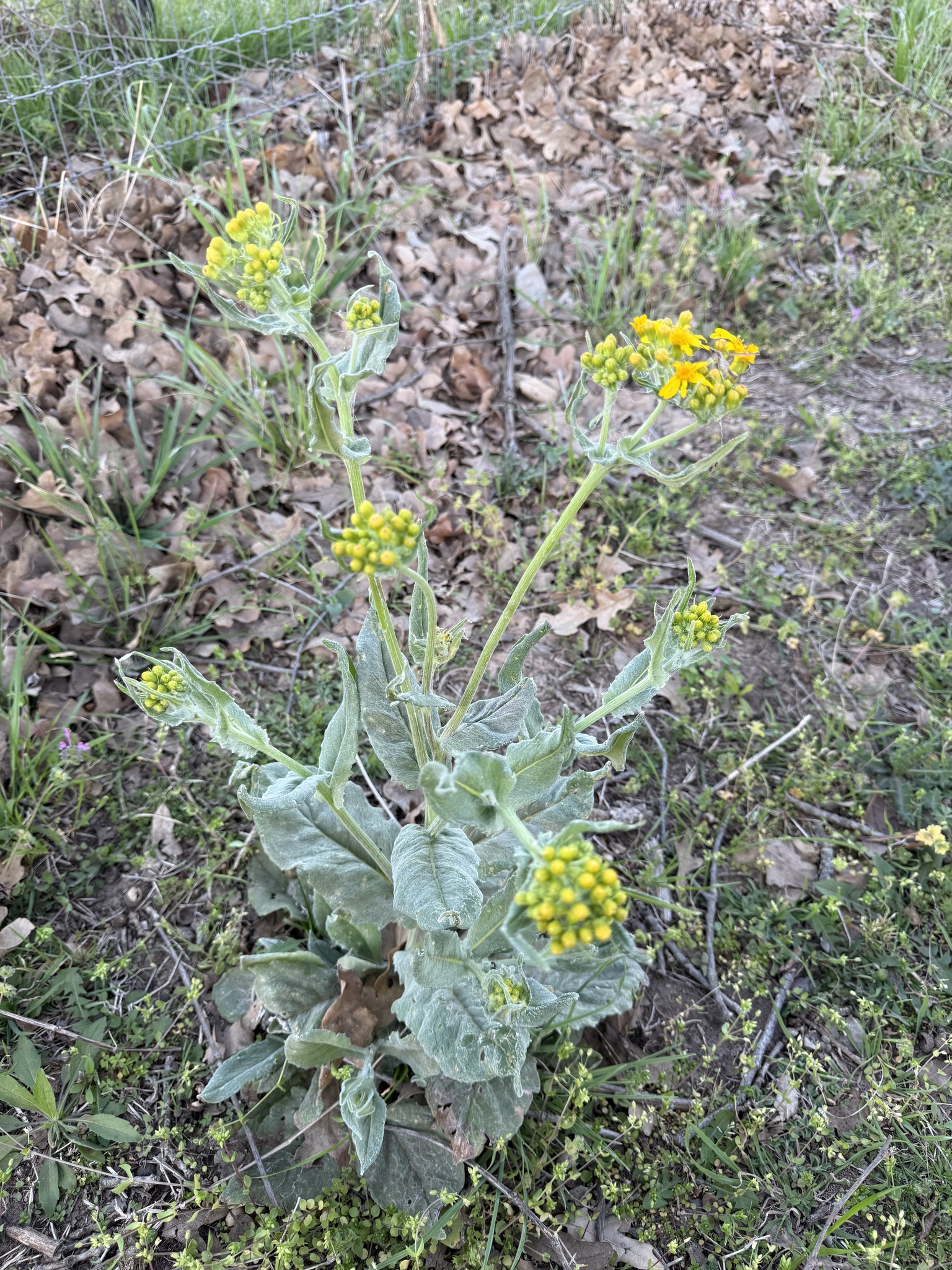
(1) P. obovata: blades of basal leaves are round (< 1.5 times as long as wide), plants glabrous except in leaf axils, inflorescence WITHOUT woolly pubescence; basal leaves usually purple on the underside. (GOLDEN GROUNDSEL, ROUNDLEAF RAGWORT)

(2) P. plattensis: blades of basal leaves oblong:(> 1.5 times as long as wide) plants unevenly woolly pubescent: Very unevenly woolly when young, and with at least some woolly pubescence at the nodes of the inflorescence even when mature. Basal leaves usually green on the underside, but may have some purple. (PRAIRIE GROUNDSEL)

The final two Packera species have leaves that are pinnately compound or very deeply lobed, fairly evenly distributed along the stem (not crowded at the base,) and basal and stem leaves are similar in shape. Neither of these have wooly pubescence.

(1) P. tampicana: lateral lobes of lower and middle stem eaves often contracted to very narrow linear basal that attaches to the midrib. Weedy in low prairies ,disturbed areas, roadsides. Typically in open places. (GREAT PLAINS
RAGWORT, YELLOWTOP)

(2) P. glabella: Rare in nc TX, mainly se and e TX. (BUTTERWEED)
Stem pubescence

BACK TO: A Collection of Helpful Identification Guides

Posted on February 10, 2020 01:34 AM by lisa281 | 1 comment | Leave a comment

Erigeron (Fleabane and Horseweed)

In early April, 2019, I set myself a goal of taming the fleabanes, and they turned out to be quite manageable! (This was so satisfying that I became overconfident and decided to tackle the Blue-eyed grasses next. That did not work out as well, so there won't be a Sisyrinchium journal from me anytime soon!)

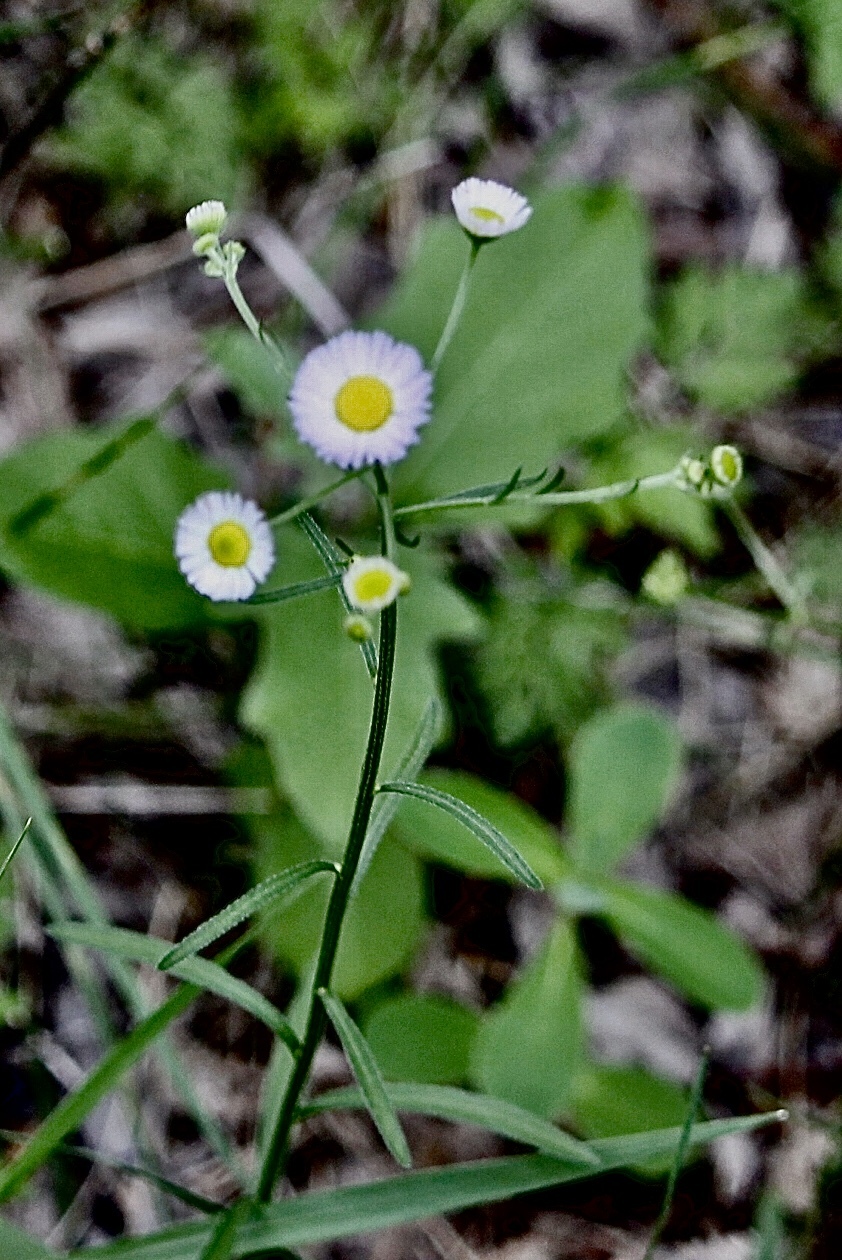
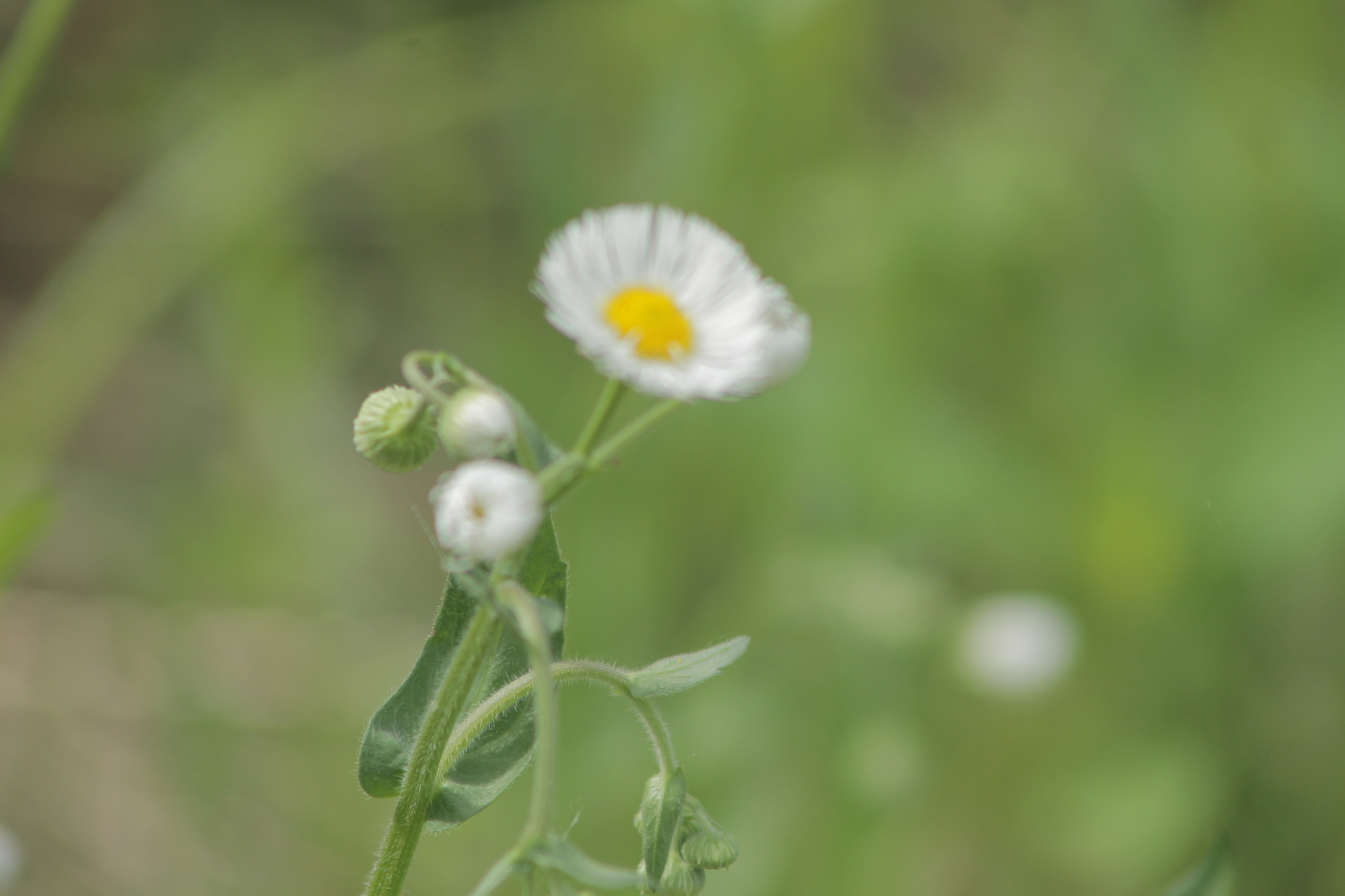
About fleabanes: in short, there are only two common species of true fleabane here: Philadelphia Fleabane (Erigeron philadelphicus) and Daisy Fleabane (E. strigosus.) The telling feature is the shape of the MIDDLE and UPPER stem leaves. In Philadelphia Fleabane, these leaves widen at the base (stem end) and are often somewhat clasping. In Daisy Fleabane, these leaves taper to the base (stem) and are not clasping.

Daisy Fleabane has stem leaves that taper to the base.

Philadelphia Fleabane has stem leaves with a wide ,somewhat clasping base.

That's the gist, but of course, it's not QUITE that simple. If you want the details, keep reading.

Four species of Erigeron occur in Collin County: E. strigosus, (Daisy Fleabane,) E. philadelphicus, (Philadelphia Fleabane,) E. canadensis (Horseweed,) and E. tenuis (Slender Fleabane.)
E. canadensis (Horseweed) is fairly easily distinguished from the fleabanes. This species has very inconspicuous ray flowers, barely exceeding the phyllaries.

E. strigosus (Daisy Fleabane) is the most common fleabane here. The upper and middle stem leaves are narrowed basally; that is, the leaf tapers to the stem. These middle and upper leaves are 4-10 times as long as wide, and there are usually 17-25 leaves on well-developed plants. The basal leaves are much different, and can be up to 70 mm wide.

E. philadelphicus (Philadelphia Fleabane) is the second most common type of fleabane here. (However, it tends to bloom earlier than Daisy Fleabane, so in earLy spring, this is one I see most frequently.) The middle and upper stem leaves widen basally, that is, the leaf’s widest part is at the stem. These leaves are often more or less clasping, are 4-20 mm wide, and 2-4 times as long as wide. The lower leaves are on petioles, often somewhat winged.

E. tenuis is not common in NC Texas, but you may encounter it. It has middle and upper leaves similar to those of E. strigosus. It has fewer leaves (7-15 on well-developed plants,) and the basal leaves are narrower (<15 mm). Most telling, the ray flowers are purple or blue-ish, especially underneath.

Posted on February 10, 2020 01:29 AM by lisa281 | 0 comments | Leave a comment

February 20, 2019

Helpful journals, guides, tips from iNat users

There are so many wonderful resources that people have created and posted on iNaturalist, but they aren't always easy to find. Even worse, I can't always find my way BACK to them after finding them in the first place. My understanding is that eventually people can add links to their guides, etc. on Taxon pages, but we don't have that feature yet.

In the meantime, this is a random collection of helpful journal posts, tips, species guides, etc. that I have found. They are in no particular order, and it's a work in progress:

From @nathantaylor

https://www.inaturalist.org/journal/nathantaylor/14848-texas-species-of-dandelion-as-near-as-i-can-tell
-Crotons
https://www.inaturalist.org/journal/nathantaylor/12462-croton-list-of-central-and-north-central-texas

Several from @pfau_tarleton

Several helpful ones from @bouteloua

Two by @lanechaffin (and he has others, too: check out his journal posts)

This one on identifying some often-confused trees with compound leaves

These are the ones I've written so far:

Privets
https://www.inaturalist.org/journal/lisa281/21289-privets-in-the-sanctuary-oh-my

Cedar Elm or Winged Elm
https://www.inaturalist.org/journal/lisa281/20574-the-elm-project-part-3-cedar-elm-vs-winged-elm

American Elm or Slippery Elm
https://www.inaturalist.org/journal/lisa281/20573-the-elm-project-part-2-american-elm-and-slippery-elm

Introduced Elms: Chinese Elm and Siberian Elm
https://www.inaturalist.org/journal/lisa281/20358-the-elm-project-part-1

Frogfruits
https://www.inaturalist.org/journal/lisa281/20234-turkey-tangle-frogfruit

Sesbania, Riverhemps, and Bladder Pod
https://www.inaturalist.org/journal/lisa281/20233-sesbania-riverhemps

Find a taxa
ie https://www.inaturalist.org/taxa/62832-Sapindus for Soapberries

Posted on February 20, 2019 04:00 PM by lisa281 | 2 comments | Leave a comment

February 2, 2019

Privets in the sanctuary, oh my!

We had six Master Naturalists working out in the Heard Sanctuary today, pulling up about 600-700 linear feet of barbed wire in the sanctuary. It was actually more fun than it might sound, since the weather was good, the company of other Master Naturalists is always great, and we got to see some interesting plants, insects, and fungi. We did get into a spirited (but not heated) discussion of the various types of privet growing out there. Parviz has been working hard on getting all the privets out of the sanctuary, but today we were working in a section that he hasn’t yet reached, so we had several samples under discussion. I felt pretty confident about Chinese Privet and Quihoui Privet, except how to pronounce Quihoui (kwee-WHO-ee, according to today’s research.)

EDIT: after some discussion (see comments section below,) I’ve settled on KYOO-ee as the pronunciation I’m going to try to stick with. (But I won’t argue if you want to say it some other way!)
Some people were calling one large specimen Japanese Privet, though, and I’d have called it Glossy Privet. None of them knew the scientific name, so I couldn’t figure out if it was a different species or just a different common name. I’ve been calling all the large-leaved privets I’ve seen Ligustrum lucidum (Glossy Privet), but there is a L. japonicum, so if we had it in the sanctuary, I wanted to know. (Most everyone elsewas of the opinion that, no matter what we called it, it needed to come out, so what did it matter? But inquiring minds need to know!) After an hour or so in my FNCT, here’s what I’ve come up

All of the privets growing here are introduced invasives which have escaped from cultivation. They are shrubs or small trees, evergreen or semi-deciduous, and have opposite leaves. (The opposite leaf attachment is the first thing to check for if you suspect privet. See more about oppositely-attached leaves below.*)

Two common types of privet have glabrous twigs and large leaf blades, 2.5-6" long. These are both evergreen.
• The first of these is Glossy Privet, Ligustrum lucidum. It can grow to be a tree up to 30 ft. tall, or occasionally taller. Glossy Privet leaves are large, 3-6" long, with 6-8 or more distinct veins on each side of the midrib. The leaves are glossy and hairless. Glossy Privet leaves taper to a narrow point and the petiole (stalk) of the larger leaves is up to 3/4" long. In the flowers, the tube of the corolla equals the lobes in length.

• The second of the large-leaf privets is Japanese Privet, L. japonicum. It is a smaller shrub or small tree, usually not much more than 10 ft. tall. The leaf is somewhat smaller than that of Glossy Privet, up to about 2.5 -4" long. Leaves have only about 4-5 indistinct veins on each side of the midrib. The leaf shape is less pointed than that of L. lucidum, and it has a shorter petiole, usually less than 1/2" long. (*New note: according to texasinvasives.org: Japanese Privet does not tend to escape cultivation, so maybe I haven't been wrong in calling the wild specimens of large-leaved privets I've seen Glossy Privet.)

Two other common types of privet have pubescent (fuzzy/hairy) twigs and small leaves. These are semi-deciduous, evergreen in mild winters.
• The most widespread invader is Chinese Privet, Ligustrum sinense . It is a shrub growing to about 12 ft. tall. Its leaves are 1 - 2.5" long and usually hairy along the midrib on the underside. The leaf shape is a rounded diamond or an egg shape. The flowers are in compact clusters, with the corolla tube shorter than the lobes.

• The other small-leaf privet is Quihou Privet, L. quihoui. The leaves are 1 - 2.5" long, dark green, usually oblanceolate (teardrop shaped, narrowest near the stem) and hairless on the underside. The leaf base tapers all the way to the twig, appearing to have almost no petiole. Flowers are in whorl-like, separated clusters at tips of branches and on paired side branchlets, forming into loose clusters. The corolla tube is about equal to the lobes.

After I finished the above, I happened to find a couple of handy guides to the privets at Texasinvasives.org. So I guess I could have saved myself the trouble, but I don't think I'll ever again get mixed up about these four privets! Each of these is a one page pdf: the first has pictures, the second a chart with more information.

https://www.texasinvasives.org/invaders/CS_Resources/PrivetKey.pdf
https://www.texasinvasives.org/invaders/Trainer_Resources/Ligustrum.pdf

*Privets are one of the few trees/shrubs around here (North Central TX) that have oppositely-attached leaves. Here's the acronym we use for remembering the most common woody plants with oppositely-attached leaves:
DAMPeR:
D - dogwood (in North Central TX, that would be Roughleaf dogwood.)
A - Ashes (around here, Green Ash, White Ash, Texas Ash)
M - Maple (around here, only Ash-leaved Maple, aka Boxelder Maple, or just Boxelder)
P - Privets
R - Rusty Blackhaw

Ashes and Boxelder both have compound leaves, so those should be easy to rule out. Rusty Blackhaw leaves have toothed margins, and privets have smooth margins, so that should be easy to rule out, too. Roughleaf dogwood does have smooth margins and simple, oppositely-attached leaves, like the privets. Dogwood leaves are thinner, and ours have a rough texture - hence the name!

Two other plants whose leaves resemble privets in shape and texture are the hollies: possumhaw holly (Ilex decidua) and yaupon holly (I. vomitoria). Just remember to check for the leaf attachment. Hollies have alternately attached leaves, rather than the oppositely-attached leaves of privets.

BACK TO: A Collection of Helpful Identification Guides

Posted on February 2, 2019 11:08 PM by lisa281 | 3 observations | 12 comments | Leave a comment

January 1, 2019

The Elm Project, Part 2: American Elm and Slippery Elm

These are the two tree species that first led me down the ELM rabbit hole. Trying to identify AMERICAN ELM vs. SLIPPERY ELM drove me crazy my first summer as a Master Naturalist. They both have larger leaves than other elm species that grow here, but it isn't really possible to distinguish these two using leaf size. Slippery Elm is named for the slimy "slippery" feel of the inner bark. That's a fine clue, if you can get to the inner bark, but I usually couldn't. Most of the time, the main thing I was using to differentiate them was how rough or smooth the leaf surface was. Slippery Elm is supposed to feel rougher to the touch than American Elm, but this isn't always easy to determine. American Elm leaves are especially variable, with some leaves feeling much rougher than others, even on the same tree. I spent the first months of the summer rubbing hundreds of elm leaves without ever being entirely certain on species. I really never made much headway that first summer, but over the winter I hit the books and found that there are actually a number of clues that are simple and clear enough to make sense to me. And these clues do not involve rubbing the elm leaves at all. (¬‿¬)


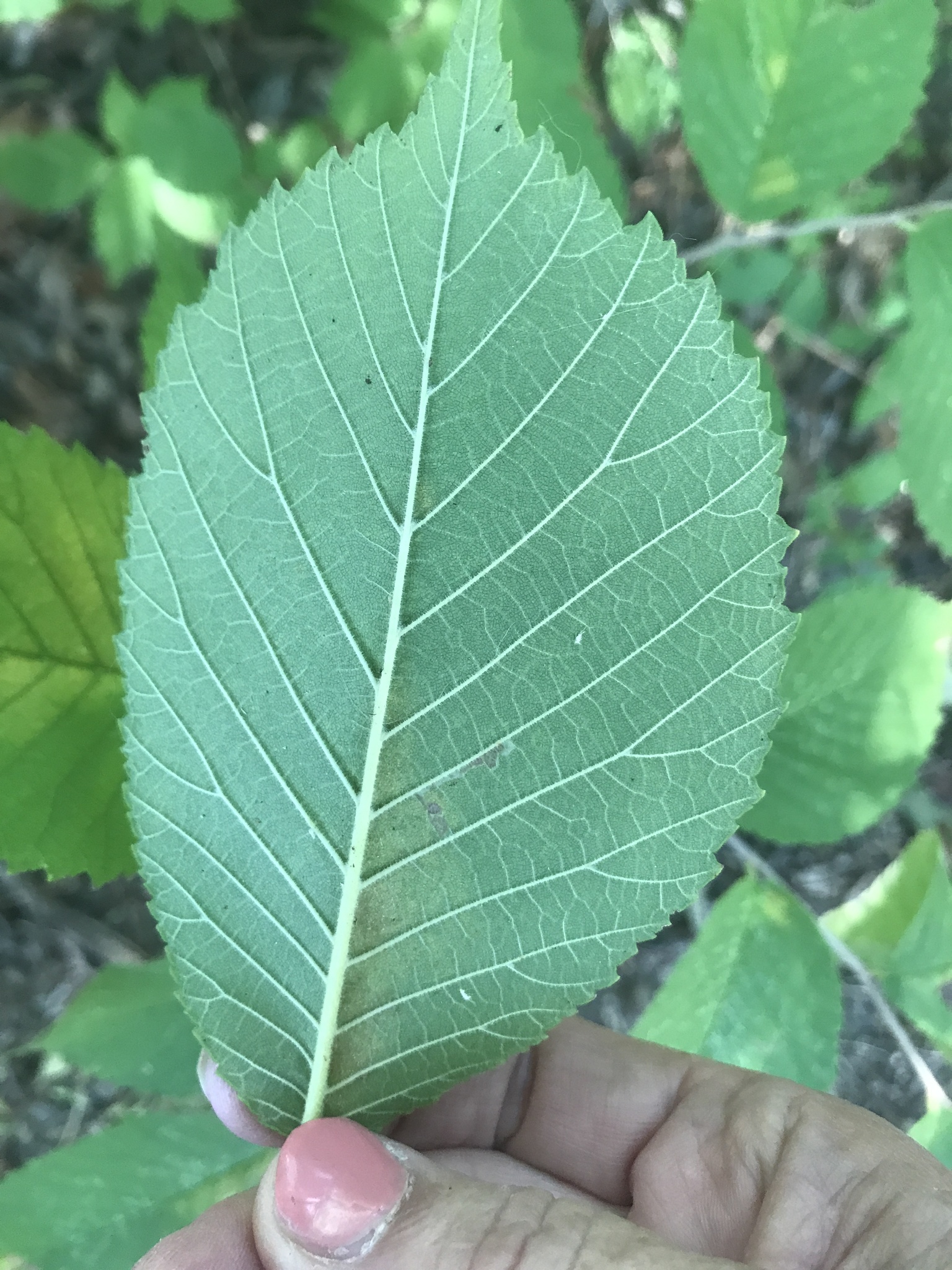
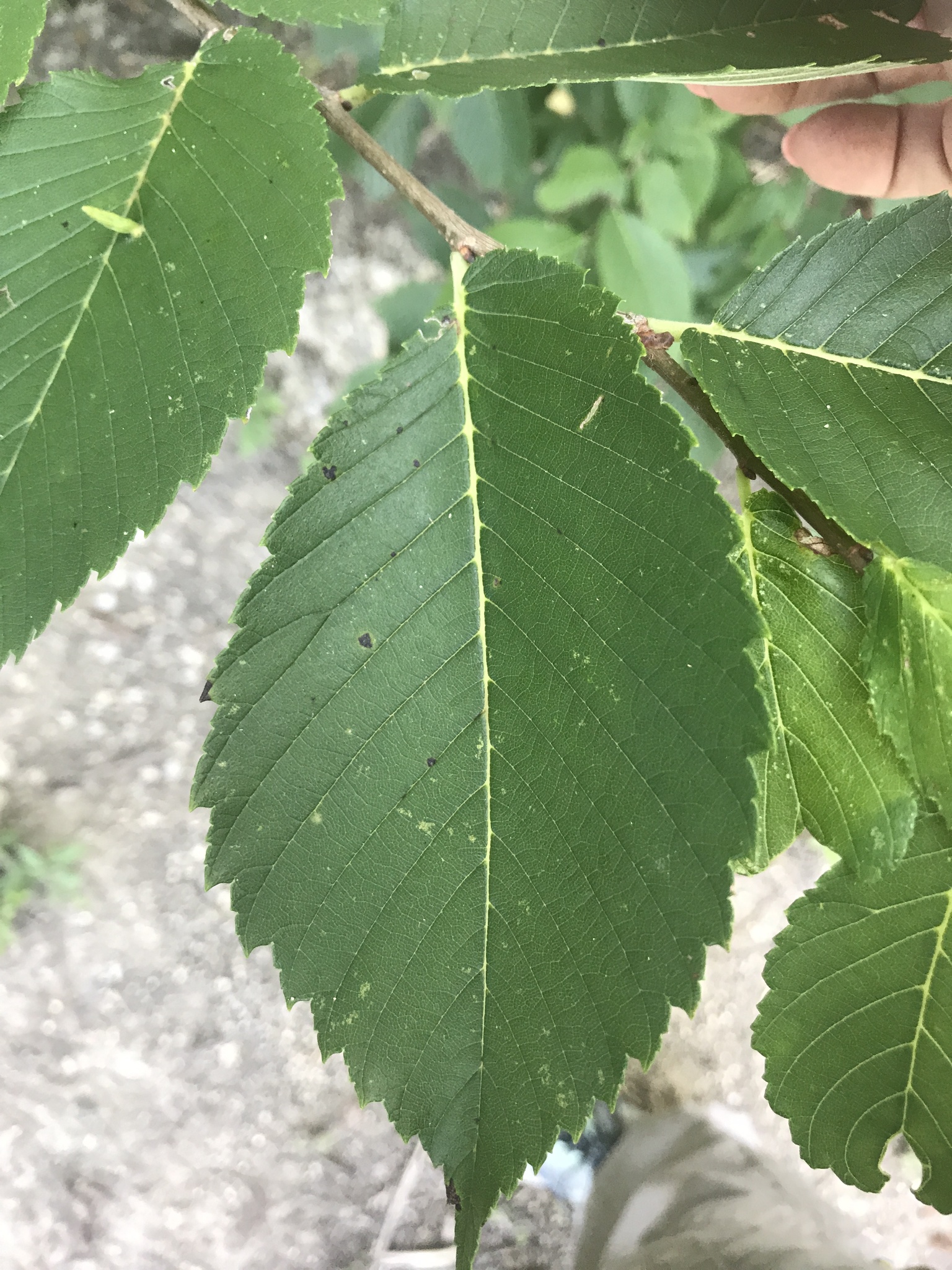
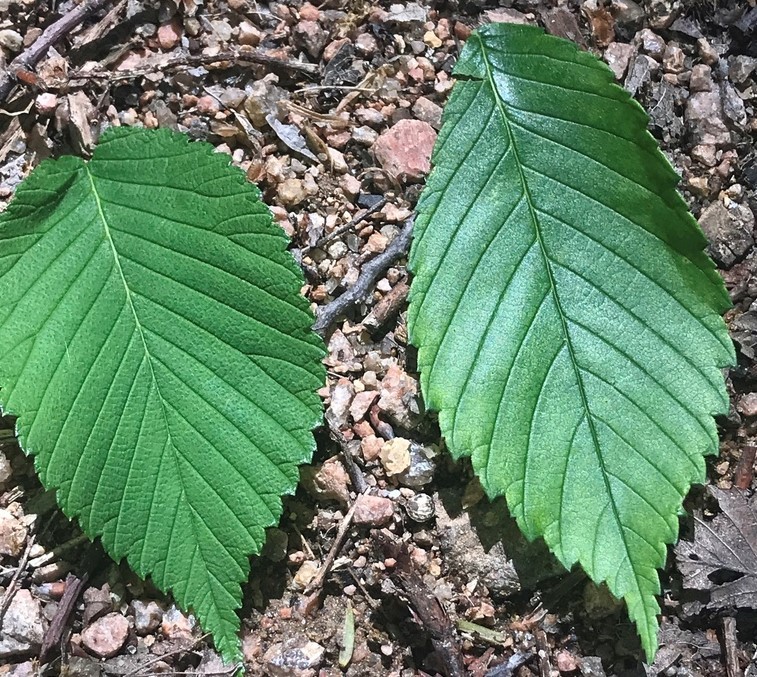
Here's my favorite: the leaves of Slippery Elm have secondary veins that are frequently forked: most leaves will have several forked veins on each side. In American Elm, the veins are rarely forked: most leaves will not have more than one or two per side. This often can be seen clearly in pictures, so is more helpful than texture! See pictures ---->> Slippery Elm on the left, American Elm on the right.
More leaf pictures: Slippery Elm on the left; American Elm on the right
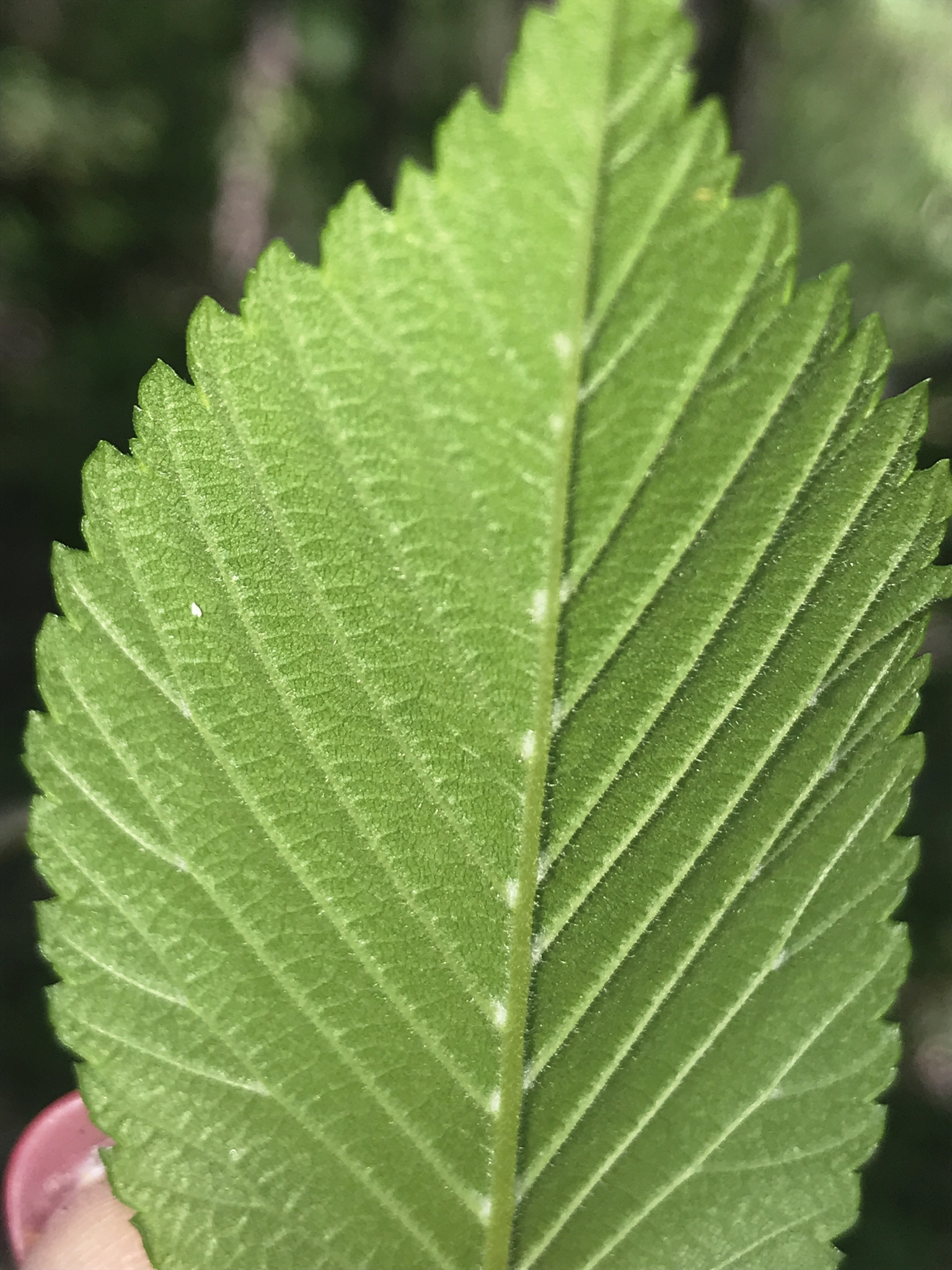
Other hints: Slippery Elm leaves often taper abruptly to a very long tip, i.e. they are acuminate. They tend to to be fuzzy on the back, with tufts in the man axils. They also tend to "fold" upwards along the central vein.
The leaf shape of American Elm is oval in outline, widest at the middle, tapering to a sharp, pointed tip.
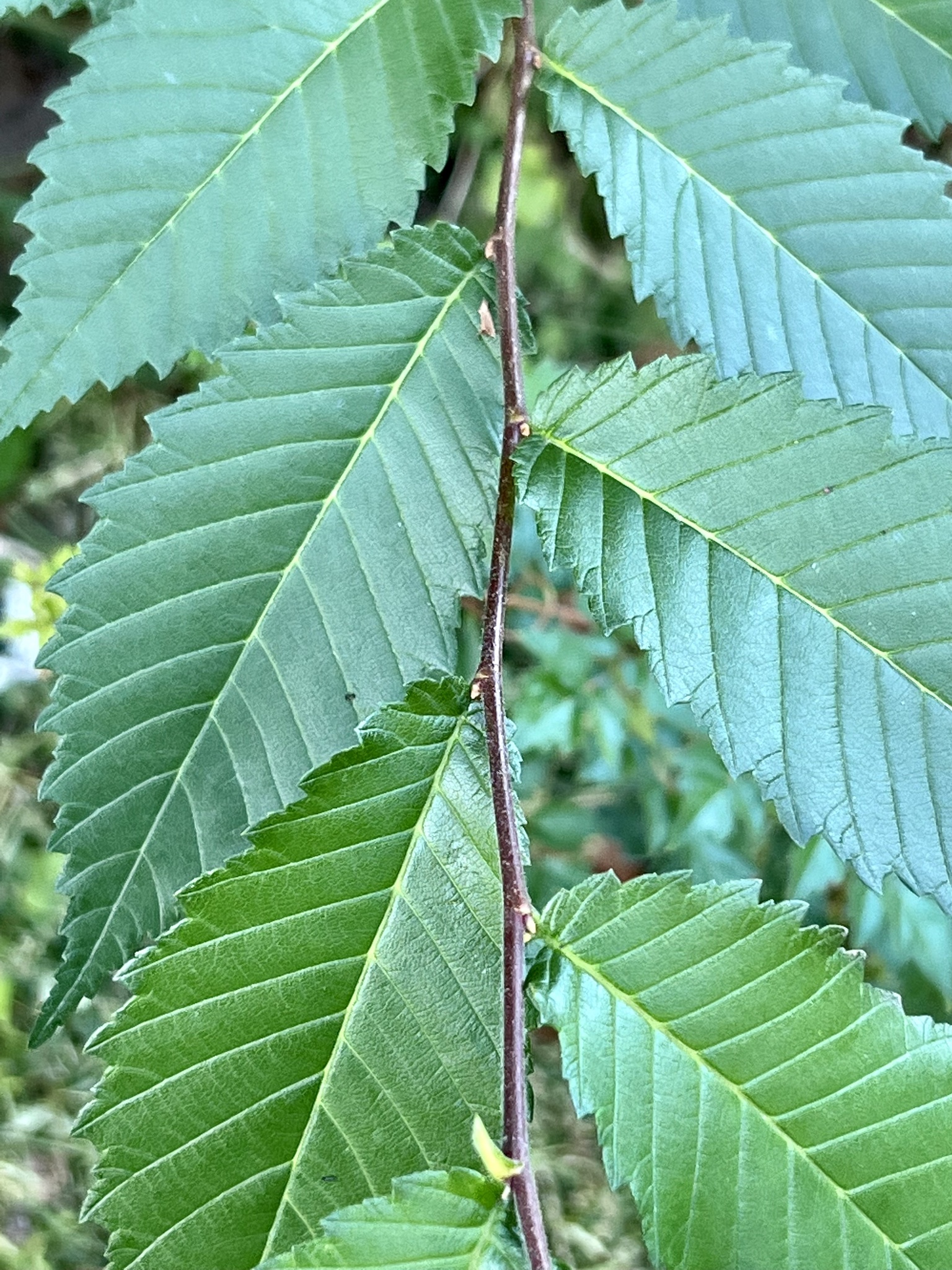
Slippery Elm twigs are sturdier than American Elm, with large, blunt-tipped buds, chestnut brown and often covered in reddish fuzz. American Elm twigs are slender; buds are reddish-brown and pointed, with darker edged scales. LEFT PICTURE: Sturdier Slippery Elm twig on the left, next to American Elm twig on the right. RIGHT PICTURE: American Elm twig and buds
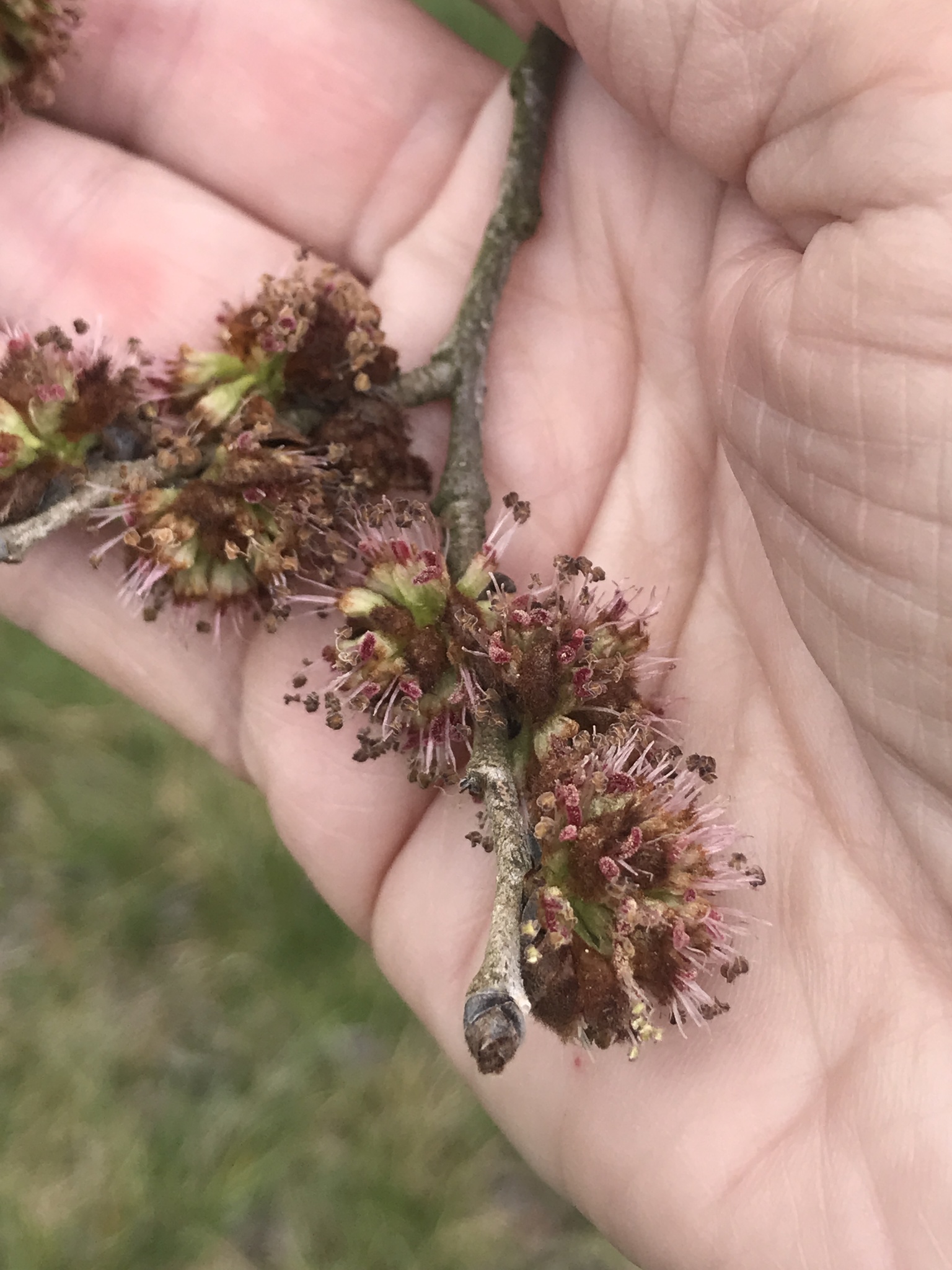
Most reliable way to identify these is with the fruit, a winged seed called a samara. Both American Elm and Slippery Elm flower and fruit in the spring, before leaves appear. In American Elm, both the flowers and the samaras hang in drooping clusters. The samara is elongated (longer than wide) and deeply notched. It is smooth and hairless on the front and back surfaces, but has fine hairs (cilia) all around the margin.
The flowers and samaras of Slippery Elm are in dense bunches, close to the branches. Slippery Elm has samaras that are round (about as long as wide) and are not deeply notched. They are hairless around the margins, but typically have fuzz on the front and back surfaces, especially over the seed in the center.


BACK TO: A Collection of Helpful Identification Guides

Posted on January 1, 2019 10:21 PM by lisa281 | 3 observations | 8 comments | Leave a comment