 Annotations
Igor Balashov Curator
Joined: May 21, 2020 Last Active: Oct 2, 2026 iNaturalist
I'm a zoologist from Ukraine, specializing in terrestrial molluscs.
Підказки починаючим i-натуралістам➚ Підказки як правильно фотографувати для iNat➚
Базові рекомендації фотографування молюсків для iNat українською➚
Basic suggestions on how to photograph molluscs for iNat➚
1,000,000 iNat observations from Ukraine: summary and some stats➚
What I like the most about iNat is its phone app that allows anyone to document nature easily at the scientific value level (with auto-detected coordinates and date). So that's what I'm mainly uploading here: the photos from my smartphone taken with iNat app, not necessarily good photos, but photos that only intended to demonstrate the organism's characters required for the identification. Though I also like to "collect" taxa.
What I don't like is when people are adding observations without precise coordinates. Please try to indicate coordinates with accuracy at least within 100 m when possible and make sure that it's correct and will not mislead someone later. Your observations could be interesting to scientists and it's possible that someone will try to rediscover some species following your observations or will even use your observations in some sort of study. "Confirmed" iNat observations with a "Research Grade" mark are being transferred to GBIF, which is used in science and nature conservation. Because of the imprecise and "cloaked" locations transferred from iNat some threatened species can appear to be more widely distributed than they actually are and their conservation statuses can be wrongly assessed as not threatened (LC), so there will be no effort to protect such species as a result (see paper in this regard).
In general my observations represent my own experience and I like it to be so, though I occasionally publish photos taken by my wife, Anna Markova, from the places we both visited (always indicated in the description and always with her permission). She does not wish to create her own iNat account. Also I've uploaded several photos by my late father that were taken when I was next to him. I do not publish photos from places I haven’t visited or of scientific specimens collected by other people.
I do upload some observations of captive/cultivated organisms (always marked of course), though it's not the main purpose of iNat. I think they can have some value as a sample of organisms cultivated in a region during a certain period of time. It could be potentially useful for studying invasions and wildlife trade, perhaps even for breeding programs in captivity. Some captive organisms have a significant impact on wild nature, so it makes sense to document them. For example, it makes sense to add an observation of a cultivated plant alongside observations of leaf mines or galls on it. Also there are some species with very few observations in wild (or even none 1➚ 2➚ 3➚), so observations in captivity could be useful for reference. (And I like to collect taxa). But if there is no additional value, I try to stick to one observation per (sub)species when captive, and I only upload living captive organisms, not things from museum exhibitions, souvenir trade or supermarkets.
Thanks to iNat I've become fascinated with 3 very different groups of organisms that I was nearly ignoring earlier: lichens, leafhoppers (Cicadellidae) and leaf miners (mostly moths and flies-agromyzids). While I'm at a very basic level of identifying the first two groups, I'm trying to ID the leaf mines more seriously using the keys and descriptions from bladmineerders.nl (same with galls), but of course it's still at the amateur level, I'm nowhere near to be an expert in this.
My main photo devices that were used for the photos uploaded on iNat
Smartphones
-- Xiaomi Redmi 3S – 2016–2021, often with a cheap macro lens, iLens clip
-- Xiaomi Redmi Note 10 Pro – since 2021 (still using in many macro situations)
-- Xiaomi 15 Ultra – since 2026
Compact cameras
-- Olympus FE-310 – 2008 (died in a few months)
-- Canon PowerShot A650 IS – 2008–2024 (still working well)
-- Canon PowerShot SX530 HS – since 2024 (old used)
Reflex camera and lens
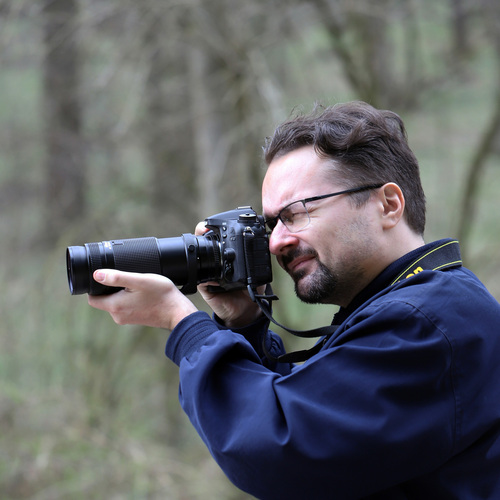
-- Nikon D7100 – since 2016
--- Nikon AF Micro-Nikkor 60mm f/2.8D – since 2016 (mostly using it in the lab, not for iNat) 1➚ 2➚ 3➚
--- Nikon AF Nikkor 75-300mm 1:4.5-5.6 – since 2022 (old used) 1➚ 2➚ 3➚
--- Tamron MC7 2x tele-converter – since 2023 (old used)
--- Sigma 50-500mm 1:4-6.3 APO DG HSM – since 2024 (without OS, old used)
Trail cameras (phototraps)
-- Suntek HC 940A – since 2024 1➚ 2➚ 3➚ 4➚ 5➚ 6➚
-- Suntek MINI-800 – since 2025 1➚ 2➚ 3➚
-- Bushwhacker Big Eye D3N – since 2025 1➚ 2➚ 3➚ 4➚ 5➚ 6➚
-- Coolifepro SV-TCQW MINI - since 2025 (used) 1➚ 2➚
I've published 3 scientific papers based largely on the data from iNaturalist, all about expansions of the invasive terrestrial molluscs in Eastern Europe and elsewhere:
- Balashov I., Markova A. 2021. The first records of an invasive land snail Cepaea nemoralis (Stylommatophora: Helicidae) in Central and Southern Ukraine. Ruthenica, 31 (3): 121–125.
- Balashov I., Markova A. 2023. Expansion of the invasive Balkan slug Tandonia kusceri (Stylommatophora: Milacidae): A new frontier in Northern Ukraine and other new records. Folia Malacologica, 31 (1): 24–31.
- Balashov I., Markova A. 2023. A further northward expansion of the invasive land snails Monacha cartusiana and M. fruticola (Stylommatophora: Hygromiidae) in Eastern Europe. Folia Malacologica, 31 (1): 32–42.
My favorite observations with iNat app:
- Dicranopalpus fraternus (Opiliones) - "iNaturalist's Observation of the Day"
- Siro carpaticus (Opiliones)
- Lamprotettix nitidulus (Hemiptera)
- Rosalia alpina (Coleoptera)
- Molorchus kiesenwetteri (Coleoptera)
- Coccinella saucerottii (Coleoptera)
- Pseudoryssus henschii (Hymenoptera)
- Polemistus abnormis (Hymenoptera)
- Morulina verrucosa (Collembola)
- Armadillidium traiani (Isopoda)
- ant infected by Dicrocoelium dendriticum (Trematoda)
- Hyla arborea (Amphibia)
- Microcarbo pygmaeus (Aves)
- Mustela erminea (stoat, Mammalia)
- antler of Cervus elaphus (red deer, Mammalia)
- Evernia divaricata (Lecanoromycetes)
- Xanthomendoza huculica (Lecanoromycetes)
- Schistostega pennata (Bryophyta)
- ancient Pinus cembra (Pinopsida)
- primary forest of Picea abies (Pinopsida)